

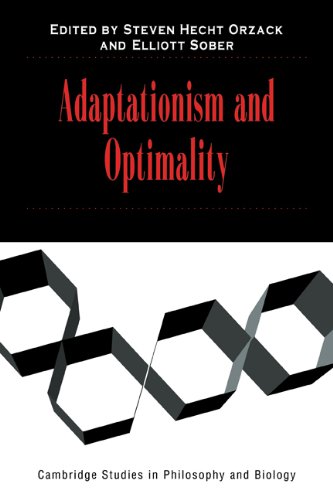
Adaptationism and Optimality 1st Edition by Steven Hecht Orzack, Elliott Sober 0521598362 9780521598361


Original price was: $50.00.$35.00Current price is: $35.00.
Adaptationism and Optimality 1st Edition by Steven Hecht Orzack, Elliott Sober – Ebook PDF Instant Download/Delivery: 0521598362, 9780521598361
Full download Adaptationism and Optimality 1st Edition after payment
Product details:
ISBN 10: 0521598362
ISBN 13: 9780521598361
Author: Steven Hecht Orzack, Elliott Sober
The debate over the relative importance of natural selection as compared to other forces affecting the evolution of organisms is a long-standing and central controversy in evolutionary biology. The theory of adaptationism argues that natural selection contains sufficient explanatory power in itself to account for all evolution. However, there are differing views about the efficiency of the adaptation model of explanation. If the adaptationism theory is applied, are energy and resources being used to their optimum? This book presents an up-to-date view of this controversy and reflects the dramatic changes in our understanding of evolution that have occurred in the last twenty years. The volume combines contributions from biologists and philosophers, and offers a systematic treatment of foundational, conceptual, and methodological issues surrounding the theory of adaptationism. The essays examine recent developments in topics such as phylogenetic analysis, the theory of optimality and ess models, and methods of testing models.
Adaptationism and Optimality 1st Table of contents:
1 A Likelihood Framework for the Phylogenetic Analysis of Adaptation
Phylogenetic approaches to the study of adaptation
The parsimony framework
A likelihood framework
Estimating the likelihoods from microevolutionary data
Estimating likelihoods from analogous chances
Advantages of a likelihood framework
Apparent Simultaneity of Change in a Character and a Selective Regime
Accounting for Uncertainty in Historical Inference
Taking Account of Selective Maintenance
Integrating Information from Elsewhere on the Tree
Conclusions
Acknowledgements
Literature cited
2 Adaptation, Phylogenetic Inertia, and the Method of Controlled Comparisons
Steven hecht orzack and elliott sober
What is phylogenetic inertia?
Natural selection and optimality
Selection and phylogenetic inertia as probabilistic influences
Testing the hypotheses
Evolutionary explanation and null hypotheses
Felsenstein’s method of independent contrasts
Can the method of independent contrasts be used to test for phylogenetic intertia?
Conflicts between the method of independent contrasts and the method of controlled comparisons in th
Summary
Acknowledgements
Literature cited
3 Optimality and Phylogeny: A Critique of Current Thought
Hudson kern reeve and paul w. sherman
A general approach to questions about phenotype existence
Optimality and “phylogenetic (historical)” constrains an analogy from quantum physics
Inferring the evolutionary histories of phenotypes
Parsimony and Phylogenetic Inference
Evolutionary Patterns that Betray Parsimony
Where Does the Burden of Proof Lie?
New horizons
Summary
Appendix
Acknowledgments
Literature cited
4 Fit of Form and Function, Diversity of Life, and Procession of Life as an Evolutionary Game
Evolution as a game
Density-independent and density-dependent selection
Density-independent Selection
Density-dependent Selection
Frequency-dependent selection
Outcomes of Natural Selection under Frequency-dependent Selection
Multistrategy ess
Speciation, Adaptive Radiations, and Evolutionarily Stable Fitness Minima
Wright’s Shifting Balance Theory and Frequency-dependent Selection
Characterizing a Multistrategy ESS
Multiple g-functions
Recipe for an Evolutionary Game
Predator–Prey Coevolution and Community Evolution
Microevolution and macroevolution
Incumbent Replacement
Procession of Life
Testing optimality models
Conclusions
Acknowledgments
Literature cited
5 Optimality and Evolutionary Stability under Short-Term and Long-Term Selection
Long-term selection and two-locus population genetics
Long-term frequency-independent selection
External stability, phenotypically stable strategies, and long-term stability
Long-term frequency-dependent selection
Long-term stability of an ess
Case I
Case II
Phenotypic stability of the ess with multiple loci
Conclusions
Appendix 1: proof of equation 7
Appendix 2: proof of result 2
Appendix 3: proof of result 6
Acknowledgments
Literauture cited
6 Selective Regime and Fig Wasp Sex Ratios: Toward Sorting Rigor from Pseudo-Rigor in Tests of Adapt
The evolutionary context
The theory relating sex ratios to population structure, inbreeding, and local mate competition
Fig wasp natural history
Fit to theory
Lack of fit and the precision of adaptation
Tests of variance
Phylogeny and fig wasp sex ratios
Conclusions
Acknowledgments
Literature cited
7 Is Optimality Over the Hill? The Fitness Landscapes of Idealized Organisms
What are fitness or adaptive landscapes?
When is a peak not a peak?
What does the shape of the peak imply about adaptation?
Fitness Landscapes in Temporally Varying Environments
How bumpy are fitness surfaces and adaptive landscapes?
How does evolution proceed on an adaptive landscape?
Optimality Models Versus Quantitative Genetic Approaches
Local versus global optimality in an empirically determined adaptive landscape
Conclusions: a topographical perspective
Acknowledgments
Literature cited
8 Adaptation, Optimality, and the Meaning of Phenotypic Variation in Natural Populations
Variation, adaptation, and optimality
Theoretical background
Empirical examples of adaptive variation in nature
Resource-based polymorphisms
Behavioral polymorphisms
Polymorphisms resulting from phenotypic plasticity
Summary
Acknowledgments
Literature cited
9 Adaptationism, Optimality Models, and Tests of Adaptive Scenarios
Does natural selection generally produce optimal traits when population sizes are large and genetic
How can optimality models aid in discovering the selective forces acting on traits?
A final remark on optimality models and their controversial past
A final remark on “tests of adaptationism”
Acknowledgments
Literature cited
10 Adaptation and Development: On the Lack of Common Ground
Functional and structural biology
The sequestering of embryology
The causal completeness argument
Consequences of attending to unity rather than diversity
Characterizing the contrast
Two meanings of “constraint”
Conclusions
Acknowledgments
Literature cited
11 Three Kinds of Adaptationism
A statement of the distinctions
On the relations between the three views
Problems of evidence: empirical adaptationism
Problems of evidence:explanatory adaptationism
Problems of evidence:methodological adaptationism
Conclusions
Acknowledgments
Literature cited
12 Adaptation, Adaptationism, and Optimality
Aristotle: the father of adaptationism
Darwin and the explanation of adaptation
Defining adaptation
Definitions Independent of Evolution
Adaptation and Natural Selection
Adaptation and History
Testing adaptation
Engineering Analyses
Adaptation and Natural Selection
Adaptation and Levels of Selection
Testing adaptive explanations: generalities
The virtues of diverse approaches
Concluding remarks
Acknowledgments
Literature cited
People also search for Adaptationism and Optimality 1st:
what is adaptationism
optimality models in evolution
philosophy of evolutionary biology
steven orzack elliott sober
natural selection and adaptation
Tags: Adaptationism, Optimality, Steven Hecht Orzack, Elliott Sober