

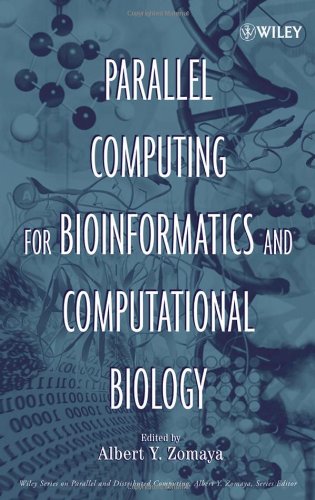
Parallel Computing for Bioinformatics and Computational Biology Models Enabling Technologies and Case Studies Wiley Series on Parallel and Distributed Computing 1st Edition by Albert Zomaya ISBN 978-0471756491 0471756491


Original price was: $50.00.$35.00Current price is: $35.00.
Parallel Computing for Bioinformatics and Computational Biology Models Enabling Technologies and Case Studies Wiley Series on Parallel and Distributed Computing 1st Edition by Albert Y. Zomaya – Ebook PDF Instant Download/Delivery: 978-0471756491 0471756491
Full download Parallel Computing for Bioinformatics and Computational Biology Models Enabling Technologies and Case Studies Wiley Series on Parallel and Distributed Computing 1st Edition after payment
Product details:
ISBN 10: 0471756491
ISBN 13: 978-0471756491
Author: Albert Y. Zomaya
Discover how to streamline complex bioinformatics applications with parallel computing
This publication enables readers to handle more complex bioinformatics applications and larger and richer data sets. As the editor clearly shows, using powerful parallel computing tools can lead to significant breakthroughs in deciphering genomes, understanding genetic disease, designing customized drug therapies, and understanding evolution.
A broad range of bioinformatics applications is covered with demonstrations on how each one can be parallelized to improve performance and gain faster rates of computation. Current parallel computing techniques and technologies are examined, including distributed computing and grid computing. Readers are provided with a mixture of algorithms, experiments, and simulations that provide not only qualitative but also quantitative insights into the dynamic field of bioinformatics.
Parallel Computing for Bioinformatics and Computational Biology is a contributed work that serves as a repository of case studies, collectively demonstrating how parallel computing streamlines difficult problems in bioinformatics and produces better results. Each of the chapters is authored by an established expert in the field and carefully edited to ensure a consistent approach and high standard throughout the publication.
The work is organized into five parts:
* Algorithms and models
* Sequence analysis and microarrays
* Phylogenetics
* Protein folding
* Platforms and enabling technologies
Researchers, educators, and students in the field of bioinformatics will discover how high-performance computing can enable them to handle more complex data sets, gain deeper insights, and make new discoveries.
Table of contents:
PART I: ALGORITHMS AND MODELS
-
Parallel and Evolutionary Approaches to Computational Biology (Nouhad J. Rizk)
1.1 Introduction
1.2 Bioinformatics
1.3 Evolutionary Computation Applied to Computational Biology
1.4 Conclusions
References -
Parallel Monte Carlo Simulation of HIV Molecular Evolution in Response to Immune Surveillance (Jack da Silva)
2.1 Introduction
2.2 The Problem
2.3 The Model
2.4 Parallelization with MPI
2.5 Parallel Random Number Generation
2.6 Preliminary Simulation Results
2.7 Future Directions
References -
Differential Evolutionary Algorithms for In Vivo Dynamic Analysis of Glycolysis and Pentose Phosphate Pathway in E. coli (Christophe Chassagnole)
3.1 Introduction
3.2 Mathematical Model
3.3 Estimation of the Parameters
3.4 Kinetic Parameter Estimation by DE
3.5 Simulation and Results
3.6 Stability Analysis
3.7 Control Characteristics
3.8 Conclusions
References -
Compute-Intensive Simulations for Cellular Models (K. Burrage)
4.1 Introduction
4.2 Simulation Methods for Stochastic Chemical Kinetics
4.3 Genetic Regulation
4.4 Parallel Computing for Biological Systems
4.5 Parallel Simulations
4.6 Spatial Modeling of Cellular Systems
4.7 Modeling Colonies of Cells
References -
Parallel Computation in Simulating Diffusion and Deformation in Human Brain (Ning Kang)
5.1 Introduction
5.2 Anisotropic Diffusion Simulation in White Matter Tractography
5.3 Brain Deformation Simulation in Image-Guided Neurosurgery
5.4 Summary
References
PART II: SEQUENCE ANALYSIS AND MICROARRAYS
-
Computational Molecular Biology (Azzedine Boukerche)
6.1 Introduction
6.2 Basic Concepts in Molecular Biology
6.3 Global and Local Biological Sequence Alignment
6.4 Heuristic Approaches for Sequence Comparison
6.5 Parallel and Distributed Sequence Comparison
6.6 Conclusions
References -
Special-Purpose Computing for Biological Sequence Analysis (Bertil Schmidt)
7.1 Introduction
7.2 Hybrid Parallel Computer
7.3 Dynamic Programming Communication Pattern
7.4 Performance Evaluation
7.5 Future Work and Open Problems
7.6 Tutorial
References -
Multiple Sequence Alignment in Parallel on a Cluster of Workstations (Amitava Datta)
8.1 Introduction
8.2 CLUSTALW
8.3 Implementation
8.4 Results
8.5 Conclusion
References -
Searching Sequence Databases Using High-Performance BLASTs (Xue Wu)
9.1 Introduction
9.2 Basic BLAST Algorithm
9.3 BLAST Usage and Performance Factors
9.4 High-Performance BLASTs
9.5 Comparing BLAST Performance
9.6 UMD-BLAST
9.7 Future Directions
9.8 Related Work
9.9 Summary
References -
Parallel Implementations of Local Sequence Alignment: Hardware and Software (Vipin Chaudhary)
10.1 Introduction
10.2 Sequence Alignment Primer
10.3 Smith–Waterman Algorithm
10.4 FASTA
10.5 BLAST
10.6 HMMER — Hidden Markov Models
10.7 ClustalW
10.8 Specialized Hardware: FPGA
10.9 Conclusion
References -
Parallel Computing in the Analysis of Gene Expression Relationships (Robert L. Martino)
11.1 Significance of Gene Expression Analysis
11.2 Multivariate Gene Expression Relations
11.3 Classification Based on Gene Expression
11.4 Discussion and Future Directions
References -
Assembling DNA Fragments with a Distributed Genetic Algorithm (Gabriel Luque)
12.1 Introduction
12.2 DNA Fragment Assembly Problem
12.3 Sequential GA
12.4 Parallel GA
12.5 Experimental Results
12.6 Conclusions
References -
A Cooperative Genetic Algorithm for Knowledge Discovery in Microarray Experiments (Mohammed Khabzaoui)
13.1 Introduction
13.2 Microarray Experiments
13.3 Association Rules
13.4 Multi-Objective Genetic Algorithm
13.5 Cooperative Multi-Objective Genetic Algorithm (PMGA)
13.6 Experiments
13.7 Conclusion
References
PART III: PHYLOGENETICS
-
Parallel and Distributed Computation of Large Phylogenetic Trees (Alexandros Stamatakis)
14.1 Introduction
14.2 Maximum Likelihood
14.3 State-of-the-Art ML Programs
14.4 Algorithmic Solutions in RAxML-III
14.5 HPC Solutions in RAxML-III
14.6 Future Developments
References -
Phylogenetic Parameter Estimation on COWs (Ekkehard Petzold)
15.1 Introduction
15.2 Quartet Puzzling
15.3 Hardware, Data, and Scheduling Algorithms
15.4 Parallelizing PEst
15.5 Extending Parallel Coverage
15.6 Discussion
References -
High-Performance Phylogeny Reconstruction Under Maximum Parsimony (Tiffani L. Williams)
16.1 Introduction
16.2 Maximum Parsimony
16.3 Parallel Branch and Bound
16.4 Disk-Covering Methods
16.5 Summary and Open Problems
References
PART IV: PROTEIN FOLDING
-
Protein Folding with the Parallel Replica Exchange Molecular Dynamics Method (Ruhong Zhou)
17.1 Introduction
17.2 REMD Method
17.3 Protein Folding with REMD
17.4 Protein Structure Refinement with REMD
17.5 Summary
References -
High-Performance Alignment Methods for Protein Threading (R. Andonov)
18.1 Introduction
18.2 Formal Definition
18.3 Mixed Integer Programming Models
18.4 Divide-and-Conquer Technique
18.5 Parallelization
18.6 Future Research Directions
18.7 Conclusion
18.8 Summary
References -
Parallel Evolutionary Computations in Discerning Protein Structures (Richard O. Day)
19.1 Introduction
19.2 PSP Problem
19.3 Protein Structure Discerning Methods
19.4 PSP Energy Minimization EAs
19.5 PSP Parallel EA Performance Evaluation
19.6 Results and Discussion
19.7 Conclusions and Suggested Research
References
PART V: PLATFORMS AND ENABLING TECHNOLOGIES
-
A Brief Overview of Grid Activities for Bioinformatics and Health Applications (Ali Al Mazari)
20.1 Introduction
20.2 Grid Computing
20.3 Bioinformatics and Health Applications
20.4 Grid Computing for Bioinformatics
20.5 Grid Activities in Europe, UK, USA, Asia, and Japan
20.9 International Grid Collaborations
20.11 Conclusions and Future Trends
References -
Parallel Algorithms for Bioinformatics (Shahid H. Bokhari)
21.1 Introduction
21.2 Parallel Computer Architecture
21.3 Bioinformatics Algorithms on the Cray MTA System
21.4 Summary
References -
Cluster and Grid Infrastructure for Computational Chemistry and Biochemistry (Kim K. Baldridge)
22.1 Introduction
22.2 GAMESS Execution on Clusters
22.3 Portal Technology
22.4 Running GAMESS with Nimrod Grid Infrastructure
22.5 Computational Chemistry Workflow Environments
22.6 Conclusions
References -
Distributed Workflows in Bioinformatics (Arun Krishnan)
23.1 Introduction
23.2 Challenges of Grid Computing
23.3 Grid Applications and Programming
23.4 Grid Execution Language
23.5 GUI-Based Workflow Construction and Execution
23.6 Case Studies
23.7 Summary
References -
Molecular Structure Determination on a Computational and Data Grid (Russ Miller)
24.1 Introduction
24.2 Molecular Structure Determination
24.3 Grid Computing in Buffalo
24.4 Center for Computational Research
24.5 ACDC-Grid Overview
24.6 Research Collaborations and Advancements
24.7 Application Abstractions and Tools
24.8 Conclusions
References -
GIPSY: A Problem-Solving Environment for Bioinformatics Applications (Rajendra R. Joshi)
25.1 Introduction
25.2 Architecture
25.3 Currently Deployed Applications
25.4 Conclusion
References -
TaskSpaces: A Software Framework for Parallel Bioinformatics on Computational Grids (Hans De Sterck)
26.1 Introduction
26.2 The TaskSpaces Framework
26.3 Application: RNA Motif Folding
26.4 Case Study on Computational Grid
26.5 Results and Future Work
26.6 Summary and Conclusion
References -
The Organic Grid: Self-Organizing Computational Biology on Desktop Grids (Arjav J. Chakravarti)
27.1 Introduction
27.2 Background and Related Work
27.3 Measurements
27.4 Conclusions and Future Directions
References -
FPGA Computing in Modern Bioinformatics (H. Simmler)
28.1 Parallel Processing Models
28.2 Image Processing Task
28.3 FPGA Hardware Accelerators
28.4 Case Study: Protein Structure Prediction
28.5 Conclusion
References -
Virtual Microscopy: Distributed Image Storage, Retrieval, Analysis, and Visualization (T. Pan)
29.1 Introduction
29.2 Architecture
29.3 Image Analysis
29.4 Clinical Use
29.5 Education
29.6 Future Directions
29.7 Summary
People also search for:
parallel computing for data science
parallel computing bioinformatics
parallel computing big data
parallel computing computational biology
parallel computing for machine learning
Tags: Albert Zomaya, Parallel Computing, for Bioinformatics, Computational Biology