

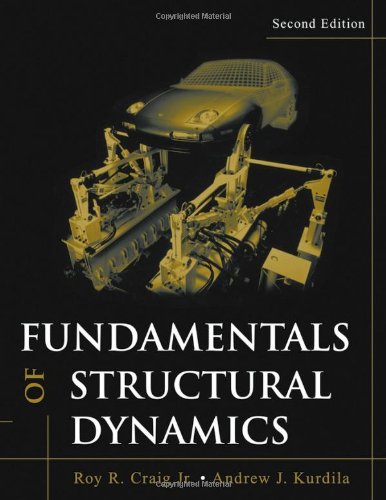
Fundamentals of Structural Dynamics 2nd Edition by Roy Craig, Andrew Kurdila 9781118151075 1118151070


Original price was: $50.00.$35.00Current price is: $35.00.
Fundamentals of Structural Dynamics 2nd Edition by Roy Craig, Andrew Kurdila – Ebook PDF Instant Download/Delivery: 9781118151075, 1118151070
Full download Fundamentals of Structural Dynamics 2nd Edition after payment
Product details:
ISBN 10: 1118151070
ISBN 13: 9781118151075
Author: Roy Craig, Andrew Kurdila
Structural dynamics is an area that covers experimental, analytical, and computational methods for determining the response of structures to dynamic environments. Fundamentals of Structural Dynamics, 2nd Edition covers the theory of engineering vibration, with an emphasis on how to obtain models of real structures by finite-element-based computational techniques. It also emphasizes topics like mode superposition and frequency response, topics that play a significant role in experimental modal analysis.
Fundamentals of Structural Dynamics 2nd Table of contents:
1: The Science and Art of Structural Dynamics
Introduction to Structural Dynamics
Modeling of Structural Components and Systems
Prototype Spring–Mass Model
Vibration Testing of Structures
Scope of the Book
Computer Simulations; Supplementary Material on the Website
References
Problems
Part I: Single-Degree-of-Freedom Systems
2: Mathematical Models of SDOF Systems
Brief Review of the Dynamics of Particles and Rigid Bodies
Elements of Lumped-Parameter Models
Application of Newton’s Laws to Lumped-Parameter Models
Application of the Principle of Virtual Displacements to Lumped-Parameter Models
Application of the Principle of Virtual Displacements to Continuous Models: Assumed-Modes Method
References
Problems
3: Free Vibration of SDOF Systems
Free Vibration of Undamped SDOF Systems
Free Vibration of Viscous-Damped SDOF Systems
Stability of Motion
Free Vibration of an SDOF System with Coulomb Damping
Experimental Determination of the Natural Frequency and Damping Factor of an SDOF System
References
Problems
4: Response of SDOF Systems to Harmonic Excitation
Response of Undamped SDOF Systems to Harmonic Excitation
Response of Viscous-Damped SDOF Systems to Harmonic Excitation: Frequency-Response Functions
Complex Frequency Response
Vibration Isolation: Force Transmissibility and Base Motion
Vibration Measuring Instruments: Accelerometers and Vibrometers
Use of Frequency-Response Data to Determine the Natural Frequency and Damping Factor of a Lightly Da
Equivalent Viscous Damping
Structural Damping
References
Problems
5: Response of SDOF Systems to Nonperiodic Excitation
Response of a Viscous-Damped SDOF System to an Ideal Step Input
Response of Undamped SDOF Systems to Rectangular Pulse and Ramp Loadings
Response of Undamped SDOF Systems to a Short-Duration Impulse: Unit Impulse Response
Response of SDOF Systems to General Dynamic Excitation: Convolution Integral Method
Response Spectra
System Response by the Laplace Transform Method: System Transfer Function
References
Problems
6: Numerical Evaluation of the Dynamic Response of SDOF Systems
Integration of Second-Order Ordinary Differential Equations
Integration of First-Order Ordinary Differential Equations
Nonlinear SDOF Systems
References
Problems
7: Response of SDOF Systems to Periodic Excitation: Frequency-Domain Analysis
Response to Periodic Excitation: Real Fourier Series
Response to Periodic Excitation: Complex Fourier Series
Response to Nonperiodic Excitation: Fourier Integral
Relationship Between Complex Frequency Response and Unit Impulse Response
Discrete Fourier Transform and Fast Fourier Transform
References
Problems
Part II: Multiple-Degree-of-Freedom Systems—Basic Topics
8: Mathematical Models of MDOF Systems
Application of Newton’s Laws to Lumped-Parameter Models
Introduction to Analytical Dynamics: Hamilton’s Principle and Lagrange’s Equations
Application of Lagrange’s Equations to Lumped-Parameter Models
Application of Lagrange’s Equations to Continuous Models: Assumed-Modes Method
Constrained Coordinates and Lagrange Multipliers
References
Problems
9: Vibration of Undamped 2-DOF Systems
Free Vibration of 2-DOF Systems: Natural Frequencies and Mode Shapes
Beat Phenomenon
Additional Examples of Modes and Frequencies of 2-DOF Systems: Assumed-Modes Models
Free Vibration of Systems with Rigid-Body Modes
Introduction to Mode Superposition: Frequency Response of an Undamped 2-DOF System
Undamped Vibration Absorber
Reference
Problems
10: Vibration Properties of MDOF Systems: Modes, Frequencies, and Damping
Some Properties of Natural Frequencies and Natural Modes of Undamped MDOF Systems
Model Reduction: Rayleigh, Rayleigh–Ritz, and Assumed-Modes Methods
Uncoupled Damping in MDOF Systems
Structures with Arbitrary Viscous Damping: Complex Modes
Natural Frequencies and Mode Shapes of Damped Structures with Rigid-Body Modes
References
Problems
11: Dynamic Response of MDOF Systems: Mode-Superposition Method
Mode-Superposition Method: Principal Coordinates
Mode-Superposition Solutions for MDOF Systems with Modal Damping: Frequency-Response Analysis
Mode-Displacement Solution for the Response of MDOF Systems
Mode-Acceleration Solution for the Response of Undamped MDOF Systems
Dynamic Stresses by Mode Superposition
Mode Superposition for Undamped Systems with Rigid-Body Modes
References
Problems
Part III: Continuous Systems
12: Mathematical Models of Continuous Systems
Applications of Newton’s Laws: Axial Deformation and Torsion
Application of Newton’s Laws: Transverse Vibration of Linearly Elastic Beams (Bernoulli–Euler Be
Application of Hamilton’s Principle: Torsion of a Rod with Circular Cross Section
Application of the Extended Hamilton’s Principle: Beam Flexure Including Shear Deformation and Rot
References
Problems
13: Free Vibration of Continuous Systems
Free Axial and Torsional Vibration
Free Transverse Vibration of Bernoulli–Euler Beams
Rayleigh’s Method for Approximating the Fundamental Frequency of a Continuous System
Free Transverse Vibration of Beams Including shear Deformation and Rotatory Inertia
Some Properties of Natural Modes of Continuous Systems
Free Vibration of Thin Flat Plates
References
Problems
Part IV: Computational Methods in Structural Dynamics
14: Introduction to Finite Element Modeling Structures
Introduction to the Finite Element Method
Element Stiffness and Mass Matrices and Element Force Vector
Transformation of Element Matrices
Assembly of System Matrices: Direct Stiffness Method
Boundary Conditions
Constraints: Reduction of Degrees of Freedom
Systems with Rigid-Body Modes
Finite Element Solutions for Natural Frequencies and Mode Shapes
References
Problems
15: Numerical Evaluation of Modes and Frequencies of MDOF Systems
Introduction to Methods for Solving Algebraic Eigenproblems
Vector Iteration Methods
Subspace Iteration
QR Method for Symmetric Eigenproblems
Lanczos Eigensolver
Numerical Case Study
References
Problems
16: Direct Integration Methods for Dynamic Response of MDOF Systems
Damping in MDOF Systems
Numerical Integration: Mathematical Framework
Integration of Second-Order MDOF Systems
Single-Step Methods and Spectral Stability
Numerical Case Study
References
Problems
17: Component-Mode Synthesis
Introduction to Component-Mode Synthesis
Component Modes: Normal, Constraint, and Rigid-Body Modes
Component Modes: Attachment and Inertia-Relief Attachment Modes
Flexibility Matrices and Residual Flexibility
Substructure Coupling Procedures
Component-Mode Synthesis Methods: Fixed-Interface Methods
Component-Mode Synthesis Methods: Free-Interface Methods
Brief Introduction to Multilevel Substructuring
References
Problems
Part V: Advanced Topics in Structural Dynamics
18: Introduction to Experimental Modal Analysis
Introduction
Frequency-Response Function Representations
Vibration Test Hardware
Fourier Transforms, Digital Signal Processing, and Estimation of FRFs
Modal Parameter Estimation
Mode Shape Estimation and Model Verification
References
Problems
19: Introduction to Active Structures
Introduction to Piezoelectric Materials
Constitutive Laws of Linear Piezoelectricity
Application of Newton’s Laws to Piezostructural Systems
Application of Extended Hamilton’s Principle to Piezoelectricity
Active Truss Models
Active Beam Models
Active Composite Laminates
References
Problems
20: Introduction to Earthquake Response of Structures
Introduction
Response of a SDOF System to Earthquake Excitation: Response Spectra
Response of MDOF Systems to Earthquake Excitation
Further Considerations
References
Problems
People also search for Fundamentals of Structural Dynamics 2nd:
fundamentals of structural dynamics 2nd edition
fundamentals of structural dynamics solution manual pdf
fundamentals of structural dynamics theory and computation
fundamentals of structural dynamics solution manual
fundamentals of structural dynamics solutions
Tags:
Structural Dynamics,Roy Craig,Andrew Kurdila