

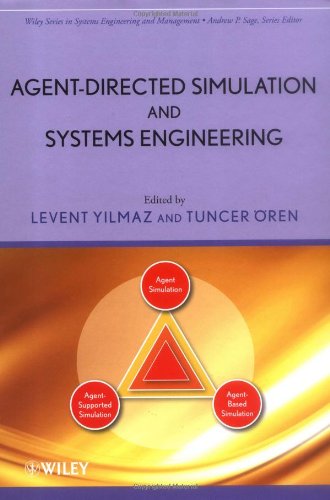
Agent Directed Simulation and Systems Engineering Wiley Series in Systems Engineering and Management 1st Edition by Levent Yilmaz, Tuncer Oren 9783527407811 3527407812


Original price was: $50.00.$35.00Current price is: $35.00.
Agent Directed Simulation and Systems Engineering Wiley Series in Systems Engineering and Management 1st Edition by Levent Yilmaz, Tuncer Oren – Ebook PDF Instant Download/Delivery: 9783527407811, 3527407812
Full download Agent Directed Simulation and Systems Engineering Wiley Series in Systems Engineering and Management 1st Edition after payment
Product details:
ISBN 10: 3527407812
ISBN 13: 9783527407811
Author: Levent Yilmaz, Tuncer Oren
The only book to present the synergy between modeling and simulation, systems engineering, and agent technologies expands the notion of agent-based simulation to also deal with agent simulation and agent-supported simulation. Accessible to both practitioners and managers, it systematically addresses designing and building agent systems from a systems engineering perspective.
Agent Directed Simulation and Systems Engineering Wiley Series in Systems Engineering and Management 1st Table of contents:
Part One Background
1 Modeling and Simulation: a Comprehensive and Integrative View
Tuncer I. Ören
1.1 Introduction
1.2 Simulation: Several Perspectives
1.2.1 Purpose of Use
1.2.2 Problem to Be Solved
1.2.3 Connectivity of Operations
1.2.4 M&S as a Type of Knowledge Processing
1.2.5 M&S from the Perspective of Philosophy of Science
1.3 Model-Based Activities
1.3.1 Model Building
1.3.2 Model-Base Management
1.3.3 Model Processing
1.3.4 Behavior Generation
1.4 Synergies of M&S: Mutual and Higher-Order Contributions
1.5 Advancement of M&S
1.6 Preeminence of M&S
1.6.1 Physical Tools
1.6.2 Knowledge-Based or Soft Tools
1.6.3 Knowledge Generation Tools
1.7 Summary and Conclusions
2 Autonomic Introspective Simulation Systems
Levent Yilmaz and Bradley Mitchell
2.1 Introduction
2.2 Perspective and Background on Autonomic Systems
2.3 Decentralized Autonomic Simulation Systems: Prospects and Issues
2.3.1 Motivating Scenario: Adaptive Experience Management in Distributed Mission Training
2.3.2 An Architectural Framework for Decentralized Autonomic Simulation Systems
2.3.3 Challenges and Issues
2.4 Symbiotic Adaptive Multisimulation: An Autonomic Simulation System
2.4.1 Metamodels for Introspection Layer Design
2.4.2 Local Adaptation: First-Order Change via Particle Swarm Optimizer
2.4.3 The Learning Layer: Genetic Search of Potential System Configurations
2.4.4 SAMS Component Architecture
2.5 Case Study: UAV Search and Attack Scenario
2.5.1 Input Factors
2.5.2 Agent Specifications
2.6 Validation and Preliminary Experimentation with SAMS
2.6.1 Face Validity of the UAV Model
2.6.2 Experiments with the Parallel SAMS Application
2.7 Summary
Part Two Agents and Modeling and Simulation
3 Agents: Agenthood, Agent Architectures, and Agent Taxonomies
Andreas Tolk and Adelinde M. Uhrmacher
3.1 Introduction
3.2 Agenthood
3.2.1 Defining Agents
3.2.2 Situated Environment and Agent Society
3.3 Agent Architectures
3.3.1 Realizing Situatedness
3.3.2 Realizing Autonomy
3.3.3 Realizing Flexibility
3.3.4 Architectures and Characteristics
3.4 Agenthood Implications for Practical Applications
3.4.1 Systems Engineering, Simulation, and Agents
3.4.2 Modeling and Simulating Human Behavior for Systems Engineering
3.4.3 Simulation-Based Testing in Systems Engineering
3.4.4 Simulation as Support for Decision Making in Systems Engineering
3.4.5 Implications for Modeling and Simulation Methods
3.5 Agent Taxonomies
3.5.1 History and Application-Specific Taxonomies
3.5.2 Categorizing the Agent Space
3.6 Concluding Discussion
4 Agent-directed Simulation
Levent Yilmaz and Tuncer I. Ören
4.1 Introduction 111
4.2 Background
4.2.1 Software Agents
4.2.2 Complexity
4.2.3 Complex Systems of Systems
4.2.4 Software Agents within the Spectrum of Computational Paradigms
4.3 Categorizing the Use of Agents in Simulation
4.3.1 Agent Simulation
4.3.2 Agent-Based Simulation
4.3.3 Agent-Supported Simulation
4.4 Agent Simulation
4.4.1 A Metamodel for Agent System Models
4.4.2 A Taxonomy for Modeling Agent System Models
4.4.3 Using Agents as Model Design Metaphors: Agent-Based Modeling
4.4.4 Simulation of Agent Systems
4.5 Agent-Based Simulation
4.5.1 Autonomic Introspective Simulation
4.5.2 Agent-Coordinated Simulator for Exploratory Multisimulation
4.6 Agent-Supported Simulation
4.6.1 Agent-Mediated Interoperation of Simulations
4.6.2 Agent-Supported Simulation for Decision Support
4.7 Summary
Part Three Systems Engineering and Quality Assurance for Agent-Directed Simulation
5 Systems Engineering: Basic Concepts and Life Cycle
Steven M. Biemer and Andrew P. Sage
5.1 Introduction
5.2 Agent-Based Systems Engineering
5.3 Systems Engineering Definition and Attributes
5.3.1 Knowledge
5.3.2 People and Information Management
5.3.3 Processes
5.3.4 Methods and Tools
5.3.5 The Need for Systems Engineering
5.4 The System Life Cycle
5.4.1 Conceptual Design (Requirements Analysis)
5.4.2 Preliminary Design (Systems Architecting)
5.4.3 Detailed Design and Development
5.4.4 Production and Construction
5.4.5 Operational Use and System Support
5.5 Key Concepts of Systems Engineering
5.5.1 Integrating Perspectives into the Whole
5.5.2 Risk Management
5.5.3 Decisions and Trade Studies (the Strength of Alternatives)
5.5.4 Modeling and Evaluating the System
5.6 Summary
6 Quality Assurance of Simulation Studies of Complex Networked Agent Systems
Osman Balci, William F. Ormsby, and Levent Yilmaz
6.1 Introduction
6.2 Characteristics of Open Agent Systems
6.3 Issues in the Quality Assurance of Agent Simulations
6.4 Large-Scale Open Complex Systems – The Network-Centric System Metaphor
6.5 M&S Challenges for Large-Scale Open Complex Systems
6.6 Quality Assessment of Simulations of Large-Scale Open Systems
6.7 Conclusions
7 Failure Avoidance in Agent-directed Simulation: Beyond Conventional v&v and qa
Tuncer I. Ören and Levent Yilmaz
7.1 Introduction
7.1.1 The Need for a Fresh Look
7.1.2 Basic Terms
7.2 What Can Go Wrong
7.2.1 Increasing Importance of M&S
7.2.2 Contributions of Simulation to Failure Avoidance
7.2.3 Need for Failure Avoidance in Simulation Studies
7.2.4 Some Sources of Failure in M&S
7.3 Assessment for M&S
7.3.1 Types of Assessment
7.3.2 Criteria for Assessment
7.3.3 Elements of M&S to be Studied
7.4 Need for Multiparadigm Approach for Successful M&S Projects
7.4.1 V&V Paradigm for Successful M&S Projects
7.4.2 QA Paradigm for Successful M&S Projects
7.4.3 Failure Avoidance Paradigm for Successful M&S Projects
7.4.4 Lessons Learned and Best Practices for Successful M&S Projects
7.5 Failure Avoidance for Agent-Based Modeling
7.5.1 Failure Avoidance in Rule-Based Systems
7.5.2 Failure Avoidance in Autonomous Systems
7.5.3 Failure Avoidance in Agents with Personality, Emotions, and Cultural Background
7.5.4 Failure Avoidance in Inputs
7.6 Failure Avoidance for Systems Engineering
7.7 Conclusion
8 Toward Systems Engineering for Agent-directed Simulation
Levent Yilmaz
8.1 Introduction
8.2 What Is a System?
8.2.1 What Is Systems Engineering?
8.2.2 The Functions of Systems Engineering
8.3 Modeling and Simulation
8.4 The Synergy of M&S and SE
8.4.1 The Role of M&S in Systems
8.4.2 Why Does M&S Require SE?
8.4.3 Why Is SSE Necessary?
8.5 Toward Systems Engineering for Agent-Directed Simulation
8.5.1 The Essence of Complex Adaptive Open Systems (CAOS)
8.5.2 The Merits of ADS
8.5.3 Systems Engineering for Agent-Directed Simulation
8.6 Sociocognitive Framework for ADS-SE
8.6.1 Social-Cognitive View
8.6.2 The Dimensions of Representation
8.6.3 The Functions for Analysis
8.7 Case Study: Human-Centered Work Systems
8.7.1 Operational Level – Organizational Subsystem
8.7.2 Operational Level – Organizational Subsystem
8.7.3 Operational Level – Integration of Organization and Social Subsystems
8.7.4 The Technical Level
8.8 Conclusions
9 Design and Analysis of Organization Adaptation in Agent Systems
Virginia Dignum, Frank Dignum, and Liz Sonenberg
9.1 Introduction
9.2 Organizational Model
9.3 Organizational Structure
9.3.1 Organizational Structures in Organization Theory
9.3.2 Organizational Structures in Multiagent Systems
9.4 Organization and Environment
9.4.1 Environment Characteristics
9.4.2 Congruence
9.5 Organization and Autonomy
9.6 Reorganization
9.6.1 Organizational Utility
9.6.2 Organizational Change
9.7 Organizational Design
9.7.1 Designing Organizational Simulations
9.7.2 Application Scenario
9.8 Understanding Simulation of Reorganization
9.8.1 Reorganization Dimensions
9.8.2 Analyzing Simulation Case Studies
9.9 Conclusions
10 Programming Languages, Environments, and Tools for Agent-directed Simulation
Yu Zhang, Mark Lewis, and Maarten Sierhuis
10.1 Introduction
10.2 Architectural Style for ADS
10.3 Agent-Directed Simulation – An Overview
10.3.1 Language
10.3.2 Environment
10.3.3 Service
10.3.4 Application
10.4 A Survey of Five ADS Platforms
10.4.1 Ascape
10.4.2 NetLogo
10.4.3 Repast
10.4.4 Swarm
10.4.5 Mason
10.5 Brahms – A Multiagent Simulation for Work System Analysis and Design
10.5.1 Language
10.5.2 Environment
10.5.3 Service
10.5.4 Application
10.6 CASESim – A Multiagent Simulation for Cognitive Agents for Social Environment
10.6.1 Language
10.6.2 Environment
10.6.3 Service
10.6.4 Application
10.7 Conclusion
11 Simulation for Systems Engineering
Joachim Fuchs
11.1 Introduction
11.2 The Systems Engineering Process
11.3 Modeling and Simulation Support
11.4 Facilities
11.5 An Industrial Use Case: Space Systems
11.5.1 Simulators for Analysis and Design
11.5.2 Facility for Spacecraft Qualification and Acceptance
11.5.3 Facility for Ground System Qualification and Testing and Operations
11.6 Outlook
11.7 Conclusions
12 Agent-directed Simulation for Systems Engineering
Philip S. Barry, Matthew T.K. Koehler, and Brian F. Tivnan
12.1 Introduction
12.2 New Approaches Are Needed
12.2.1 Employing ADS Through the Framework of Empirical Relevance
12.2.2 Simulating Systems of Systems
12.3 Agent-Directed Simulation for the Systems Engineering of Human Complex Systems
12.3.1 A Call for Agents in the Study of Human Complex Systems
12.3.2 Noteworthy Agent-Directed Simulations in the Science of Human Complex Systems
12.4 A Model-Centered Science of Human Complex Systems
12.5 An Infrastructure for the Engineering of Human Complex Systems
12.5.1 Components of the Infrastructure for Complex Systems Engineering
12.5.2 Modeling Goodness
12.5.3 The Genetic Algorithm Optimization Toolkit
12.6 Case Studies
12.6.1 Case Study 1: Defending The Stadium
12.6.2 Case Study 2: Secondary Effects from Pandemic Influenza
12.7 Summary
Part Four Agent-Directed Simulation for Systems Engineering
13 Agent-implemented Experimental Frames for Net-centric Systems Test and Evaluation
Bernard P. Zeigler, Dane Hall, and Manuel Salas
13.1 Introduction
13.2 The Need for Verification Requirements
13.3 Experimental Frames and System Entity Structures
13.4 Decomposition and Design of System Architecture
13.5 Employing Agents in M&S-Based Design, Verification and Validation
13.6 Experimental Frame Concepts for Agent Implementation
13.7 Agent-Implemented Experimental Frames
13.8 DEVS/SOA: Net-Centric Execution Using Simulation Service
13.8.1 Automation of Agent Attachment to System Components
13.8.2 DEVS-Agent Communications/Coordination
13.8.3 DEVS-Agent EndomorphicModels
13.9 Summary and Conclusions
13.A cAutoDEVS – A Tool for the Bifurcated Methodology
14 Agents and Decision Support Systems
Andreas Tolk, Poornima Madhavan, Jeffrey W. Tweedale, and Lakhmi C. Jain
14.1 Introduction
14.1.1 History
14.1.2 Motivating Agent-Directed Decision Support Simulation Systems
14.1.3 Working Definitions
14.2 Cognitive Foundations for Decision Support
14.2.1 Decision Support Systems as Social Actors
14.2.2 How to Present the System to the User and Improve Trust
14.2.3 Relevance for the Engineer
14.3 Technical Foundations for Decision Support
14.3.1 Machine-Based Understanding for Decision Support
14.3.2 Requirements for Systems When Being Used for Decision Support
14.3.3 Agent-Directed Multimodel and Multisimulation Support
14.3.4 Methods Applicable to Support Agent-Directed Decision Support Simulation Systems
14.4 Examples for Intelligent and Agent-Directed Decision Support Simulation Systems
14.4.1 Supporting Command and Control
14.4.2 Supporting Inventory Control and Integrated Logistics
14.5 Conclusion
15 Agent Simulation for Software Process Performance Analysis
Levent Yilmaz and Jared Phillips
15.1 Introduction
15.2 Related Work
15.2.1 Organization-Theoretic Perspective for Simulation-Based Analysis of Software Processes
15.2.2 Simulation Methods for Software Process Performance Analysis
15.3 Team-RUP: A Framework for Agent Simulation of Software Development Organizations
15.3.1 Organization Structure
15.3.2 Team-RUP Task Model
15.3.3 Team-RUP Team Archetypes and Cooperation Mechanisms
15.3.4 Reward Mechanism in Team-RUP
15.4 Design and Implementation of Team-RUP
15.4.1 Performance Metrics
15.4.2 Validation of the Model
15.5 Results and Discussion
15.6 Conclusions
16 Agent-Directed Simulation for Manufacturing System Engineering
Jeffrey S. Smith, Erdal Sahin, and Levent Yilmaz
16.1 Introduction
16.1.1 Manufacturing Systems
16.1.2 Agent-Based Modeling
16.2 Simulation Modeling and Analysis for Manufacturing Systems
16.2.1 Manufacturing System Design
16.2.2 Manufacturing Operation
16.3 Agent-Directed Simulation for Manufacturing Systems
16.3.1 Emergent Approaches
16.3.2 Agent-Based Manufacturing
16.3.3 The Holonic Approach: Hierarchic Open Agent Systems
16.4 Summary
17 Organization and Work Systems Design and Engineering: from Simulation to Implementation of Multiagent Systems
Maarten Sierhuis,William J. Clancey, and Chin H. Seah
17.1 Introduction
17.2 Work Systems Design
17.2.1 Existing Work System Design Methods
17.2.2 A Brief History of Work Systems Design
17.3 Modeling and Simulation of Work Systems
17.3.1 Designing Work Systems: What Is the Purpose and What Can Go Wrong?
17.3.2 The Difficulty of Convincing Management
17.4 Work Practice Modeling and Simulation
17.4.1 Practice vs. Process
17.4.2 Modeling Work Practice
17.5 The Brahms Language
17.5.1 Simulation or Execution with Brahms
17.5.2 Modeling People and Organizations
17.5.3 Modeling Artifacts and Data Objects
17.5.4 Modeling Communication
17.5.5 Modeling Location and Movement
17.5.6 Java Integration
17.6 Systems Engineering: From Simulation to Implementation
17.6.1 A Cyclic Approach
17.6.2 Modeling Current Operations
17.6.3 Modeling Future Operations
17.6.4 MAS Implementation
17.7 A Case Study: The OCA Mirroring System
17.7.1 Mission Control as a Socio-Technical Work System
17.7.2 The OCA Officer’s Work System
17.7.3 Simulating the Current OCA Work System
17.7.4 Designing the Future OCA Work System
17.7.5 Simulating the Future OCA Work System
17.7.6 Implementing OCAMS
17.8 Conclusion
People also search for Agent Directed Simulation and Systems Engineering Wiley Series in Systems Engineering and Management 1st:
agent-based simulation
agent-based simulation examples
agent-based modeling and simulation
agent-based simulation python
a simple agent-based simulation approach
Tags:
Agent Directed,Systems Engineering,Levent Yilmaz,Tuncer Oren