

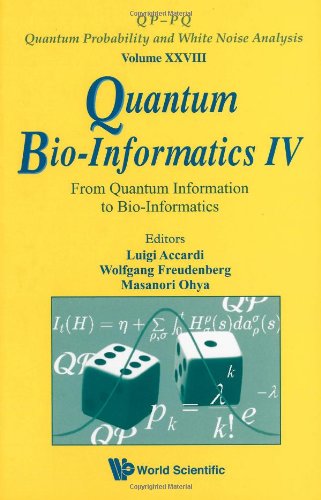
Quantum Bio informatics IV From Quantum Information to Bio informatics Qp Pq Quantum Probability and White Noise Analysis 1st Edition by Accardi, Freudenberg, Ohya 9789814343756 9814343757


Original price was: $50.00.$35.00Current price is: $35.00.
Quantum Bio informatics IV From Quantum Information to Bio informatics Qp Pq Quantum Probability and White Noise Analysis 1st Edition by Accardi, Freudenberg, Ohya – Ebook PDF Instant Download/Delivery:9789814343756, 9814343757
Full download Quantum Bio informatics IV From Quantum Information to Bio informatics Qp Pq Quantum Probability and White Noise Analysis 1st Edition after payment
Product details:
ISBN 10: 9814343757
ISBN 13: 9789814343756
Author: L. Accardi, W. Freudenberg and M. Ohya
The purpose of this proceedings volume is to return to the starting point of bio-informatics and quantum information, fields that are growing rapidly at present, and to seriously attempt mutual interaction between the two, with a view to enumerating and solving the many fundamental problems they entail. For such a purpose, we look for interdisciplinary bridges in mathematics, physics, information and life sciences, in particular, research for new paradigm for information science and life science on the basis of quantum theory.
Quantum Bio informatics IV From Quantum Information to Bio informatics Qp Pq Quantum Probability and White Noise Analysis 1st Table of contents:
1. QP-DYN algorithms: general scheme
2. Dynamical systems underlying the QP-DYN algorithms
3. From sequences of vectors to sequences of bits
3.1. Recursive construction of the sequence (K,n)
3.2. KGF by left concatenation
4. Modifications of the dynamical law
5. Orbit jump function
5.1. A choice of the orbit jump function
6. Machine truncation
7. Use of multiple dynamical systems
7.1. The 2 prime protocol
8. Attacks to the 1-matrix algorithm
9. Attacks to the 2-matrix algorithm
References
Study of Transcriptional Regulatory Network Based on Cis Module Database S. Akasaka, T. Urushibam, T
1. Introduction
2. Transcriptional control and cis-modules
3. Available Cis-Module Data in public database
4. Construction Cis-module Datbase
4.1. Data sources and Data Collection (Fig4-1)
4.2. Identification of CDS location on Genome (Fig4-2)
4.3. Extraction and Comparison upstream region (Fig4-3, 4-4)
5. Explanation of User Interface and Advantage of Cis-Module Database
6. Application of Cis-module Database
6.1. Summary of Co-occurrence ofCEs and TFsfrom Cis-module Database
6.2. Prediction of gene network for caloric restriction Rat
6.3. Evaluation CE pattern predicted in USR of genes
6.4. Identification of genes regulated by SREBPI
7. Conclusion and Future works
References
On Lie Group-Lie Algebra Correspondences of Unitary Groups in Finite von Neumann Algebras H. Ando, 1
1. Introduction
2. Murray-von Neumann’s result
3. Lie Group-Lie Algebra Correspondences
3.1. Topological properties of
3.1.1. Strong Resolvent Topology
3.1.2. T-Measure Topology
3.2. Main Results
4. Categorical Characterization of
Acknowledgement
References
On a General Form of Time Operators of a Hmiltonian with Purely Discrete Spectrum A. Ami
1. Introduction
2. Time Operators of a Hamiltonian with Discrete Eigenvalues (I)
2.1. A general class of time operators of H
2.2. Necessary condition for H to have time operators and the general form of them
2.3. Non-existence theorems of time operators
3. Time Operators of a Hamiltonian with Discrete Eigenvalues (II)
Acknowledgments
References
Quantum Uncertainty and Decision-making in Game Theory M. Asano, M. Ohya, Y. Tanaka, A. Khrennikov a
1. Introduction
References
New Types of Quantum Entropies and Additive Information Capacities V. P. Belavkin
1. Introduction
2. The Entanglement States and Operations
2.1. Normal states, densities and pairings
2.2. Examples: the standard and the qubit paring
2.3. Coupling operators
2.4. Mixed entangled states
2.5. Entanglement as operation
2.6. The standard entanglement
3. Informational Divergences and Relative Entropies
3.1. Entanglement measures
3.2. The general information divergences
3.3. The relative l-entropies of types A&B
3.4. The entropy increase, its concavity and additivity
3.5. A new type of relative l-entropy C
3.6. Other new entropy types D&E
4. Quantum Mutual Information and Encodings
4.1. Entangled mutual information
4.2. The proper quantum entropies
4.3. Quantum noisy and noiseless channels
4.4. Entanglement as quantum encoding
5. Quantum Channel Capacities and their Additivity
5.1. The quantum and semiclassical capacities
5.2. The true quantum capacity
5.3. Block encoding for quantum product channels
5.4. The additivity problem for quantum capacities
5.5. Optimal true quantum block encoding
5.6. The additivity of true quantum capacities
6. Conclusion
7. Appendix: The standard pairing
Acknowledgment
References
Non-Markovian Dynamics of Quantum Systems D. Chrusciriski and A . Kossakowski
1. Introduction
2. Local vs. non-local approach
3. Examples
4. Conclusions
Acknowledgments
References
Self-collapses of Quantum Systems and Brain Activities K.-H. Fichtner, L. Fichtner, W. Freudenberg a
1. Introduction
2. Some biological facts and experiments
3. The Space of Signals
4. The Process of Recognition
5. A Markov Chain with Discrete Time
References
Statistical Analysis of Random Number Generators L. Accardi and M. Gabler
1. Introduction
2. Statistical Testing of RNGs
2.1. Historical Development
2.2. General Setup of a Statistical Test
2.3. Specialties for Testing of RNGs
3. Test Results
4. Summary and Outlook
Acknowledgements
References
Entangled Effects of Two Consecutive Pairs in Residues and Its Use in Alignment T. Ham, K. Sato and
1. Introduction
2. A new measure taking entangled effects of two consecutive pairs in residues
3. Evaluation
4. Results
5. Conclusion
References
The Passage from Digital to Analogue in White Noise Analysis and Applications T. Hida
1. Prologue
2. An i.i.d. random variables as a representation of parameter set
3. Poisson noise
4. Calculus of Poisson noise functionals
References
Remarks on the Degree of Entanglement D. Chrusciriski, Y. Hirota, T. Matsuoka and M. Ohya
1. Introduction
2. The Degree of Entanglement
3. DEN for 2-qudit states
3.1. Circulant states
3.2. Horodecki state
4. Bell diagonal states
5. Conclusions
Acknowledgments
References
A Completely Discrete Particle Model Derived from a Stochastic Partial Differential Equation by Poin
1. Introduction
2. Basic notations
3. A Special Type of a Stochastic Partial Differential Equation
4. Some Lemmas
5. Proof
References
On Quantum Algorithm for Exptime Problem S. Iriyama and M. Ohya
1. Introduction
2. Quantum Algorithm
3. OMV SAT Algorithm
3.1. Chaos Amplifier
4. Language Classes
5. Pebble Game
5.1. Representation of a Game
5.2. Pebble Game
5.3. Computational Complexity of a Classical Algorithm for Pebble Game
6. Quantum Algorithm for Pebble Game
7. Computational Complexity
8. Conclusion
References
On Sufficient Algebraic Conditions for Identification of Quantum States A. J amiolkowski
1. Introduction
2. Identification of quantum states
3. Stroboscopic tomography of open quantum systems
4. Algebraic approach to identification problems
5. Examples. Low dimensional cases
References
Concurrence and Its Estimations by Entanglement Witnesses J. Jurkowski
1. Introduction
2. Detecting and measuring entanglement
3. Estimations of concurrence
4. Main result
5. Examples
References
Classical Wave Model of Quantum-like Processing in Brain A. Khrennikov
1. Introduction
2. The role of the law of total probability
2.1. LTP and classical decision making
2.2. Violation of LTP from contextuality of probabilities
2.3. Violation of LTP in cognitive science
2.4. Wave representation of information in the brain?
3. Prequantum classical statistical field theory: noncomposite systems
4. Composite systems
5. QL processing in the brain
5.1. Multiplicity of time scales in brain and cognitive QLR
5.2. Precognitive time scale
References
Entanglement Mapping vs. Quantum Conditional Probability Operator D. Chrusciriski, A. Kossakowski, T
1. Introduction
2. Entanglement mapping and its classification
3. Quantum conditional probability operator and its classification
4. The relation between entanglement mapping and QCPO
5. Mutual entropy and conditional entropy vs. quantum entanglement
6. Summary
References
Constructing Multipartite Entanglement Witnesses M. Michalski
1. Introduction
2. Multipartite entanglement
3. Construction of entanglement witnesses
4. Example: Anisotropic Heisenberg spin chains
Acknowledgment
References
On Kadison- Schwarz Property of Quantum Quadratic Operators on M2 (C) F. Mukhamedov and A . Abdugani
1. Introduction
2. Preliminaries
3. Quantum quadratic operators with Kadison-Schwarz property on M2 (C)
4. An Example of q.q.o. which is not Kadision-Schwarz one
Acknowledgement
References
On Phase Transitions in Quantum Markov Chains on Cayley Tree L. Accardi, F. Mukhamedov and M. Saburo
1. Introduction
2. Preliminaries
3. Constructions of Quantum d-Markov chains on the Cayley tree
4. Quantum d-Markov chains associated with XY-model
Acknowledgement
References
Space( -Time) Emergence as Symmetry Breaking Effect I. Ojima
1. Outline of the Problem
1.1. “Theory of Everything” vs. Duheme-Quine thesis
1.2. “Geometrization principle” vs. Physical emergence of space-time
2. Universality inherent in Macro-levels
3. “Sector bundle” associated with broken symmetry
4. Emergence of space(-time) as symmetry breaking
Acknowledgment
References
Use of Cryptographic Ideas to Interpret Biological Phenomena (and Vice Versa) M. Regoli
1. Introduction
1.1. Interpretation
2. Ingredients
2.1. Spaces
2.2. Functions
2.3. Global variables and further definitions
2.4. Biological parallelism
3. The algorithm
3.1. Coding
3.2. Decoding
3.3. Preliminary observations
4. Early implementations
4.1. The environment
4.2. Functions and implementation
4.3. Observation
4.4. A biological implementation
5. The role of the Coding Functions
6. Statistical Analysis
6.1. Cryptanalysis
6.2. OUT Idea
6.3. BIG results
6.3.1. The Experiment
6.3.2. The protocol
6.3.3. The Data
6.3.4. The Results
6.4. RNA-Crypto System results
6.4.1. The Experiment
6.4.2. The Protocol
6.4.3. The Data
6.4.4. The Results
6.5. First Results – Differences
6.6. Changes: Informatics emulates biology
6.6.1. Modify Cryptographic protocol – Phase I
6.6.2. Strategies
6.6.3. Alter Cryptographic protocol – Phase II
6.6.4. Phase II – Strategies
6.7. Results
6.8. New Results – Differences
7. Conclusion
References
Discrete Approximation to Operators in White Noise Analysis Si Si
1. Introduction
2. Analysis of white noise functionals
3. Discrete parameter case
4. Operators : from discrete to continuous form
Acknowledgement
References
Bogoliubov Type Equations via Infinite-dimensional Equations for Measures V. V. Kozlov and O. G. Smo
Introduction
1. Symplectic locally convex spaces and Hamilton’s equations.
2. Liouville’s equations with respect to measures.
3. Systems of equations with respect to finite-dimensional distributions of probabilities.
4. Bogolyubov’s systems of equations.
5. Wigner measures.
6. Generalization of Poincare’s model.
References
Analysis of Several Categorical Data Using Measure of Proportional Reduction in Variation K. Yamamot
1. Introduction
2. Review of generalized total uncertainty measure
3. Approximate confidence interval for measure
4. Analysis of data
5. Remarks
6. Conclusions
7. Discussion
References
The Electron Reservoir Hypothesis for Two-dimensional Electron Systems K. Yamada, T. Uchida, M. Fuji
1. Introduction
2. Quantum Hall Effects
3. Magnetoplasmon Dispersion Plateaus
4. Radiation-induced Magnetoresistance Oscillations
5. Concluding Remarks
References
On the Correspondence between Newtonian and Functional Mechanics E. V. Piskovskiy and I. V. Volovich
1. Introduction
2. Anharmonic oscillator
3. Newtonian and Averaged Trajectories Comparison
4. Numerical Approach
Acknowledgements
References
Quantile-Quantile Plots: An Approach for the Inter-species Comparison of Promoter Architecture in Eu
1. Introduction
2. Material and Methods
2.1. Plant genome information
2.2. Hexanucleotide Motifs and cisRegulatory Elements
2.3. Variance based Promoter Motif Analysis
2.4. Phylogenetic Analysis
2.5. Interspecies Quantile-Quantile Plots
3. Results and Discussion
3.1. DNA-motif variance as a measure of information content
3.2. Quantile-quantile (QQ)-plots for interspecies promoter comparison
4. Conclusions
Acknowledgements
References
Entropy Type Complexities in Quantum Dynamical Processes N. Watanabe
1. Introduction
2. Quantum Channels
2.1. Noisy optical channel
3. Complexities
3.1. Example of Complexity CS (p)
3.1.1. (1) von Neumann entropy
3.1.2. (2) S-mixing entropy
3.2. Example of Transmitted Complexity rs (Pi A *)
3.2.1. (1) Ohya mutual entropy for density operator
3.2.2. (2) Ohya mutual entropy for general C*-system
4. Quantum Mean Mutual Entropy of K-S type
4.1. Computation of mean mutual entropy for modulated states of OOK and PSK
4.1.1. Mean mutual entropy for modulated state of OOK and PSK
References
A Fair Sampling Test for Ekert Protocol G. Adenier, A. Yu. Khrennikov and N. Watanabe
1. Introduction
2. A biased-sampling attack on Ekert protocol
3. Countermeasures
4. Conclusion
Acknowledgments
References
Brownian Dynamics Simulation of Macromolecule Diffusion in a Protocell T. A ndo and J. Skolnick
1. Introduction
2. Methods
2.1. Estimation of diffusion tensor of a macromolecule from atomic structure
2.2. Brownian dynamics for arbitrarily shaped objects
2.3. Potential function
2.4. Simulation conditions and analysis
3. Results
3.1. Estimation of diffusion tensor of a macromolecule from atomic structure
3.2. Construction of the intracellular environment
3.3. Effect of molecular shapes on diffusion
4. Discussion
5. Conclusions
Acknowledgements
References
Signaling Network of Envitonmental Sensing and Adaptation in Plants: Key Roles of Calcium Ion K. K u
1. Calcium ion as a key element in information processingl
2. Ca2+ -mediated signaling and plant immunity4.6
3. Regulation of spatio-temporal patterns of cytosolic Ca2+ concentration triggered by signal molecu
4. Ca2+-permeable cation channels and plant immunityl-3
5. Regulation of Ca2+ -permeable channels2,3
6. Decoding of Ca2+ -mediated signals by Ca2+ sensor proteins1,20.22
7. Concluding remarks
Acknowledgement
References
NetzCope: A Tool for Displaying and Analyzing Complex Networks M. J. Barber, L. Streit and O. Stroga
1. Introduction
1.1. Bipartite Networks
1.2. Modularity
2. A Few Words on Graphs
2.1. How to plot a graph
2.2. Modularity of Graphs
3. What NetzCope does
4. Some NetzCope Screenshots
4.1. The Connected Components
4.2. The Adjacency Matrix
4.3. Plotting the Graph
4.4. Plotting the Network of Communities
4.5. The Network Portrait
5. Auxiliary Features
6. Conclusion
Acknowledgments
References
Study of HIV-1 Evolution by Coding Theory and Entropic Chaos Degree K. Sato
1. Introduction
2. Methods
2.1. The Code Structure of HIV-I
2.2. The Evolutionary Changes of HIV-I by Entropic Chaos Degree
2.3. Longitudinal Sequence Data
3. Results and Discussion
References
The Prediction of Botulinum Toxin Structure Based on in Silico and in Vitro Analysis T. Suzuki and S
1. Introduction
2. Modeling of NTNHA structures
3. Modeling of HA-70 structure
Acknowledgments
References
On the Mechanism of D-wave High Tc Superconductivity by the Interplay of Jahn-Teller Physics and Mot
1. Introduction
2. Brief review of the Kamimura-Suwa (K-S) model
2.1. Anti-Jahn-Teller Effect
2.2. The energy landscape of CU06 octahedron
2.3. Kamimura-Suwa model (K-S model)
2.4. Effective Hamiltonian for the Kamimura-Suwa model (K-S) model
3. Effective energy band and the shape of Fermi surface
3.1. Effective energy band
3.2. The shape of Fermi surface
4. High temperature superconductivity
4.1. Spin-dependent electron-phonon interaction
4.2. Effective inter-hole interaction via phonon
4.3. Calculated results of the hole-concentration dependence of Tc and of isotope effect
4.4. Comment on why Tc is higher in CU05 pyramid than in CU06 octahedron
5. Conclusion and concluding remarks
Acknowledgments
References
People also search for Quantum Bio informatics IV From Quantum Information to Bio informatics Qp Pq Quantum Probability and White Noise Analysis 1st :
quantum bioinformatics
quantum computing bioinformatics
quantum computational biology
a quantum processor based on coherent transport
a quantum computer
Tags: Accardi, Freudenberg, Ohya, informatics