

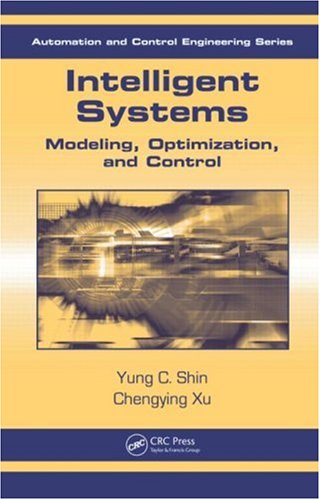
Intelligent Systems Modeling Optimization and Control Automation and Control Engineering 1st Edition by Yung Shin, Chengying Xu 9781351835404 1351835408
Original price was: $50.00.$35.00Current price is: $35.00.
Intelligent Systems Modeling Optimization and Control Automation and Control Engineering 1st Edition by Yung Shin, Chengying Xu – Ebook PDF Instant Download/Delivery: 9781351835404, 1351835408
Full download Intelligent Systems Modeling Optimization and Control Automation and Control Engineering 1st Edition after payment
Product details:
ISBN 10: 1351835408
ISBN 13: 9781351835404
Author: Yung Shin, Chengying Xu
Providing a thorough introduction to the field of soft computing techniques, Intelligent Systems: Modeling, Optimization, and Control covers every major technique in artificial intelligence in a clear and practical style. This book highlights current research and applications, addresses issues encountered in the development of applied systems, and describes a wide range of intelligent systems techniques, including neural networks, fuzzy logic, evolutionary strategy, and genetic algorithms. The book demonstrates concepts through simulation examples and practical experimental results. Case studies are also presented from each field to facilitate understanding.
Intelligent Systems Modeling Optimization and Control Automation and Control Engineering 1st Table of contents:
Chapter 1 Intelligent Systems
1.1 Introduction
1.2 Introduction of Soft Computing Techniques
1.2.1 Neural Networks
1.2.2 Fuzzy Logic
1.2.3 Evolutionary Algorithms
1.3 Summary
References
Chapter 2 Modeling of Nonlinear Systems: Fuzzy Logic, Neural Networks, and Neuro-Fuzzy Systems
2.1 Fuzzy Systems
2.1.1 Fuzzy Sets
2.1.2 Fuzzy Operations
2.1.3 Membership Functions
2.1.3.1. Triangular Membership Function
2.1.3.2. Trapezoidal Membership Function
2.1.3.3. Gaussian Membership Function
2.1.3.4. Generalized Bell Membership Function
2.1.3.5. Sigmoidal Membership Function
2.1.3.6. Z-Shaped Membership Function
2.1.4 Fuzzy Relations
2.1.5 Fuzzy Inference System
2.1.5.1. Fuzzifier
2.1.5.2. Fuzzy Rule Base
2.1.5.3. Fuzzy Inference Engine
2.1.5.4. Defuzzifier
2.2 Artificial Neural Networks
2.2.1 Basic Structure
2.2.2 Multilayer Feedforward Neural Networks (Backpropagation Neural Networks)
2.2.3 Radial Basis Function Networks
2.2.3.1. Definition and Types of RBF
2.2.4 Recurrent Neural Networks
2.2.4.1. Introduction
2.2.4.2. Network Architecture
2.2.4.3. Structure and Parameter Learning
2.2.4.4. Other Issues
2.3 Neuro-Fuzzy Systems
2.3.1 Fuzzy Basis Function Networks
2.3.2 ANFIS
2.4 Modeling of Dynamic Systems
2.4.1 Dynamic System Identification Using Feedforward Networks
2.4.1.1. Dynamic System Modeling by Radial Basis Function Neural Network
2.4.2 Dynamic System Representation by Recurrent Neural Networks
2.4.3 State Observer Construction
2.4.3.1. State Estimation Using RBFNN
2.4.3.2. Example Applications of the RBFNN State Estimator
2.5 Conclusions
References
Chapter 3 Efficient Training Algorithms
3.1 Supervised Algorithm
3.2 Unsupervised Algorithm
3.3 Backpropagation Algorithm
3.4 Dynamic Backpropagation
3.5 Orthogonal Least Squares Algorithm
3.6 Orthogonal Least Square and Generic Algorithm
3.6.1 OLS Learning Using Genetic Algorithm
3.6.2 Determination of the Number of Hidden Nodes
3.6.3 Performance Evaluation
3.7 Adaptive Least-Squares Learning Using GA
3.7.1 Adaptive Least-Squares Learning Using GA
3.7.2 Extension of ALS Algorithm to Multi-Input, Multi-Output Systems
3.7.3 Performance Evaluation in Approximating Nonlinear Functions
3.7.4 Application of FBFN to Modeling of Grinding Processes
References
Chapter 4 Fuzzy Inverse Model Development
4.1 Fuzzy Inverse Model Development
4.2 Simulation Examples
4.2.1 Two-Link Robot Manipulator
4.2.2 Five-Link AdeptOne Industry Robot Manipulator
4.2.3 Four-Link AdeptOne Industry Robot Manipulator
4.3 Conclusion
References
Chapter 5 Model-Based Optimization
5.1 Model Building
5.2 Model-Based Forward Optimization
5.2.1 Formulation of the Problem
5.2.2 Optimization Algorithm
5.2.2.1. Standard Evolutionary Strategies for Continuous Variables
5.2.2.2. Handling of Discrete Variables
5.2.2.3. Handling of Constraints
5.2.2.4. Algorithm
5.3 Application of ES to Numerical Examples
5.4 Application of Model-Based Optimization Scheme to Grinding Processes
5.4.1 Application to Creep Feed Grinding Example
5.4.2 Application to Surface Grinding Example
References
Chapter 6 Neural Control
6.1 Supervised Control
6.2 Direct Inverse Control
6.3 Model Reference Adaptive Control
6.4 Internal Model Control
6.5 Model Predictive Control
6.6 Feedforward Control
References
Chapter 7 Fuzzy Control
7.1 Knowledge-Based Fuzzy Control
7.1.1 Fuzzy PID Control
7.1.2 Hybrid Fuzzy Control
7.1.3 Supervisory Fuzzy Control
7.1.4 Self-Organizing Fuzzy Control
7.1.5 Fuzzy Model Reference Learning Control
7.2 Model–Based Fuzzy Control
7.2.1 Fuzzy Inverse Control
7.2.2 Fuzzy Inverse Control for a Singleton Fuzzy Model
7.2.3 Fuzzy Model–Based Predictive Control
7.2.4 Fuzzy Internal Model Control
References
Chapter 8 Stability Analysis Method
8.1 Lyapunov Stability Analysis
8.1.1 Mathematical Preliminaries
8.1.2 Lyapunov’s Direct Method
8.1.3 Lyapunov’s Indirect Method
8.1.4 Lyapunov’s Method to the TS Fuzzy Control System
8.1.5 Stability Concepts for Nonautonomous Systems
8.1.5.1. Lyapunov’s Direct Method
8.1.5.2. Lyapunov’s Indirect Method
8.2 Passivity Approach
8.2.1 Passivity Concept
8.2.1.1. Continuous-Time Case
8.2.1.2. Discrete-Time Case
8.2.2 Sectorial Fuzzy Controller
8.2.2.1. Inputs
8.2.2.2. Rule Base
8.2.2.3. Output
8.2.3 Property of Sectorial Fuzzy Controller
8.2.4 Passivity of Sectorial Fuzzy Controller in Continuous Domain
8.2.5 Passivity of Sectorial Fuzzy Controller in Discrete Domain
8.3 Conclusion
References
Chapter 9 Intelligent Control for SISO Nonlinear Systems
9.1 Fuzzy Control System Design
9.1.1 First Layer Fuzzy Controller
9.1.2 Self-Organizing Fuzzy Controller
9.1.3 Online Scaling Factor Determination Scheme
9.2 Stability Analysis
9.2.1 Multilevel Fuzzy Control Structure
9.2.2 Stability Analysis in Continuous-Time Case
9.2.3 Stability Analysis in Discrete-Time Case
9.3 Simulation Examples
9.3.1 Cargo Ship Steering
9.3.2 Fuzzy Cruise Control
9.3.3 Water Level Control
9.4 Implementation—Force Control for Grinding Processes
9.4.1 Hardware Configuration
9.4.2 Monitoring and Workpiece Setup
9.4.3 Experimental Implementation Results
9.4.4 Wheel Wear Experiments
9.5 Simulation and Implementation—Force Control for Milling Processes
9.5.1 Simulation Examples
9.5.2 Experimental Setup—Hardware Configuration
9.5.3 Experimental Implementation Results
9.6 Conclusion
References
Chapter 10 Intelligent Control for MISO Nonlinear Systems
10.1 MLFC-MISO Control System Structure
10.1.1 Control Parameters Initialization
10.1.2 Fuzzy Adaptive PD–PI Controller
10.2 Stability Analysis
10.3 Simulation Examples
10.3.1 Magnetic Bearing System
10.3.2 Fed-Batch Reactor
10.4 Conclusion
References
Chapter 11 Knowledge-Based Multivariable Fuzzy Control
11.1 Complexity Reduction Methods
11.1.1 Rule Base Simplification
11.1.2 Dimensionality Reduction
11.1.3 Structured Systems
11.2 Methods to Optimize Multivariable Fuzzy Inferencing Calculation
11.2.1 Intersection Coefficients
11.2.2 Decomposition of a Multidimensional Fuzzy Rule Base
11.2.3 Simplification of a Multidimensional Fuzzy Rule Base
11.3 Multivariable Fuzzy Controller to Deal with the Cross-Coupling Effect
11.3.1 Mixed Fuzzy Controller
11.3.2 Multiobjective Fuzzy Controller
11.4 Conclusion
References
Chapter 12 Model-Based Multivariable Fuzzy Control
12.1 Fuzzy Model of Multivariable Systems
12.2 Multivariable Interaction Analysis
12.2.1 Relative Gain Array
12.2.1.1. Relative Gain Array for Square Systems
12.2.1.2. Relative Gain Array for Nonsquare Systems
12.2.2 Interaction Analysis in Multivariable Fuzzy Models
12.2.3 Simulation Examples
12.2.4 Conclusion
12.3 Multivariable Fuzzy Control Design
12.3.1 Horizontal Fuzzy Control Engine
12.3.2 Perpendicular Fuzzy Control Engine
12.4 Stability Analysis
12.5 Simulation Examples
12.5.1 Distillation Column
12.5.2 Chemical Pressure Tank System
12.6 Conclusion
References
People also search for Intelligent Systems Modeling Optimization and Control Automation and Control Engineering 1st:
what is modelling in control system
intelligent optimization
intelligent systems design
intelligent control systems
intelligent control systems course
Tags:
Intelligent Systems,Modeling,Optimization,Yung Shin,Chengying Xu