

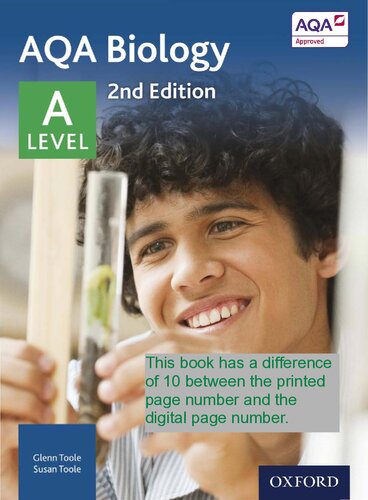
AQA A Level Biology 2nd Edition by Glenn Toole ISBN 0198357702 9780198357704
Original price was: $50.00.$35.00Current price is: $35.00.
AQA A Level Biology 2nd Edition by Glenn Tool – Ebook PDF Instant Download/Delivery: 0198357702, 9780198357704
Full download AQA A Level Biology 2nd Edition after payment
Product details:
ISBN 10: 0198357702
ISBN 13: 9780198357704
Author: Glenn Tool
Please note this title is suitable for any student studying: Exam Board: AQA Level: A Level Subject: Biology First teaching: September 2015 First exams: June 2017 Fully revised and updated for the new linear qualification, written and checked by curriculum and specification experts, this Student Book supports and extends students through the new course whilst delivering the maths, practical and synoptic skills needed to succeed in the new A Levels and beyond. The book uses clear straightforward explanations to develop true subject knowledge and allow students to link ideas together while developing essential exam skills.
Table of contents:
Section 1 Biological molecules
1 Biological molecules
-
1.1 Introduction to biological molecules
-
1.2 Carbohydrates – monosaccharides
-
1.3 Carbohydrates – disaccharides and polysaccharides
-
1.4 Starch, glycogen and cellulose
-
1.5 Lipids
-
1.6 Proteins
-
1.7 Enzyme action
-
1.8 Factors affecting enzyme action
-
1.9 Enzyme inhibition
-
Practice questions: Chapter 1
2 Nucleic acids
-
2.1 Structure of RNA and DNA
-
2.2 DNA replication
-
2.3 Energy and ATP
-
2.4 Water and its functions
-
Practice questions: Chapter 2
Section 2 Cells
3 Cell structure
-
3.1 Methods of studying cells
-
3.2 The electron microscope
-
3.3 Microscope measurements and calculations
-
3.4 Eukaryotic cell structure
-
3.5 Cell specialisation and organisation
-
3.6 Prokaryotic cells and viruses
-
3.7 Mitosis
-
3.8 The cell cycle
-
Practice questions: Chapter 3
4 Transport across cell membranes
-
4.1 Structure of the cell-surface membrane
-
4.2 Diffusion
-
4.3 Osmosis
-
4.4 Active transport
-
4.5 Co-transport and absorption of glucose in the ileum
-
Practice questions: Chapter 4
5 Cell recognition and the immune system
-
5.1 Defence mechanisms
-
5.2 Phagocytosis
-
5.3 T lymphocytes and cell-mediated immunity
-
5.4 B lymphocytes and humoral immunity
-
5.5 Antibodies
-
5.6 Vaccination
-
5.7 The human immunodeficiency virus (HIV)
-
Practice questions: Chapter 5
Section 3 Organisms exchange substances with their environment
6 Exchange
-
6.1 Exchange between organisms and their environment
-
6.2 Gas exchange in single-celled organisms and insects
-
6.3 Gas exchange in fish
-
6.4 Gas exchange in the leaf of a plant
-
6.5 Limiting water loss
-
6.6 Structure of the human gas-exchange system
-
6.7 The mechanism of breathing
-
6.8 Exchange of gases in the lungs
-
6.9 Enzymes and digestion
-
6.10 Absorption of the products of digestion
-
Practice questions: Chapter 6
7 Mass transport
-
7.1 Haemoglobin
-
7.2 Transport of oxygen by haemoglobin
-
7.3 Circulatory system of a mammal
-
7.4 The structure of the heart
-
7.5 The cardiac cycle
-
7.6 Blood vessels and their functions
-
7.7 Transport of water in the xylem
-
7.8 Transport of organic substances in the phloem
-
7.9 Investigating transport in plants
-
Practice questions: Chapter 7
Section 4 Genetic information, variation and relationships between organisms
8 DNA, genes and protein synthesis
-
8.1 Genes and the genetic code
-
8.2 DNA and chromosomes
-
8.3 Structures of ribonucleic acid
-
8.4 Polypeptide synthesis – transcription and splicing
-
8.5 Polypeptide synthesis – translation
-
Practice questions: Chapter 8
9 Genetic diversity and adaptation
-
9.1 Gene mutation
-
9.2 Meiosis and genetic variation
-
9.3 Genetic diversity and adaptation
-
9.4 Types of selection
-
Practice questions: Chapter 9
10 Biodiversity
-
10.1 Species and taxonomy
-
10.2 Diversity within a community
-
10.3 Species diversity and human activities
-
10.4 Investigating diversity
-
10.5 Quantitative investigations of variation
-
Practice questions: Chapter 10
Section 5 Energy transfer in and between organisms
11 Photosynthesis
-
11.1 Overview of photosynthesis
-
11.2 The light-dependent reaction
-
11.3 The light-independent reaction
-
Practice questions: Chapter 11
12 Respiration
-
12.1 Glycolysis
-
12.2 Link reaction and Krebs cycle
-
12.3 Oxidative phosphorylation
-
12.4 Anaerobic respiration
-
Practice questions: Chapter 12
13 Energy and ecosystems
-
13.1 Food chains and energy transfer
-
13.2 Energy transfer and productivity
-
13.3 Nutrient cycles
-
13.4 Use of natural and artificial fertilisers
-
13.5 Environmental issues concerning use of nitrogen-containing fertilisers
-
Practice questions: Chapter 13
Section 6 Organisms respond to changes in their environment
14 Response to stimuli
-
14.1 Survival and response
-
14.2 Plant growth factors
-
14.3 A reflex arc
-
14.4 Receptors
-
14.5 Control of heart rate
-
Practice questions: Chapter 14
15 Nervous coordination and muscles
-
15.1 Neurones and nervous coordination
-
15.2 The nerve impulse
-
15.3 Passage of an action potential
-
15.4 Speed of the nerve impulse
-
15.5 Structure and function of synapses
-
15.6 Transmission across a synapse
-
15.7 Structure of skeletal muscle
-
15.8 Contraction of skeletal muscle
-
Practice questions: Chapter 15
16 Homeostasis
-
16.1 Principles of homeostasis
-
16.2 Feedback mechanisms
-
16.3 Hormones and the regulation of blood glucose concentration
-
16.4 Diabetes and its control
-
16.5 Control of blood water potential – structure of the nephron
-
16.6 Role of the nephron in osmoregulation
-
16.7 The role of hormones in osmoregulation
-
Practice questions: Chapter 16
Section 7 Genetics, populations, evolution, and ecosystems
17 Inherited change
-
17.1 Studying inheritance
-
17.2 Monohybrid inheritance
-
17.3 Probability and genetic crosses
-
17.4 Dihybrid inheritance
-
17.5 Codominance and multiple alleles
-
17.6 Sex-linkage
-
17.7 Autosomal linkage
-
17.8 Epistasis
-
17.9 The chi-squared (χ²) test
-
Practice questions: Chapter 17
18 Populations and evolution
-
18.1 Population genetics
-
18.2 Variation in phenotype
-
18.3 Natural selection
-
18.4 Effects of different forms of selection on evolution
-
18.5 Isolation and speciation
-
Practice questions: Chapter 18
19 Populations in ecosystems
-
19.1 Populations and ecosystems
-
19.2 Variation in population size
-
19.3 Competition
-
19.4 Predation
-
19.5 Investigating populations
-
19.6 Succession
-
19.7 Conservation of habitats
-
Practice questions: Chapter 19
Section 8 The control of gene expression
20 Gene expression
-
20.1 Gene mutations
-
20.2 Stem cells and totipotency
-
20.3 Regulation of transcription and translation
-
20.4 Epigenetic control of gene expression
-
20.5 Gene expression and cancer
-
20.6 Genome projects
-
Practice questions: Chapter 20
21 Recombinant DNA technology
-
21.1 Producing DNA fragments
-
21.2 In vivo gene cloning – the use of vectors
-
21.3 In vitro gene cloning – the polymerase chain reaction
-
21.4 Locating genes, genetic screening, and counselling
-
21.5 Genetic fingerprinting
-
Practice questions: Chapter 21
Section 9 Skills in A level Biology
-
Chapter 22 Mathematical skills
-
Chapter 23 Practical skills
People also search for:
pmt aqa a level biology
physics and maths tutor aqa a level biology
meiosis aqa a level biology
aqa a level biology spec
aqa a level biology textbook
Tags: Glenn Tool, AQA, A Level, Biology