

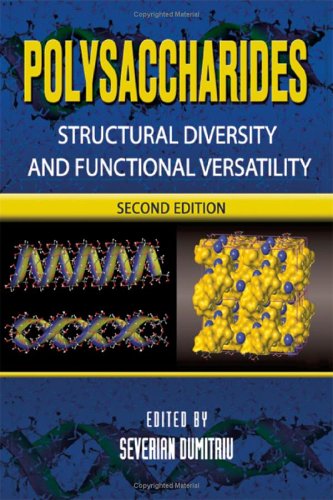
Polysaccharides Structural Diversity and Functional Versatility 2nd Edition by Severian Dumitriu 1040063101 9781040063101


Original price was: $50.00.$35.00Current price is: $35.00.
Polysaccharides Structural Diversity and Functional Versatility 2nd Edition by Severian Dumitriu – Ebook PDF Instant Download/Delivery: 1040063101, 9781040063101
Full download Polysaccharides Structural Diversity and Functional Versatility 2nd Edition after payment
Product details:
ISBN 10: 1040063101
ISBN 13: 9781040063101
Author: Severian Dumitriu
Completely revised and expanded to reflect the latest advancements in the field, Polysaccharides: Structural Diversity and Functional Versatility, Second Edition outlines fundamental concepts in the structure, function, chemistry, and stability of polysaccharides and reveals new analytical techniques and applications currently impacting the cosmetic, medicinal, chemical, and biochemical industries. The authoritative book discusses polysaccharides utilized in medical applications such as polysaccharide-based hydrogels, polysialic acids, proteoglycans, glycolipids, and anticoagulant polysaccharides; renewable resources for the production of various industrial chemicals and engineering plastics polysaccharides; and more.
Polysaccharides Structural Diversity and Functional Versatility 2nd Table of contents:
1. Progress in Structural Characterization of Functional Polysaccharides
I. Introduction
II. Strategy and Methods of Analysis
A. Structure of Monosaccharide and Disaccharide
B. Fundamentals of Small-Angle X-Ray Scattering
C. Fundamentals of Nuclear Magnetic Resonance Spectroscopy Applied to the Conformational Analysis
1. Chemical Shift
2. Relaxation Time
3. High-Resolution Solid State Nuclear Magnetic Resonance
4. Two-Dimensional Nuclear Magnetic Resonance
D. Molecular Modeling
1. Monte Carlo Method
2. Molecular Dynamics
III. Structural and Conformational Analysis of Oligosaccharides and Polysaccharides
A. (1→4)-α-D-Glucan Represented by Amylose
B. (1→4)-β-D-Glucan Represented by Cellulose
C. (1→3)-β-D-Glucan
D. Cyclic and Linear (1→2)-β-D-Glucan
IV. Supramolecular Structure of Polysaccharides in Solution and Gel
A. Thermotropic Liquid Crystal of Cellulose Derivatives
B. Supramolecular Structure in Xyloglucan Gel
C. Glycoconjugate Synthetic Polymer
Acknowledgments
References
2. Conformations, Structures, and Morphologies of Celluloses
I. Introduction
II. Cellulose and Its Cell Wall Environment
III. Chemical Structure of the Cellulose Macromolecule
IV. Crystallinity and Polymorphism of Cellulose
V. Crystalline Structures of Native Celluloses
A. Cellulose I
B. Celluloses Iα and Iβ
VI. Cellulose II
VII. Cellulose III
VIII. Cellulose IV
IX. Alkali Cellulose
X. Crystalline Microfibrils of Native Cellulose
A. Polarity of Cellulose Crystals
B. The Crystalline Morphology of Native Celluloses
C. Whiskers and Cellulose Microfibrils
XI. Surface Features of Celluloses
XII. Intermolecular Interactions
A. Congo Red
B. Benzophenone
C. Water
D. Lignin
XIII. Microfibril Organization
XIV. Conclusions
Acknowledgments
References
3. Hydrogen Bonds in Cellulose and Cellulose Derivatives
I. Hydrogen Bonds in Cellulose
A. Hydrogen Bonds in Cellulose Crystals
1. Hydrogen Bonds in Native Cellulose
2. Hydrogen Bonds in Cellulose II
B. Hydrogen Bonds in Regioselectively Substituted Cellulose Derivatives in Solid-State Noncrystalline Films
1. Characterization Using FT-IR and Solid-State CP/MAS 13C NMR Spectra
2. Influence of Substituent on the Hydrogen Bonding Formation
3. Assignment of “Free” Hydroxyl Groups in Cellulose
C. Hydrogen Bonds in Noncrystalline or Amorphous Cellulose
1. Noncrystalline Cellulose and Amorphous Cellulose
Difference Between the Real and the Artificial Spectra
2. Hydrogen-Bonded Domain in Amorphous Cellulose
D. The Relationship Between Intramolecular Hydrogen Bonds and Certain Physical Properties of Regioselectively Substituted Cellulose Derivatives
Solubility
Relative Reactivities of the Remaining OH Groups at the C-2 and C-3 Positions
Crystallinity
The Influence of Intramolecular Hydrogen Bonds on Handedness in Ethylcellulose/CH2CL2 Liquid Crystalline Mesophases
II. Conclusion
References
4. X-ray Diffraction Study of Polysaccharides
I. Introduction
II. X-Ray Structure Analysis
A. Sample Preparation
B. X-ray Fiber Diffraction Measurements
C. Refinement of Molecular and Crystal Structure
III. Molecular Conformations of Topical Polysaccharides
A. Polyaminosugars
1. Chitosan
A Spontaneous Water-Removing Action of the Type II Salts
The Crystalline Transformation of Chitosan
2. Polygalactosamine
B. (1→3)-β-D-Glucans
C. (1→3)-α-D-Glycans
1. (1→3)-α-D-Glucans
2. (1→3)-α-D-Mannan
D. Food Additives
1. Xanthan
2. Gellan
3. Beijeran
4. Konjac Glucomannan
IV. Recent Progress in Crystal Structure Studies on Cellulose Allomorphs
A. Cellulose I
B. Cellulose II
References
5. Recent Developments in Spectroscopic and Chemical Characterization of Cellulose
I. Introduction
Part A
II. Structures
III. New Spectroscopic Methods
A. Raman Spectroscopy
B. Solid-State 13C NMR Spectra and the Two Forms of Native Cellulose Iα and Iβ
IV. Further Studies of Structures in Cellulose
A. Raman and Infrared Spectra
B. Solid-State 13C NMR Spectra
C. Electron Microscopic Studies
V. Computational Modeling
VI. Polymorphy in Cellulose
VII. Chemical Implications of Structure
VIII. Cellulose Structures in Summary
Part B
I. Introduction
II. Solvents
III. Derivatization
A. Esterification
B. Etherification
IV. Oxidation
V. Degradation
A. Acid Hydrolysis
B. Enzymatic Degradation
C. Thermal Degradation
VI. Chemical and Enzymatic Syntheses of Cellulose
References
6. Two-Dimensional Fourier Transform Infrared Spectroscopy Applied to Cellulose and Paper
I. Infrared Spectroscopy for Wood and Cellulose Research
II. Two-Dimensional Fourier Transform Infrared Spectroscopy
III. Two-Dimensional Fourier Transform Infrared Spectroscopy Applied To Cellulose
A. Orientation Aspects
B. Load Distribution
C. Hydrogen Bonding
1. General Remarks
2. Hydrogen Bonding in Cellulose
D. Crystal Structure
IV. Two-Dimensional Fourier Transform Infrared Spectroscopy Applied To Pulps
A. Hemicellulose Interaction
1. Characteristic Vibrations
2. Holocellulose
3. Softwood Pulps
4. Interaction Between Fibers
5. Hardwood Pulps
B. Lignin Interaction
C. Moisture Effects
V. Future Developments
References
7. Light Scattering from Polysaccharides
I. Introduction
II. Basic Relationships
A. Static Light Scattering. Some General Remarks
B. The Particle Scattering Factor P(θ)
1. Origin of the Angular Dependence
2. Behavior of the Particle Scattering Factors of Selected Examples
3. Zimm Plots
4. Modified Zimm Plots (Berry and Guinier Modifications)
C. Dynamic Light Scattering
1. Some Properties of Time Correlation Functions in Dynamic Light Scattering
2. Hydrodynamic Radius and Rho-Parameter
3. Dynamic Zimm Plot
III. Dilute Solution Properties of Polysaccharides
A. Grouping Into Various Classes
B. Homopolysaccharides
1. Cellulose
2. Amylose
C. Microbial Polysaccharides of Well-Defined Repeating Units
1. Xanthan
2. Exopolysaccharides from Pseudomonas Elodea (Gellan) and Rhizobia Leguminosarum
3. Surface Polysaccharides from Mammalian Invasive Bacteria
4. Bacterial Cellulose and Triple Helix Forming β(1,3) Glucans
5. Pullulan
D. Microbial Polysaccharides of Higher Heterogeneity
1. Exopolysaccharides From Red Algae
2. Fructans of the Inulin and Levan Type
3. Dextran
E. Polysaccharides from Eukaryotic Cells
1. Some General Remarks
2. Starch
3. Pectin
4. Hemicellulose of Xylan Type
5. Polysaccharides as Thickeners
6. Hyaluronic Acid (Hyaluronan)
IV. Conclusion
Acknowledgments
References
8. Advances in Characterization of Polysaccharides in Aqueous Solution and Gel State
Abstract
I. Introduction
II. Polyelectrolyte Characterization and Conformational Transition
III. Semirigid Chain Characterization and Conformation
IV. Steric Exclusion Chromatography Analysis
V. Rheology of Polysaccharide Solution
A. Flow Behavior
B. Dynamic Measurements
VI. Mechanism of Gelation and Gel Behavior Characterization
VII. Role of the Chemical Structure on the Properties
VIII. Conclusion
References
9. Conformational and Dynamics Aspects of Polysaccharide Gels by High-Resolution Solid-State NMR
I. Introduction
II. Nuclear Magnetic Resonance Approaches To Characterize Conformation and Dynamics of Gel Networks
A. Dynamics
B. Conformational Characterization
III. Distinction of Single/Multiple Chains By Mutual Conversion Among Polymorphs
A. (1 →3)-β-D-Glucans
B. (1→4)-α-D-Glucans
IV. Network Structures, Gelation Mehanism, and Dynamic Feature
A. (1→3)-h-D-Glucans
B. (1 →4)-α-D-Glucans
C. Agarose and Carrageenans
V. Concluding Remarks
Acknowledgments
References
10. Correlating Structural and Functional Properties of Lignocellulosics and Paper by Fluorescence Spectroscopy and Chemometrics
Summary
I. Introduction and Background
II. Methods: “the Affluence Approach”
III. Results
A. Delignification Processes
B. Product Characterization
C. Paper Aging
IV. Concluding Remarks
References
People also search for Polysaccharides Structural Diversity and Functional Versatility 2nd:
structural diversity of polysaccharides
types of structural polysaccharides
structural polysaccharides examples
polysaccharide structure diagram
polysaccharide structures
Tags: Polysaccharides, Structural Diversity, Functional Versatility, Severian Dumitriu