

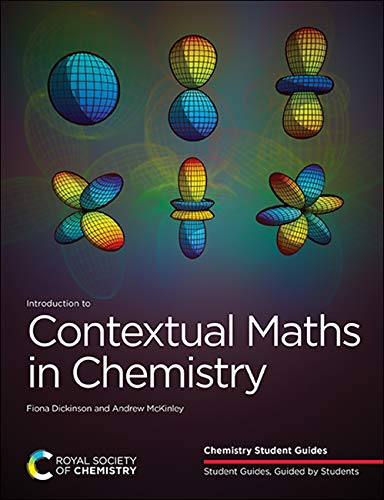
Introduction to Contextual Maths in Chemistry 1st Edition by Fiona Dickinson, Andrew McKinley 9781839164163 1839164166


Original price was: $50.00.$35.00Current price is: $35.00.
Introduction to Contextual Maths in Chemistry 1st Edition by Fiona Dickinson, Andrew McKinley – Ebook PDF Instant Download/Delivery:9781839164163, 1839164166
Full download Introduction to Contextual Maths in Chemistry 1st Edition after payment
Product details:
ISBN 10: 1839164166
ISBN 13: 9781839164163
Author: Fiona Dickinson, Andrew McKinley
CHEMISTRY STUDENT GUIDES. GUIDED BY STUDENTS For any student who has ever struggled with a mathematical understanding of chemistry, this book is for you. Mathematics is the essential tool for physical scientists. We know that confidence in using mathematics early on in a chemistry degree builds a solid foundation for further study. However, applying the abstract mathematics taught in schools to chemical phenomena is one of the biggest challenges that chemistry students face. In this book, we take a ‘chemistry-first’ approach. We link the mathematics to recognisable chemical concepts, building on high school chemistry, to facilitate deeper understanding. We cover the practical mathematical skills, including representation of data as tables and graphs, and give an overview of error handling in the physical sciences. More advanced mathematical concepts are introduced, using calculus to determine kinetic rate laws, intermolecular forces and in quantifying energetic change in thermodynamics. We also introduce the concept of the complex number and its role in considering quantum wave functions, widely used in computational chemistry. There are worked examples and problem sets to provide plenty of practise material to build proficiency. We also include insights from real students, which identify common problem areas and provide the prompts that helped them to overcome these. Chemistry Student Guides are written with current students involved at every stage, guiding the books towards the most challenging aspects of the topic.
Introduction to Contextual Maths in Chemistry 1st Table of contents:
Chapter 1 – The Basics: Mathematical Functions, Rearranging Equations and Handling Units
1.1 Reversible Reactions, Reversible Mathematics
1.2 An Introduction to Mathematical Operations
1.2.1 Powers, Roots, Exponentials and Logarithms
1.2.2 Power Functions
1.2.3 Roots: The Inverse Power Function
1.2.4 Exponential Functions
1.2.5 Logarithms: The Inverse Exponential Function
1.2.6 Logarithms in a Chemical Context
1.3 Treating Both Sides Fairly: The Nature of Equality
1.3.1 The Application of Inverse Functions
1.3.2 The Arrhenius Equation
1.4 Dimensional Analysis
1.4.1 Base Units and Derived Units
1.4.2 Congruence of Units
1.4.3 Scaling Factors; SI and Non-SI
1.5 Interconverting Units
1.6 Summary
Solutions to Exercises
Chapter 2 – Probability and Statistics in Chemistry
2.1 Probability in Chemical Kinetics
2.2 Flipping Coins, Filling Reactions
2.2.1 Dependence of Events
2.2.2 Calculations of Chemical Systems: Stirling’s Approximation
2.3 Standard Distributions and Standard Deviations
2.3.1 Distribution of Data
2.3.2 The ‘Standard’ Distribution
2.3.3 The Standard Deviation
2.3.4 Using the Standard Deviation
2.4 Summary
Solutions to Exercises
Chapter 3 – Experimental Uncertainty and Significant Figures: What Are the Bounds of Experimental Error
3.1 Accuracy and Precision
3.1.1 Random and Systematic Error
3.2 Managing Significant Figures
3.2.1 Combining Significant Figures
3.3 The Standard Error
3.4 Combining Uncertainties
3.5 Identifying Outliers in a Single Data Series
3.5.1 Dixon’s Test
3.5.2 Grubbs’ Test
3.6 Comparing Data Series—Student’s t Test
3.7 Summary
Solutions to Exercises
Chapter 4 – Tables and Graphs—Presenting and Analysing Experimental Data
4.1 Recording Data
4.1.1 Presenting Data in Tables
4.1.2 Presenting Data on Graphs
4.2 Straight-line Graphs: ‘y = mx + c’
4.2.1 Putting Quantities on the Correct Axes
4.2.2 Graphs of the Form ‘y = mx + c’
4.2.3 Graphs of Non-linear Functions—Rearranging Equations to Fit the Form ‘y = mx + c’
4.3 Determining Gradients and Intercepts
4.4 Uncertainties in Straight-line Graphs
4.4.1 Uncertainties in the Trendline: The Gradient
4.5 Plotting Experimental Data
4.6 Summary
Solutions to Exercises
Chapter 5 – Trigonometry and Coordinate Systems: Describing Molecular Positions
5.1 Determination of Molecular Distances
5.1.1 Elements of Trigonometry: Angular Measurement
5.1.2 Elements of Trigonometry: The Triangle
5.1.3 Elements of Trigonometry: The Right-angled Triangle
5.1.4 Elements of Trigonometry: SOH-CAH-TOA
5.1.5 In Context: Contact Angles at Interfaces
5.2 Molecular Geometry: Molecular Spectroscopy
5.2.1 Double-angle Formulae
5.3 Coordinate Systems
5.3.1 Cartesian (x, y, z) Coordinates
5.3.2 Polar (r, ϕ, u) Coordinates
5.3.3 Consistency in Converting Polar to Cartesian Coordinates
People also search for Introduction to Contextual Maths in Chemistry 1st :
explain how mathematics is used in chemistry
introduction to chemistry math and science
introduction to contemporary math
contextual maths in chemistry pdf
introduction to contemporary mathematics
Tags:
Fiona Dickinson,Andrew McKinley,Contextual