

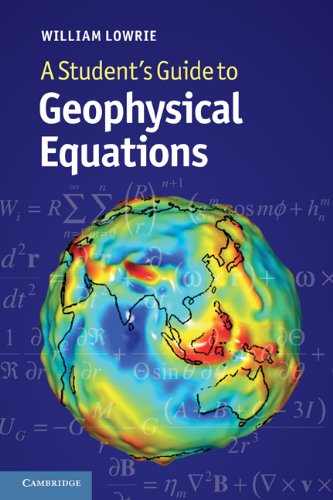
A Student s Guide to Geophysical Equations 1st Edition by William Lowrie 0521183774 9780521183772

Original price was: $50.00.$35.00Current price is: $35.00.
A Student s Guide to Geophysical Equations 1st Edition by William Lowrie – Ebook PDF Instant Download/DeliveryISBN: 0521183774, 9780521183772
Full download A Student s Guide to Geophysical Equations 1st Edition after payment
Product details:
ISBN 10: 0521183774
ISBN 13: 9780521183772
Author: William Lowrie
The advent of accessible student computing packages has meant that geophysics students can now easily manipulate datasets and gain first-hand modeling experience – essential in developing an intuitive understanding of the physics of the Earth. Yet to gain a more in-depth understanding of physical theory, and to develop new models and solutions, it is necessary to be able to derive the relevant equations from first principles. This compact, handy book fills a gap left by most modern geophysics textbooks, which generally do not have space to derive all of the important formulae, showing the intermediate steps. This guide presents full derivations for the classical equations of gravitation, gravity, tides, earth rotation, heat, geomagnetism and foundational seismology, illustrated with simple schematic diagrams. It supports students through the successive steps and explains the logical sequence of a derivation – facilitating self-study and helping students to tackle homework exercises and prepare for exams.
A Student s Guide to Geophysical Equations 1st Table of contents:
1 Mathematical background
1.1 Cartesian and spherical coordinates
1.2 Complex numbers
1.3 Vector relationships
1.4 Matrices and tensors
1.5 Conservative force, field, and potential
1.6 The divergence theorem (Gauss’s theorem)
1.7 The curl theorem (Stokes’ theorem)
1.8 Poisson’s equation
1.9 Laplace’s equation
1.10 Power series
1.11 Leibniz’s rule
1.12 Legendre polynomials
1.13 The Legendre differential equation
1.14 Rodrigues’ formula
1.15 Associated Legendre polynomials
1.16 Spherical harmonic functions
1.17 Fourier series, Fourier integrals, and Fourier transforms
Further reading
2 Gravitation
2.1 Gravitational acceleration and potential
2.2 Kepler’s laws of planetary motion
2.3 Gravitational acceleration and the potential of a solid sphere
2.4 Laplace’s equation in spherical polar coordinates
2.5 MacCullagh’s formula for the gravitational potential
Further reading
3 Gravity
3.1 The ellipticity of the Earth’s figure
3.2 The geopotential
3.3 The equipotential surface of gravity
3.4 Gravity on the reference spheroid
3.5 Geocentric and geographic latitude
3.6 The geoid
Further reading
4 The tides
4.1 Origin of the lunar tide-raising forces
4.2 Tidal potential of the Moon
4.3 Love’s numbers and the tidal deformation
4.4 Tidal friction and deceleration of terrestrial and lunar rotations
Further reading
5 Earth’s rotation
5.1 Motion in a rotating coordinate system
5.2 The Coriolis and Eötvös effects
5.3 Precession and forced nutation of Earth’s rotation axis
5.4 The free, Eulerian nutation of a rigid Earth
5.5 The Chandler wobble
Further reading
6 Earth’s heat
6.1 Energy and entropy
6.2 Thermodynamic potentials and Maxwell’s relations
6.3 The melting-temperature gradient in the core
6.4 The adiabatic temperature gradient in the core
6.5 The Grüneisen parameter
6.6 Heat flow
Further reading
7 Geomagnetism
7.1 The dipole magnetic field and potential
7.2 Potential of the geomagnetic field
7.3 The Earth’s dipole magnetic field
7.4 Secular variation
7.5 Power spectrum of the internal field
7.6 The origin of the internal field
Further reading
8 Foundations of seismology
8.1 Elastic deformation
8.2 Stress
8.3 Strain
8.4 Perfectly elastic stress–strain relationships
8.5 The seismic wave equation
8.6 Solutions of the wave equation
8.7 Three-dimensional propagation of plane P- and S-waves
People also search for A Student s Guide to Geophysical Equations 1st:
a student’s guide to maxwell’s equations
a student’s guide to waves
a student’s guide to geophysical equations
geoscience study guide
geophysics study
Tags: A Student s Guide, Geophysical Equations, William Lowrie, accessible student