

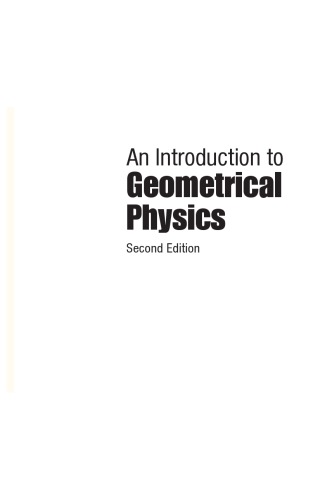
An Introduction to Geometrical Physics 2nd Edition by Aldrovandi, Pereira 9789813146839 9813146834


Original price was: $50.00.$35.00Current price is: $35.00.
An Introduction to Geometrical Physics 2nd Edition by Aldrovandi, Pereira – Ebook PDF Instant Download/Delivery:
9789813146839, 9813146834
Full download An Introduction to Geometrical Physics 2nd Edition after payment
Product details:
ISBN 10: 9813146834
ISBN 13: 9789813146839
Author: Aldrovandi, Pereira
This book focuses on the unifying power of the geometrical language in bringing together concepts from many different areas of physics, ranging from classical physics to the theories describing the four fundamental interactions of Nature — gravitational, electromagnetic, strong nuclear, and weak nuclear.The book provides in a single volume a thorough introduction to topology and differential geometry, as well as many applications to both mathematical and physical problems. It is aimed as an elementary text and is intended for first year graduate students.In addition to the traditional contents of books on special and general relativities, this book discusses also some recent advances such as de Sitter invariant special relativity, teleparallel gravity and their implications in cosmology for those wishing to reach a higher level of understanding.
An Introduction to Geometrical Physics 2nd Table of contents:
Part 1: MANIFOLDS
General Topology
Introductory remarks
Topological spaces
Kinds of texture
Functions
Quotients and groups
Homology
Introductory remarks
Graphs
Graphs, first way
Graphs, second way
The first topological invariants
Simplexes, complexes and all that
Topological numbers
Final remarks
Homotopy
General homotopy
Path homotopy
Homotopy of curves
The fundamental group
Some examples
Covering spaces
Multiply-connected spaces
Riemann surfaces
Higher homotopy
Manifolds and Charts
Manifolds
Topological manifolds
Dimensions, integer and other
Charts and coordinates
Differentiable Manifolds
Definition and overlook
Smooth functions
Differentiable submanifolds
Part 2: DIFFERENTIABLE STRUCTURE
Tangent Structure
Introduction
Tangent spaces
Tensors on manifolds
Fields and transformations
Frames
Metric and riemannian manifolds
Differential Forms
Introduction
Exterior derivative
Vector-valued forms
Duality and coderivation
Integration and homology
Integration
Cohomology of differential forms
Algebras, endomorphisms and derivatives
Symmetries
Lie groups
Transformations on manifolds
Lie algebra of a Lie group
The adjoint representation
Fiber Bundles
Introduction
Vector bundles
The bundle of linear frames
Structure group
Soldering
Orthogonal groups
Reduction
Tetrads
Linear connections
Principal bundles
General connections
Bundle classification
Part 3: NATURE’S EXTREME GEOMETRIES
Quantum Geometry
Quantum goups: a pedestrian outline
Noncommutative geometry
Cosmology: the Standard Model
The geometrical perspective
The physical content
The cosmos curvature
Planck Scale Kinematics
Part 4: MATHEMATICAL TOPICS
The Basic Algebraic Structures
Some general concepts
Groups and lesser structures
Rings, ideals and fields
Modules and vector spaces
Algebras
Coalgebras
Discrete Groups: Braids and Knots
Discrete groups
Words and free groups
Presentations
Cyclic groups
The group of permutations
Braids
Geometrical braids
Braid groups
Braids in everyday life
Braids presented
Braid statistics
Direct product representations
The Yang–Baxter equation
Knots and links
Knots
Links
Knot groups
Links and braids
Invariant polynomials
Sets and Measures
Measure spaces
The algebra of subsets
Measurable space
Borel algebra
Measure and probability
Partition of identity
Riemannian metric
Measure and integration
Ergodism
Types of flow
The ergodic problem
Topological Linear Spaces
Inner product space
Norm
Normed vector spaces
Hilbert space
Banach space
Topological vector spaces
Function spaces
Banach Algebras
Quantization
Banach algebras
-algebras and C-algebras
From geometry to algebra
von Neumann algebras
The Jones polynomials
Representations
Introductory remarks
Linear representations
Regular representation
Fourier expansions
Variations and Functionals
Curves
Variation of a curve
Variation fields
Path functionals
Functional differentials
Second variation
General functionals
Functionals
Linear functionals
Operators
Derivatives: Fréchet and Gateaux
Functional Forms
Introductory remarks
Exterior variational calculus
Lagrangian density
Variations and differentials
The action functional
Variational derivative
Euler forms
Higher order forms
Relation to operators
Continuum Einstein convention
Existence of a lagrangian
Inverse problem of variational calculus
Helmholtz–Vainberg theorem
Equations with no lagrangian
Building lagrangians
The homotopy formula
Examples
Symmetries of equations
Final remarks
Singular Points
Index of a curve
Index of a singular point
Relation to topology
Basic two-dimensionals singularities
Critical points
Morse lemma
Morse indices and topology
Catastrophes
Euclidean Spaces and Subspaces
Introductory remarks
Structure equations
Moving frames
The Cartan lemma
Adapted frames
Second quadratic form
First quadratic form
Riemannian structure
Curvature
Connection
Gauss, Ricci and Codazzi equations
Riemann tensor
Geometry of surfaces
Gauss theorem
Relation to topology
The Gauss–Bonnet theorem
The Chern theorem
Non-Euclidean Geometries
The age-old controversy
The curvature of a metric space
The spherical case
The Boliyai–Lobachevsky case
On the geodesic curves
The Poincaré space
Geodesics
Introductory remarks
Self-parallel curves
In General Relativity
In optics
The absolute derivative
Self-parallelism
Complete spaces
Fermi transport
Congruences
Jacobi equation
Vorticity, shear and expansion
Landau–Raychaudhury equation
Part 5: PHYSICAL TOPICS
Hamiltonian Mechanics
Introduction
Symplectic structure
Time evolution
Canonical transformations
Phase spaces as bundles
The algebraic structure
Relations between Lie algebras
Liouville integrability
More Mechanics
Hamilton–Jacobi
Hamiltonian structure
Hamilton–Jacobi equation
The Lagrange derivative
The Lagrange derivative as a covariant derivative
The rigid body
Frames
The configuration space
The phase space
Dynamics
The “space” and the “body” derivatives
The reduced phase space
Moving frames
The rotation group
Left- and right-invariant fields
The Poinsot construction
Symmetries on Phase Space
Symmetries and anomalies
The Souriau momentum
The Kirillov form
Integrability revisited
Classical Yang–Baxter equation
Statistics and Elasticity
Statistical mechanics
Introduction
General overview
Lattice models
The Ising model
Spontaneous breakdown of symmetry
The Potts model
Cayley trees and Bethe lattices
The four-color problem
Elasticity
Regularity and defects
Classical elasticity
Nematic systems
The Franck index
Propagation of Discontinuities
Characteristics
Partial differential equations
Maxwell’s equations in a medium
The eikonal equation
Geometrical Optics
Introduction
The light-ray equation
Hamilton’s point of view
Relation to geodesics
The Fermat principle
Maxwell’s fish-eye
Fresnel’s ellipsoid
Classical Relativistic Fields
The fundamental fields
Spacetime transformations
The Poincaré group
The basic cases
Internal transformations
Lagrangian formalism
The Euler–Lagrange equation
First Noether’s theorem
Minimal coupling prescription
Local phase transformations
Second Noether’s theorem
Gauge Fields: Fundamentals
Introductory remarks
The gauge tenets
Electromagnetism
Non-abelian theories
The gauge prescription
Hamiltonian approach
Exterior differential formulation
Functional differential approach
Functional forms
People also search for An Introduction to Geometrical Physics 2nd:
an introduction to geometry
introduction to geometric optics
an introduction to physics
an introduction to physical geology
an introduction to geometric topology
Tags:
Introduction,Geometrical Physics,Aldrovandi,Pereira