

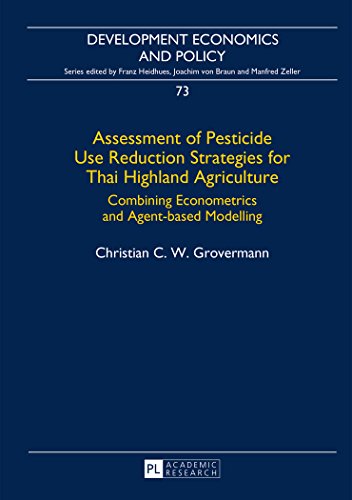
Assessment of Pesticide Use Reduction Strategies for Thai Highland Agriculture Combining Econometrics and Agent based Modelling 1st Edition by Christian Grovermann ISBN 3631657846 9783631657843

Original price was: $50.00.$35.00Current price is: $35.00.
Assessment of Pesticide Use Reduction Strategies for Thai Highland Agriculture Combining Econometrics and Agent based Modelling 1st Edition by Christian Grovermann – Ebook PDF Instant Download/Delivery: 3631657846, 9783631657843
Full download Assessment of Pesticide Use Reduction Strategies for Thai Highland Agriculture Combining Econometrics and Agent based Modelling 1st Edition after payment
Product details:
ISBN 10: 3631657846
ISBN 13: 9783631657843
Author: Christian Grovermann
This study combines econometrics and agent-based modelling to evaluate the impacts of a range of pesticide use reduction strategies in the context of Thai highland agriculture. Pesticide productivity and pesticide overuse are quantified, while determinants of the adoption of innovations in pesticide use reduction are estimated. On that basis, the Mathematical Programming-based Multi Agent System (MPMAS), a bio-economic simulation model, is used to ex-ante assess the adoption of Integrated Pest Management (IPM) in combination with a series of market-based instruments that boost the transition to more sustainable pest control practices. The MPMAS simulation results demonstrate that, over five years, it is possible to bring down levels of pesticide use significantly without income trade-offs for farm agents. A proportional tax, increasing the price of synthetic pesticides by 50% on average, together with bio-pesticide subsidies for IPM proves to be the most cost-effective and practicable policy package. IPM practices are adopted by up to 75% of farm agents and pesticide use reductions reach up to 34%.
Table of contents:
Cover
Title
Copyright
About the author(s)/editor(s)
About the book
This eBook can be cited
Acknowledgements
Summary
Zusammenfassung
Table of Contents
List of Tables
List of Figures
Abbreviations
1. Introduction
1.1 Problem statement
1.2 State of the art and research gaps
1.2.1 Optimal pesticide use and pesticide overuse
1.2.2 Diffusion and adoption of innovations to reduce pesticide use
1.2.3 Assessment of pesticide use reductions
1.3 Research objectives
1.4 Pesticide policy background
1.5 Structure of the thesis
2. Materials
2.1 Study area selection and data collection
2.2 Farm characteristics in the study area
2.3 Land-use in the study area
2.3.1 Description of cropping patterns
2.3.2 Categorisation and selection of land-uses
2.4 Pest pressure, pest management and pesticide use in the study area
2.5 Vegetable IPM, the Royal Project and sustainable intensification
3. Methods
3.1 Quantification of pesticide productivity and pesticide overuse from farmer as well as from societal points of view
3.1.1 Conceptual frame
3.1.2 Specification of the production functions
3.1.3 Econometric estimation of pesticide productivity
3.1.4 Quantification of the external costs of pesticide use
3.2 Innovation diffusion and adoption probabilities
3.2.1 Agricultural technologies and the theory of innovation diffusion
3.2.2 Specification of the adoption regression model
3.2.3 Innovativeness ranking and categorisation
3.2.4 Econometric estimation of adoption probabilities
3.3 Model description of the MPMAS Mae Sa watershed application
3.3.1 The methodological context of MPMAS
3.3.2 Model set-up and dynamics
3.3.3 Asset allocation to create the agent population
3.3.4 Random spatial allocation of plots and other spatial inputs
3.3.5 The decision-making component
3.3.6 Investment objects and innovation diffusion
3.3.7 Innovativeness ranking and adopter categorisation of agents
3.3.8 Perennial crops
3.3.9 Crop water demand and yields
3.3.10 Irrigation water supply
3.3.11 Farmgate selling, input prices and other input data
3.3.12 Tax collection and compensation payments
3.3.13 SWAT-based pesticide use constraints – chlorothalonil and cypermethrin
3.4 Scenario specifications of simulation experiments
3.4.1 Pesticide taxes
3.4.2 IPM access and pesticide taxes
3.4.3 IPM access and adoption incentives
3.4.4 Policy mixes
3.4.5 SWAT-based pesticide use regulation scenarios
4. Model verification and validation
4.1 Verification of asset allocations
4.2 Validation of outcome variables
4.3 Testing of innovation diffusion and adoption process
5. Results
5.1 Private and social levels of optimal pesticide use and overuse
5.2 Adoption of GAP standard
5.3 Simulation experiments
5.3.1 The baseline scenario
5.3.2 Impact of tax interventions
5.3.3 Impact of IPM adoption with and without pesticide taxes
5.3.4 Impact of IPM adoption with adoption incentives
5.3.5 Impact of intervention mixes
5.3.6 SWAT-based reductions scenarios for chlorothalonil and cypermethrin
5.4 Key lessons learned for policy-making
6. Discussion and conclusion
6.1 Strength and weaknesses of the econometric analysis
6.2 Strength and weaknesses of the MPMAS application
6.3 Implications for pesticide policy-making
References
Annex
Annex I: Percentage of IPM adopters in the agent population
Annex II: Flat tax for 3 selected scenarios + 2 additional scenarios with higher tax rates
Annex III: Land-use shares in the different scenarios
Annex IV: Segmented cumulative distribution functions for innovativeness determinants
Annex V: Selected spatial inputs
People also search for:
assessment of pesticide use reduction
assessment i – pesticides & herbicides an introduction
reducing pesticide use in agriculture
reducing pesticide use
assessment group on glyphosate
Tags: Christian Grovermann, Assessment, Pesticide, Reduction, Strategies, Thai, Highland, Agriculture, Econometrics, Agent Based, Modelling