

Sale!
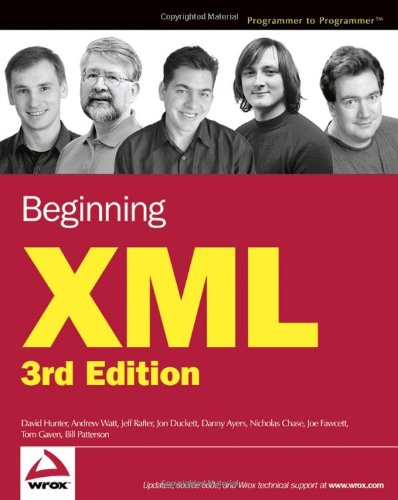
Beginning XML 3rd Edition by David Hunter, Andrew Watt, Jeff Rafter, Jon Duckett, Danny Ayers, Nicholas Chase, Joe Fawcett, Tom Gaven, Bill Patterson ISBN 0764570773 9780764570773

Original price was: $50.00.$35.00Current price is: $35.00.
Beginning XML 3rd Edition David Hunter Digital Instant Download
ISBN(s): 9780764570773, 0764570773
Edition: 3
File Details: PDF, 8.15 MB
Year: 2004
Language: english
Beginning XML 3rd Edition by David Hunter, Andrew Watt, Jeff Rafter, Jon Duckett, Danny Ayers, Nicholas Chase, Joe Fawcett, Tom Gaven, Bill Patterson – Ebook PDF Instant Download/Delivery: 0764570773, 9780764570773
Full download Beginning XML 3rd Edition after payment
Product details:
ISBN 10: 0764570773
ISBN 13: 9780764570773
Author: David Hunter, Andrew Watt, Jeff Rafter, Jon Duckett, Danny Ayers, Nicholas Chase, Joe Fawcett, Tom Gaven, Bill Patterson
Beginning XML 3rd Table of contents:
Part I: Understanding XML
- Chapter 1: Introducing XML
- What is XML? Why is it important?
- XML vs. HTML: Key differences and similarities.
- The XML family of technologies.
- Basic XML document structure (elements, attributes).
- A simple XML example.
- Chapter 2: Well-Formed XML
- Rules for creating well-formed XML documents.
- Elements, attributes, comments, processing instructions.
- CDATA sections.
- Entity references (predefined, numeric, custom).
- Chapter 3: Valid XML and DTDs
- Introduction to document validity.
- What is a DTD (Document Type Definition)?
- Declaring elements, attributes, entities, and notations in DTDs.
- Internal vs. external DTDs.
- Pros and cons of DTDs.
- Chapter 4: XML Schemas
- Limitations of DTDs.
- Introduction to XML Schema (XSD).
- Defining elements, attributes, complex types, simple types.
- Namespaces in XML Schema.
- Validation with XML Schema.
- Comparison of DTDs and Schemas.
Part II: Working with XML Data
- Chapter 5: Parsers and Parsing XML
- The role of XML parsers.
- SAX (Simple API for XML): Event-driven parsing.
- DOM (Document Object Model): Tree-based parsing.
- Choosing the right parser for your needs.
- Chapter 6: XML Namespaces
- Why namespaces are needed.
- Declaring and using namespaces.
- Default namespaces.
- Namespace scope.
- Chapter 7: XML and Data
- XML as a data format.
- Structuring data in XML.
- Designing XML vocabularies.
- Best practices for data-centric XML.
Part III: Transforming and Presenting XML
- Chapter 8: Introducing XSLT
- What is XSLT (Extensible Stylesheet Language Transformations)?
- The concept of transforming XML to XML, HTML, or text.
- Basic XSLT stylesheet structure.
- Templates, match patterns.
- Chapter 9: XSLT: Advanced Transformations
- Variables and parameters.
- Conditionals (if, choose).
- Looping (for-each).
- Keys and Muenchian grouping.
- Sorting, numbering.
- Working with multiple XML documents.
- Chapter 10: XPath
- What is XPath?
- Node types.
- Location paths (absolute, relative).
- Axes, predicates.
- XPath functions.
- Using XPath with XSLT.
- Chapter 11: XSL-FO (Formatting Objects)
- Introduction to XSL-FO for print-ready output.
- Basic XSL-FO constructs (page masters, regions, blocks).
- Generating PDFs from XML using XSL-FO.
- Chapter 12: CSS and XML
- Applying CSS to XML documents for display in browsers.
- Differences from CSS with HTML.
- Limitations and use cases.
Part IV: XML in Action (Programming and Applications)
- Chapter 13: XML with JavaScript and the DOM
- Parsing XML in the browser using JavaScript.
- Accessing and manipulating XML data with the DOM API.
- AJAX basics (though full AJAX would be more prominent in later editions).
- Chapter 14: XML and ASP.NET / C#
- Working with XML in .NET applications.
- XML classes in the .NET Framework (XmlDocument, XmlReader, XmlWriter, XslCompiledTransform).
- Data binding with XML.
- Chapter 15: XML and Java
- Parsing XML in Java (SAX, DOM).
- JAXP (Java API for XML Processing).
- XSLT transformations in Java.
- Other Java XML APIs.
- Chapter 16: XML and PHP
- Working with XML in PHP (DOM, SAX, SimpleXML).
- Generating and parsing XML.
- Chapter 17: XML and Databases
- Storing XML in relational databases.
- XML-enabled databases.
- Querying XML data (XPath, XQuery basics).
- Chapter 18: XML and Web Services (SOAP and WSDL)
- Introduction to web services.
- SOAP (Simple Object Access Protocol) for messaging.
- WSDL (Web Services Description Language) for service description.
- How XML underpins web services.
- Chapter 19: RSS and Syndication
- Understanding RSS (Really Simple Syndication).
- Creating and consuming RSS feeds.
- Other syndication formats (Atom).
Part V: Advanced Topics and Future Directions
- Chapter 20: XML Security
- XML Signatures.
- XML Encryption.
- Security considerations for XML applications.
- Chapter 21: XML and the Semantic Web (Introduction)
- Brief overview of the Semantic Web vision.
- RDF (Resource Description Framework).
- OWL (Web Ontology Language).
- Chapter 22: Emerging XML Technologies and Best Practices
- Looking ahead at the evolution of XML.
- Design patterns for XML.
- Common pitfalls and how to avoid them.
People also search for Beginning XML 3rd:
beginning xml
beginning xml 5th edition pdf
beginning xml pdf
beginning xml 5th edition
text xmldecl not at the beginning of input
Tags: David Hunter, Andrew Watt, Jeff Rafter, Jon Duckett, Danny Ayers, Nicholas Chase, Joe Fawcett, Tom Gaven, Bill Patterson, Beginning, XML