

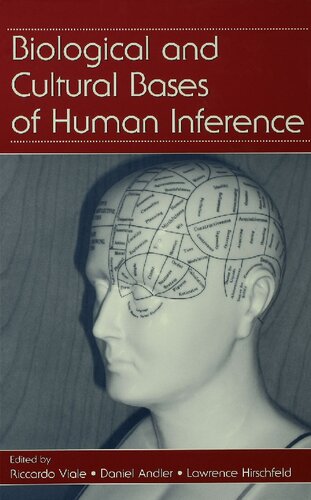
Biological and Cultural Bases of Human Inference 1st Edition by Riccardo Viale ISBN 1134812776 9781134812776

Original price was: $50.00.$35.00Current price is: $35.00.
Biological and Cultural Bases of Human Inference 1st Edition by Riccardo Viale – Ebook PDF Instant Download/Delivery: 1134812776, 9781134812776
Full download Biological and Cultural Bases of Human Inference 1st edition after payment
Product details:
ISBN 10: 1134812776
ISBN 13: 9781134812776
Author: Riccardo Viale
Biological and Cultural Bases of Human Inference addresses the interface between social science and cognitive science. In this volume, Viale and colleagues explore which human social cognitive powers evolve naturally and which are influenced by culture. Updating the debate between innatism and culturalism regarding human cognitive abilities, this book represents a much-needed articulation of these diverse bases of cognition.
Chapters throughout the book provide social science and philosophical reflections, in addition to the perspective of evolutionary theory and the central assumptions of cognitive science. The overall approach of the text is based on three complementary levels: adult performance, cognitive development, and cultural history and prehistory. Scholars from several disciplines contribute to this volume, including researchers in cognitive, developmental, social and evolutionary psychology, neuropsychology, cognitive anthropology, epistemology, and philosophy of mind.
This contemporary, important collection appeals to researchers in the fields of cognitive, social, developmental, and evolutionary psychology and will prove valuable to researchers in the decision sciences.
Biological and Cultural Bases of Human Inference 1st Table of contents:
1 Cognitive Development, Culture, and Inductive Judgment
Two Views of Intellectual Development
The Child as Scientist
Evidential Diversity
Reaction to the Experimental Data
A Probability Principle
Assessing Conformity To Ppp
Concluding Remarks
Acknowledgments
References
2 Culture and Point of View
Cognitive Differences
Causal Attribution and Prediction
Logic Versus Dialectics
Categorization
Attention and Perception Differences
Detection of Covariation
Field Dependence: Difficulty in Separating an Object From Its Surroundings
Attention to the Field
Change Blindness
“Affordances” in the Environment
Aesthetics East and West
Change Versus Stability
Perception of Everyday Life Events
Discussion
Acknowledgments
References
3 Cultural Variation in Reasoning
Study 1: Rule- Versus Exemplar-Based Category Learning
Study 2: Rule- Versus Family-Resemblance-Based Classification And Similarity Judgments
STUDY 3: Conceptual Structure Based On Logic Versus Typicality
Study 4: Logic Versus Belief In Deductive Reasoning
General Discussion
Conclusion: Cultural Variations In Reasoning
Acknowledgments
References
4 Thinking About Biology: Modular Constraints on Categorization and Reasoning in the Everyday Life of Americans, Maya, and Scientists
Four Points Of General Correspondence Between Folk Biology And Scientific Systematics
First Point
Second Point
Third Point
Fourth Point
Folk Biology Does Not Come From Folk Psychology: Experiment 1
Childhood Conceptions Of Species Essences: Experiment 2
Summary
Essence (Generic Species) Versus Appearance (Basic Levels) In Folk Biology: Experiment 3
Cultural And Expertise Effects In Taxonomic Inference
The General-Purpose Nature Of Folk-Biological Taxonomy
Science And Common Sense
Conclusion: Cultural Emergence In An Evolutionary Landscape
Acknowledgments
References
5 Who Needs a Theory of Mind?
Explaining People And Their Actions
Cognitive Architecture And Modes Of Construal
The “Natural” Objects of Intentions
Does The Autistic Child Have A Theory Of Society?
The Robustness Of Group Identity
The Invisibility of Groups
Conclusion
Acknowledgments
References
6 Framing and the Theory-Simulation Controversy: Predicting People’s Decisions
Theory Theory Versus Simulation Theory
A Brief History Of The Theory-Simulation Controversy: Two Important Points
The Framing Effect
The Method To Decide
Experiment 1: Payoff Size — A Case of Theory
Experiment 2: The Framing Effect—A Case of Simulation
Evaluation Of Experimental Results
Making Simulation Theory Testable
Acknowledgments
References
7 An Evolutionary Perspective on Testimony and Argumentation
Testimony
Argumentation
Conclusion
Acknowledgments
References
8 Normativity and Epistemic Intuitions
Intuition-Driven Romanticism And The Normativity Problem
Epistemic Romanticism and Intuition-Driven Romanticism
The Normativity Problem
Cultural Variation In Epistemic Intuitions
Nisbett and Haidt: Some Suggestive Evidence
Four Hypotheses
Some Experiments Exploring Cultural Variation in Epistemic Intuitions
Objections and Replies
What Is So Bad About Epistemic Relativism?
There Are Several Senses of Knowledge
The Effect Size We Found Is Small and Philosophically Uninteresting
We Are Looking at the Wrong Sort of Intuitions; The Right Sort Are Accompanied by a Clear Sense of Necessity
We Are Looking at the Wrong Sort of Intuitions; The Right Sort Require at Least a Modicum of Reflection
We Are Looking at the Wrong Sort of Intuitions; The Right Sort Are Those That Emerge After an Extended Period of Discussion and Reflection
Acknowledgments
References
Appendix
9 Probabilistic Reasoning and Natural Language
The Use And Understanding Of Conditional Probability
A Pragmatics Perspective: The Partitive Hypothesis
The Process of Estimating the Ratio Between Favorable and Possible Cases
Pragmatic Analysis Of The Problem
People also search for Biological and Cultural Bases of Human Inference 1st:
biological and cultural
biological and cultural diversity
biological and cultural changes
biology and culture are intertwined
a biological anthropologist interested in health and illness would study