

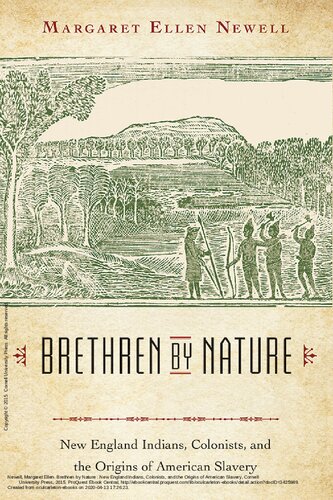
Brethren by Nature New England Indians Colonists and the Origins of American Slavery 1st Edition by Margaret Ellen Newell ISBN 0801434157 9780801434150


Original price was: $50.00.$35.00Current price is: $35.00.
Brethren by Nature New England Indians Colonists and the Origins of American Slavery 1st Edition by Margaret Ellen Newell – Ebook PDF Instant Download/Delivery: 0801434157, 9780801434150
Full download Brethren by Nature New England Indians Colonists and the Origins of American Slavery 1st Edition after payment
Product details:
ISBN 10: 0801434157
ISBN 13: 9780801434150
Author: Margaret Ellen Newell
In Brethren by Nature, Margaret Ellen Newell reveals a little-known aspect of American history: English colonists in New England enslaved thousands of Indians. Massachusetts became the first English colony to legalize slavery in 1641, and the colonists’ desire for slaves shaped the major New England Indian wars, including the Pequot War of 1637, King Philip’s War of 1675–76, and the northeastern Wabanaki conflicts of 1676–1749. When the wartime conquest of Indians ceased, New Englanders turned to the courts to get control of their labor, or imported Indians from Florida and the Carolinas, or simply claimed free Indians as slaves.Drawing on letters, diaries, newspapers, and court records, Newell recovers the slaves’ own stories and shows how they influenced New England society in crucial ways. Indians lived in English homes, raised English children, and manned colonial armies, farms, and fleets, exposing their captors to Native religion, foods, and technology. Some achieved freedom and power in this new colonial culture, but others experienced violence, surveillance, and family separations. Newell also explains how slavery linked the fate of Africans and Indians. The trade in Indian captives connected New England to Caribbean and Atlantic slave economies. Indians labored on sugar plantations in Jamaica, tended fields in the Azores, and rowed English naval galleys in Tangier. Indian slaves outnumbered Africans within New England before 1700, but the balance soon shifted. Fearful of the growing African population, local governments stripped Indian and African servants and slaves of legal rights and personal freedoms. Nevertheless, because Indians remained a significant part of the slave population, the New England colonies did not adopt all of the rigid racial laws typical of slave societies in Virginia and Barbados. Newell finds that second- and third-generation Indian slaves fought their enslavement and claimed citizenship in cases that had implications for all enslaved peoples in eighteenth-century America.
Table of contents:
-
“Davids warre”: The Pequot War and the Origins of Slavery in New England
-
“I doe not see how wee can thrive untill wee gett into a stock of slaves”: Slavery in the Puritan Atlantic World
-
“Indians we have received into our houses”: Pequot War Captives in New England Households
-
“Such a servant is part of her Master’s estate”: Acculturation, Resistance, and the Making of a Hybrid Society
-
“An Indian to help in the work”: The Importance of Indian Labor in the New England Economy
-
“We sold … 47 Indians, young and old for 80£. in money”: Enslavement in King Philip’s War
-
“As good if not better then the Moorish Slaves”: Law, Slavery, and the Second Native Diaspora
-
“Free men subjects to the king”: The Search for Enslavable Indians in the Northeast and Southeast
-
To be sold “in any part of ye kings Dominyons”: Judicial Enslavement of New England Indians
People also search for:
brethren by nature new england
brethren by nature
brethren home new oxford
brethren national conference
brethren home new oxford pennsylvania
brethren home new oxford pa
Tags: Margaret Ellen Newell, Brethren by Nature, New England Indians, Colonists, Origins, American Slavery