

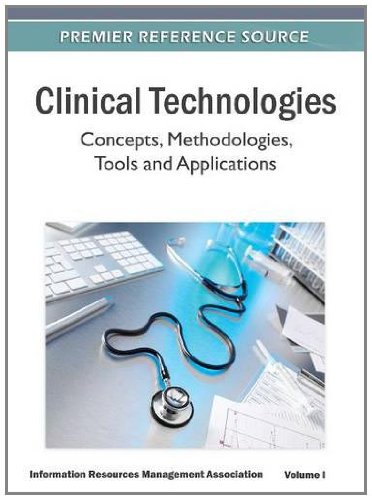
Clinical Technologies Concepts Methodologies Tools and Applications 3 Volume Set 1st Edition by Information Resources Management Association 9781609605612 1609605616


Original price was: $50.00.$35.00Current price is: $35.00.
Clinical Technologies Concepts Methodologies Tools and Applications 3 Volume Set 1st Edition by Information Resources Management Association – Ebook PDF Instant Download/Delivery: 9781609605612, 1609605616
Full download Clinical Technologies Concepts Methodologies Tools and Applications 3 Volume Set 1st Edition after payment
Product details:
ISBN 10: 1609605616
ISBN 13: 9781609605612
Author: Information Resources Management Association
Modern technological advances in medicine are not restricted to treatments, but rather have revolutionized the entire application of healthcare from finding a doctor to executing a treatment. Clinical Technologies: Concepts, Methodologies, Tools and Applications provides an exhaustive chronicling of these changes through the compiled research of hundreds of scholars. This multi-volume book delves into the many applications of information technology ranging from digitizing patient records to high-performance computing, to medical imaging and diagnostic technologies. Technological advancements have begun turning potential breakthroughs into established applications across the field of healthcare, as demonstrated by these volumes. The importance of healthcare cannot be overstated, making this work vital to everyone involved in creating the future of medicine.
Clinical Technologies Concepts Methodologies Tools and Applications 3 Volume Set 1st Table of contents:
Volume I
Section I. Fundamental Concepts and Theories
Chapter 1.1. The Implementation of Innovative Technologies in Healthcare: Barriers and Strategies
Chapter 1.2. Risks and Benefits of Technology in Health Care
Chapter 1.3. The Effectiveness of Health Informatics.
Chapter 1.4. Personal Health Information in the Age of Ubiquitous Health
Chapter 1.5. E-Health as the Realm of Healthcare Quality: A Mental Image of the Future
Chapter 1.6. The Use of Personal Digital Assistants in Nursing Education
Chapter 1.7. Reforming Nursing with Information Systems and Technology
Chapter 1.8. Quality Issues in Personalized E-Health, Mobile Health and E-Health Grids
Chapter 1.9. Adoption of Electronic Health Records: A Study of CIO Perceptions
Chapter 1.10. Technology Enabled Knowledge Translation: Using Information and Communications Technologies to Accelerate Evidence Based Health Practices
Chapter 1.11. The Computer-Assisted Patient Consultation: Promises and Challenges
Chapter 1.12. Quality and Reliability Aspects in Evidence Based E-Medicine
Chapter 1.13. E-Medical Education: An Overview
Chapter 1.14. Nursing Home
Section II. Development and Design Methodologies
Chapter 2.1. Improving Clinical Practice through Mobile Medical Informatics
Chapter 2.2. A Web-Enabled, Mobile Intelligent Information Technology Architecture for On-Demand and Mass Customized Markets
Chapter 2.3. A Framework for Information Processing in the Diagnosis of Sleep Apnea
Chapter 2.4. Computer-Aided Diagnosis of Cardiac Arrhythmias
Chapter 2.5. Computer Aided Risk Estimation of Breast Cancer: The “Hipprocrates-mst” Project
Chapter 2.6. Automatic Analysis of Microscopic Images in Hematological Cytology Applications
Chapter 2.7. Computational Methods in Biomedical Imaging
Chapter 2.8. Visual Medical Information Analysis
Chapter 2.9. Angiographic Images Segmentation Techniques
Chapter 2.10. Segmentation Methods in Ultrasound Images
Chapter 2.11. Exploring Type-and-Identity-Based Proxy Re-Encryption Scheme to Securely Manage Personal Health Records
Chapter 2.12. Integration of Clinical and Genomic Data for Decision Support in Cancer
Chapter 2.13. Module Finding Approaches for Protein Interaction Networks
Chapter 2.14. Networks of Action for Anti Retroviral Treatment Information Systems
Chapter 2.15. Socio-Technical Structures, 4Ps and Hodges’ Model
Chapter 2.16. Techniques for Decomposition of EMG Signals
Chapter 2.17. Prototype Based Classification in Bioinformatics
Chapter 2.18. An Integrated System for E-Medicine: E-Health, Telemedicine and Medical Expert Systems
Chapter 2.19. The Integration of Systems Dynamics and Balanced Scorecards in Strategic Healthcare Policy Simulation Analysis
Chapter 2.20. Use of Clinical Simulations to Evaluate the Impact of Health Information Systems and Ubiquitous Computing Devices Upon Health Professional Work
Chapter 2.21. Using New Model-Based Techniques for the User Interface Design of Medical Devices and Systems .
Chapter 2.22. The European Perspective of E-Health and a Framework for its Economic Evaluation
Chapter 2.23. A Biomimetic Adaptive Algorithm and Micropower Circuit Architecture for Implantable Neural Decoders
Section III. Tools and Technologies
Chapter 3.1. Avatars and Diagnosis: Delivering Medical Curricula in Virtual Space
Chapter 3.2. Agile Patient Care with Distributed M-Health Applications
Chapter 3.3. Affect-Sensitive Virtual Standardized Patient Interface System
Chapter 3.4. Telemedicine and Biotelemetry for E-Health Systems: Theory and Applications
Chapter 3.5. Tele-Audiology in the United States: Past, Present, and Future
Chapter 3.6. SIe-Health, e-Health Information System
Chapter 3.7. Sensing of Vital Signs and Transmission Using Wireless Networks
Volume II
Chapter 3.8. Neural Networks in Medicine: Improving Difficult Automated Detection ofCancer in the Bile Ducts
Chapter 3.9. Image Registration for Biomedical Information Integration
Chapter 3.10. Cognition Meets Assistive Technology: Insights from Load Theory of Selective Attention
Chapter 3.11. Wearable Kinesthetic System for Joint Knee Flexion-Extension Monitoring in Gait Analysis
Chapter 3.12. Wearable Systems for Monitoring Mobility Related Activities: From Technology to Application for Healthcare Services
Chapter 3.13. RFID in Hospitals and Factors Restricting Adoption
Chapter 3.14. Transcranial Magnetic Stimulation (TMS) as a Tool for Neurorehabilitation in Parkinson’s Disease
Chapter 3.15. Modeling of Porphyrin Metabolism with PyBioS
Chapter 3.16. AI Methods for Analyzing Microarray Data
Chapter 3.17. 3D and 4D Medical Image Registration Combined with Image Segmentation and Visualization
Chapter 3.18. Time-Sequencing and Force-Mapping with Integrated Electromyography to Measure Occlusal Parameters
Chapter 3.19. Ultrasound Guided Noninvasive Measurement of Central Venous Pressure
Chapter 3.20. Software Support for Advanced Cephalometric Analysis in Orthodontics
Chapter 3.21. Quantitative Analysis of Hysteroscopy Imaging in Gynecological Cancer
Chapter 3.22. Myoelectric Control of Prosthetic Devices for Rehabilitation
Chapter 3.23. Med-on-@ix: Real-Time Tele-Consultation in Emergency Medical Services – Promising or Unnecessary?
Chapter 3.24. DISMON: Using Social Web and Semantic Technologies to Monitor Diseases in Limited Environments
Section IV. Utilization and Application
Chapter 4.1. Speech-Based Clinical Diagnostic Systems
Chapter 4.2. The Use of Artificial Intelligence Systems for Support of Medical Decision-Making
Chapter 4.3. Persistent Clinical Encounters in User Driven E-Health Care
Chapter 4.4. Remote Patient Monitoring in Residential Care Homes: Using Wireless and Broadband Networks
Chapter 4.5. Telemedicine Consultations in Daily Clinical Practice: Systems, Organisation, Efficiency
Chapter 4.6. The Use and Evaluation of IT in Chronic Disease Management
Chapter 4.7. Safe Implementation of Research into Healthcare Practice through a Care Process Pathways Based Adaptation of Electronic Patient Records.
Chapter 4.8. Towards Computer Supported Clinical Activity: A Roadmap Based on Empirical Knowledge and Some Theoretical Reflections.
Chapter 4.9. Nursing Documentation in a Mature EHR System.
Chapter 4.10. Applying Social Network Analysis in a Healthcare Setting
Chapter 4.11. The Graphic Display of Labor Events
Chapter 4.12. The MOBEL Project: Experiences from Applying User-Centered Methods for Designing Mobile ICT for Hospitals
Chapter 4.13. Processing and Communication Techniques for Applications in Parkinson Disease Treatment
Chapter 4.14. Informatics Applications in Neonatology
Chapter 4.15. Digital Pathology and Virtual Microscopy Integration in E-Health Records
Chapter 4.16. Clinical Decision Support System to Prevent Toxicity in Patients Treated with Digoxin
Chapter 4.17. An Advanced Concept of Altered Auditory Feedback as a Prosthesis-Therapy for Stuttering Founded on a Non-Speech Etiologic Paradigm
Chapter 4.18. Reporting Clinical Gait Analysis Data
Chapter 4.19. Variational Approach Based Image Pre- Processing Techniques for Virtual Colonoscopy
Chapter 4.20. Verification of Uncurated Protein Annotations
Chapter 4.21. Relationship Between Shrinkage and Stress
Chapter 4.22. Predicting Ambulance Diversion
Section V. Organizational and Social Implications
Chapter 5.1. Demystifying E-Health Human Resources
Chapter 5.2. Multi-Agent Systems in Developing Countries
Chapter 5.3. Primary Care through a Public-Private Partnership: Health Management and Research Institute
Chapter 5.4. Strategic Fit in the Healtcare IDS
Chapter 5.5. Regional and Community Health Information Exchange in the United States
Volume III
Chapter 5.6. Regional Patient Safety Initiatives: The Missing Element of Organizational Change
Chapter 5.7. Use of Handheld Computers in Nursing Education
Chapter 5.8. Women’s Health Informatics in the Primary Care Setting
Chapter 5.9. Assistive Technology for Individuals with Disabilities
Chapter 5.10. Ageing, Chronic Disease, Technology, and Smart Homes: An Australian Perspective
Chapter 5.11. Synthetic Speech Perception in Individuals with Intellectual and Communicative Disabilities
Chapter 5.12. Telepractice: A 21st Century Model of Health Care Delivery
Chapter 5.13. The Electronic Health Record to Support Women’s Health
Chapter 5.14. Managing Paramedic Knowledge for Treatment of Acute Myocardial Infarction
Section VI. Managerial Impact
Chapter 6.1. Operationalizing the Science: Integrating Clinical Informatics into the Daily Operations of the Medical Center
Chapter 6.2. Current Challenges in Empowering Clinicians to Utilise Technology
Chapter 6.3. Challenges and Solutions in the Delivery of Clinical Cybersupervision
Chapter 6.4. Technology in the Supervision of Mental Health Professionals: Ethical, Interpersonal, and Epistemological Implications
Chapter 6.5. Optimization of Medical Supervision, Management, and Reimbursement of Contemporary Homecare
Chapter 6.6. Systems Engineering and Health Informatics: Context, Content, and Implementation
Chapter 6.7. Critical Factors for the Creation of Learning Healthcare Organizations
Chapter 6.8. Supporting Knowledge-Based Decision Making in the Medical Context: The GLARE Approach
Chapter 6.9. Simulation Modeling as a Decision-Making Aid in Economic Evaluation for Randomized Clinical Trials
Chapter 6.10. How Can Human Technology Improve the Scheduling of Unplanned Surgical Cases?
Chapter 6.11. TACMIS: A Total Access Care and Medical Information System
Chapter 6.12. A Distributed Approach of a Clinical Decision Support System Based on Cooperation
Chapter 6.13. Applying Personal Health Informatics to Create Effective Patient-Centered E-Health
Chapter 6.14. Diagnostic Cost Reduction Using Artificial Neural Networks: The Case of Pulmonary Embolism
Section VII. Critical Issues
Chapter 7.1. eHealth and Ethics: Theory, Teaching, and Practice
Chapter 7.2. Standards and Guidelines Development in the American Telemedicine Association
Chapter 7.3. The Regulation of Genetic Testing and the Protection of Genetic and Medical Information in Singapore
Chapter 7.4. A Bio-Psycho-Social Review of Usability Methods and their Applications in Healthcare
Chapter 7.5. The Gap between What is Knowable and What We Do in Clinical Practice
Chapter 7.6. Trust and Clinical Information Systems
Chapter 7.7. Data Security in Electronic Health Records
Chapter 7.8. Legal Issues in Health Information and Electronic Health Records
Chapter 7.9. Integrating Telehealth into the Organization’s Work System
Chapter 7.10. Social Cognitive Ontology and User Driven Healthcare ..
Chapter 7.11. A Treatise on Rural Public Health Nursing
Section VIII. Emerging Trends
Chapter 8.1. New Technologies in Hospital Information Systems
Chapter 8.2. IT-Based Virtual Medical Centres and Structures
Chapter 8.3. Emerging Technologies for Aging in Place
Chapter 8.4. The Development and Implementation of Patient Safety Information Systems (PSIS)
Chapter 8.5. The Use of Virtual Reality in Clinical Psychology Research: Focusing on Approach and Avoidance Behaviors
Chapter 8.6. Novel Data Interface for Evaluating Cardiovascular Outcomes in Women
Chapter 8.7. New Developments in Intracoronary Ultrasound Processing
Chapter 8.8. Pulse!!: Designing Medical Learning in Virtual Reality
Chapter 8.9. Visualization and Modelling in Dental Implantology
Chapter 8.10. Patient Journey Record Systems (PaJR) for Preventing Ambulatory Care Sensitive Conditions: A Developmental Framework
Chapter 8.11. Picture Archiving and Communication System for Public Healthcare
Chapter 8.12. Imaging Advances of the Cardiopulmonary System
Chapter 8.13. The Study of Transesophageal Oxygen Saturation Monitoring
People also search for Clinical Technologies Concepts Methodologies Tools and Applications 3 Volume Set 1st:
clinical technology at university of pretoria
clinical technology at tut
clinical technology at cut
clinical technology at dut
clinical technology at unisa
Tags:
Clinical Technologies,Concepts,Methodologies,Information Resources Management Association