

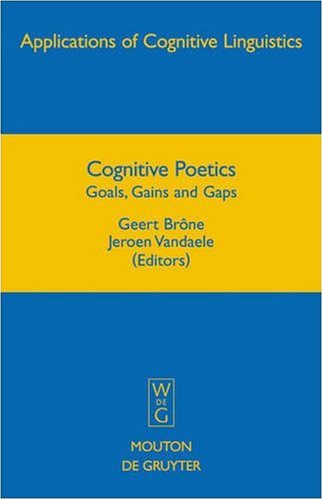
Cognitive Poetics Goals Gains and Gaps Applications of Cognitive Linguistics 1st Edition by Geert Brone, Jeroen Vandaele 9783110213379 3110213370

Original price was: $50.00.$35.00Current price is: $35.00.
Cognitive Poetics Goals Gains and Gaps Applications of Cognitive Linguistics 1st Edition by Geert Brone, Jeroen Vandaele – Ebook PDF Instant Download/Delivery: 9783110213379, 3110213370
Full download Cognitive Poetics Goals Gains and Gaps Applications of Cognitive Linguistics 1st Edition after payment
Product details:
ISBN 10: 3110213370
ISBN 13: 9783110213379
Author: Geert Brone, Jeroen Vandaele
For more than two decades now, cognitive science has been making overtures to literature and literary studies. Only recently, however, cognitive linguistics and poetics seem to be moving towards a more serious and reciprocal type of interdisciplinarity. In coupling cognitive linguistics and poetics, cognitive poeticians aim to offer cognitive readings of literary texts and formulate specific hypotheses concerning the relationship between aesthetic meaning effects and patterns in the cognitive construal and processing of literary texts. One of the basic assumptions of the endeavour is that some of the key topics in poetics (such as the construction of text worlds, characterization, narrative perspective, distancing discourse, etc.) may be fruitfully approached by applying cognitive linguistic concepts and insights (such as embodied cognition, metaphor, mental spaces, iconicity, construction grammar, figure/ground alignment, etc.), in an attempt to support, enrich or adjust ‘traditional’ poetic analysis. Conversely, the tradition of poetics may support, frame or call into question insights form cognitive linguistics. In order to capture the goals, gains and gaps of this rapidly growing interdisciplinary field of research, this volume brings together some of the key players and critics of cognitive poetics. The eleven chapters are grouped into four major sections, each dealing with central concerns of the field: (i) the cognitive mechanisms, discursive means and mental products related to narrativity (Semino, Herman, Culpeper); (ii) the different incarnations of the concept of figure in cognitive poetics (Freeman, Steen, Tsur); (iii) the procedures that are meant to express or create discursive attitudes, like humour, irony or distance in general (Antonopoulou and Nikiforidou, Dancygier and Vandelanotte, Giora et al.); and (iv) a critical assessment of the current state of affairs in cognitive poetics, and more specifically the incorporation of insights from cognitive linguistics as only one of the contributing fields in the interdisciplinary conglomerate of cognitive science (Louwerse and Van Peer, Sternberg). The ensuing dialogue between cognitive and literary partners, as well as between advocates and opponents, is promoted through the use of short response articles included after ten chapters of the volume. Geert Brône, Katholieke Universiteit Leuven, Belgium; Jeroen Vandaele, University of Oslo, Norway.
Cognitive Poetics Goals Gains and Gaps Applications of Cognitive Linguistics 1st Table of contents:
- Cognitive poetics. A critical introduction
- Text worlds
- Cognitive approaches to narrative analysis
- Reflections on a cognitive stylistic approach to characterisation
- Minding: feeling, form, and meaning in the creation of poetic iconicity
- Metaphor and figure-ground relationship: comparisons from poetry, music, and the visual arts
- Deconstructing verbal humour with Construction Grammar
- Judging distances: mental spaces, distance, and viewpoint in literary discourse
- Does an “ironic situation” favor an ironic interpretation?
- How cognitive is cognitive poetics? The interaction between symbolic and embodied cognition
- Epilogue. How (not) to advance toward the narrative mind
- Backmatter
People also search for Cognitive Poetics Goals Gains and Gaps Applications of Cognitive Linguistics 1st:
long term goals for articulation therapy
long-term transition goals examples
goals to set with therapist
goals for long term
cognitive gains
Tags:
Cognitive Poetics,Geert Brone,Jeroen Vandaele