

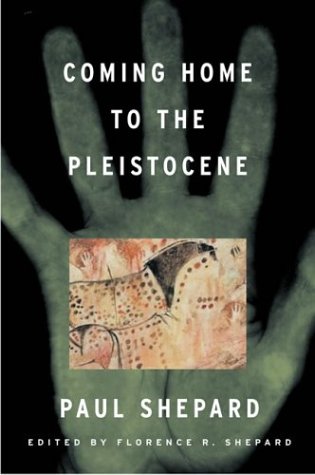
Coming Home to the Pleistocene 1st Edition by Paul Shepard 9781559635905 1559635908


Original price was: $50.00.$35.00Current price is: $35.00.
Coming Home to the Pleistocene 1st Edition by Paul Shepard – Ebook PDF Instant Download/Delivery:9781559635905, 1559635908
Full download Coming Home to the Pleistocene 1st Edition after payment
Product details:
ISBN 10: 1559635908
ISBN 13: 9781559635905
Author: Paul Shepard
Coming Home to the Pleistocene 1st Table of contents:
PART I. The Relevance of the Past
-
Our Pleistocene ancestors and contemporary hunter/gatherers cannot be understood in a historical context that, as a chronicle of linear events, has distorted the meaning of the “savage” in us.
PART II. Getting a Genome
-
Being human means having evolved—especially with respect to a special past in open country, where the basic features that make us human came into being. Coming down out of the trees, standing on our own two feet, freed our hands and brought a perceptual vision never before seen on the planet.
PART III. How We Once Lived
-
For a hundred thousand years or more our ancestors worked out a way of life at peace with their world. Although their economy was one of hunting and gathering, the special meaning of that way must be understood anew if we are to learn by their example.
PART IV. How the Mind Once Lived
-
The great puzzle of our species is how we got so smart. The answer is that we joined the great foraging network—the game of prey and predator—and participated in the complex, competitive strategies that brought with them the ability to think ahead, consider our actions, and develop the capacity for metaphor.
PART V. Savages Again
-
Removing the historical lens brings primitive society into clear sight in the present—not as a past but as the basic human context. Modern studies of hunter/gatherers reveal our cultural distance from them while at the same time defining optimum ways of being human.
PART VI. Romancing the Potato
-
The idealism of domestication is like other ideologies that have arisen in history—a blanket repudiation of anything prehistoric except as the concrete model of inferiority. Agrarian power and the domestication of plants and animals brought consequences that were not only practical but also profoundly psychopathic for all succeeding generations.
PART VII. The Cowboy Alternative
-
The other course that domestication opened to us was the herding of hoofed animals. This route took its toll not only in the ravagement of the earth by overgrazing but also in its otherworldly and patriarchal orientation, which was hostile to women, nature, and Planet Earth.
PART VIII. Wildness and Wilderness
-
Wildness is a genetic state of an organism or a natural population, an intrinsic human condition, and the basis for the species and complexity of the biosphere. Wilderness is a place we have dedicated to wildness, both in ourselves and in other species. Seen as landscape, wilderness is intrinsically distancing—a science or art form that reduces nature to representations.
PART IX. The New Mosaic—A Primal Closure
-
How can we make use of an admirable “past” to which access seems blocked by time and progress? The dilemma disappears when we realize that culture, like the genome and the ecosystem, is a mosaic of removable parts that can be reintegrated into our present. We can go back to the Pleistocene because, as a species, we never left. And by identifying characteristic aspects of the lives of our ancestors and contemporary hunter/gatherers, our modern culture can absorb these features in its own way.
Bibliography
People also search for Coming Home to the Pleistocene 1st :
what came after pleistocene
coming home the destinators
coming home peter jeremias
coming home peter
coming home to passion
Tags: Paul Shepard, Coming, Home