

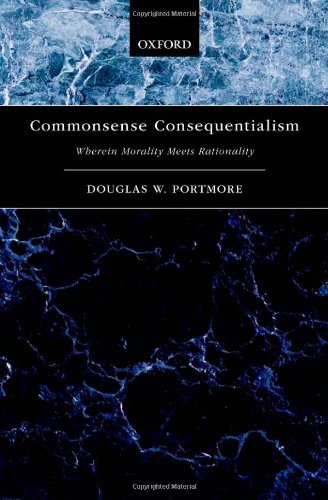
Commonsense consequentialism wherein morality meets rationality 1st Edition by Douglas W Portmore ISBN 0199794537 9780199794539


Original price was: $50.00.$35.00Current price is: $35.00.
Commonsense consequentialism wherein morality meets rationality 1st Edition by Douglas W. Portmore – Ebook PDF Instant Download/Delivery: 0199794537, 9780199794539
Full download Commonsense consequentialism wherein morality meets rationality 1st Edition after payment
Product details:
ISBN 10: 0199794537
ISBN 13: 9780199794539
Author: Douglas W. Portmore
Commonsense Consequentialism is a book about morality, rationality, and the interconnections between the two. In it, Douglas W. Portmore defends a version of consequentialism that both comports with our commonsense moral intuitions and shares with other consequentialist theories the same compelling teleological conception of practical reasons.
Broadly construed, consequentialism is the view that an act’s deontic status is determined by how its outcome ranks relative to those of the available alternatives on some evaluative ranking. Portmore argues that outcomes should be ranked, not according to their impersonal value, but according to how much reason the relevant agent has to desire that each outcome obtains and that, when outcomes are ranked in this way, we arrive at a version of consequentialism that can better account for our commonsense moral intuitions than even many forms of deontology can. What’s more, Portmore argues that we should accept this version of consequentialism, because we should accept both that an agent can be morally required to do only what she has most reason to do and that what she has most reason to do is to perform the act that would produce the outcome that she has most reason to want to obtain.
Although the primary aim of the book is to defend a particular moral theory (viz., commonsense consequentialism), Portmore defends this theory as part of a coherent whole concerning our commonsense views about the nature and substance of both morality and rationality. Thus, it will be of interest not only to those working on consequentialism and other areas of normative ethics, but also to those working in metaethics. Beyond offering an account of morality, Portmore offers accounts of practical reasons, practical rationality, and the objective/subjective obligation distinction.
Table of contents:
1. Why I Am Not a Utilitarian
1.1 Utilitarianism: The good, the bad, and the ugly
1.2 The plan for the rest of the book
1.3 My aims
1.4 Objective oughts and objective reasons
1.5 Conventions that I will follow throughout the book
2. Consequentialism and Moral Rationalism
2.1 The too-demanding objection: How moral rationalism leads us to reject utilitarianism
2.2 The argument against utilitarianism from moral rationalism
2.3 How moral rationalism compels us to accept consequentialism
2.4 What is consequentialism?
2.5 The presumptive case for moral rationalism
2.6 Some concluding remarks
3. The Teleological Conception of Practical Reasons
3.1 Getting clear on what the view is
3.2 Clearing up some misconceptions about the view
3.3 Scanlon’s putative counterexamples to the view
3.4 Arguments for the view
4. Consequentializing Commonsense Morality
4.1 How to consequentialize
4.2 The deontic equivalence thesis
4.3 Beyond the deontic equivalence thesis: How consequentialist theories can do a better job of accounting for our considered moral convictions than even some nonconsequentialist theories can
4.4 The implications of the deontic equivalence thesis
4.5 An objection
5. Dual-Ranking Act-Consequentialism: Reasons, Morality, and Overridingness
5.1 Some quick clarifications
5.2 Moral reasons, overridingness, and agent-centered options
5.3 Moral reasons, overridingness, and supererogation
5.4 A meta-criterion of rightness and how it leads us to adopt dual-ranking act-consequentialism
5.5 Norcross’s objection
5.6 Splawn’s objection
5.7 Violations of the transitivity and independence axioms
6. Imperfect Reasons and Rational Options
6.1 Kagan’s objection: Are we sacrificing rational options to get moral options?
6.2 Imperfect reasons and rational options
6.3 Securitism
6.4 Securitism and the basic belief
6.5 Securitism’s suppositions and implications
7. Commonsense Consequentialism
7.1 The best version of act-utilitarianism: commonsense utilitarianism
7.2 Securitist consequentialism and the argument for it
7.3 Commonsense consequentialism and how it compares with traditional act-consequentialism
7.4 What has been shown and what remains to be shown
People also search for:
commonsense consequentialism wherein
commonsense consequentialism wherein morality meets rationality
what is an example of consequentialism
consequentialism in a sentence
consequentialism in simple terms
Tags: Douglas W Portmore, Commonsense, Consequentialism, Morality, Rationality