

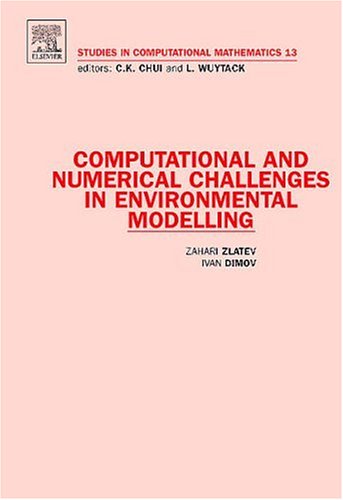
Computational and Numerical Challenges in Environmental Modelling 1st Edition by Zahari Zlatev, Ivan Dimov ISBN 0444522093 9780444522092


Original price was: $50.00.$35.00Current price is: $35.00.
Computational and Numerical Challenges in Environmental Modelling 1st Edition by Zahari Zlatev, Ivan Dimov – Ebook PDF Instant Download/Delivery: 0444522093, 9780444522092
Full download Computational and Numerical Challenges in Environmental Modelling 1st Edition after payment
Product details:
ISBN 10: 0444522093
ISBN 13: 9780444522092
Author: Zahari Zlatev, Ivan Dimov
Many large mathematical models, not only models arising and used in environmental studies, are described by systems of partial differential equations. The discretization of the spatial derivatives in such models leads to the solution of very large systems of ordinary differential equations. These systems contain many millions of equations and have to be handled over large time intervals by applying many time-steps (up to several hundred thousand time-steps). Furthermore, many scenarios are as a rule to be run. This explains the fact that the computational tasks in this situation are enormous. Therefore, it is necessary to select fast numerical methods; to develop parallel codes and, what is most important when the problems solved are very large to organize the computational process in a proper way.The last item (which is very often underestimated but, let us re-iterate, which is very important) is the major topic of this book. In fact, the proper organization of the computational process can be viewed as a preparation of templates which can be used with different numerical methods and different parallel devices. The development of such templates is described in the book. It is also demonstrated that many comprehensive environmental studies can successfully be carried out when the computations are correctly organized. Thus, this book will help the reader to understand better that, while (a) it is very important to select fast numerical methods as well as (b) it is very important to develop parallel codes, this will not be sufficient when the problems solved are really very large. In the latter case, it is also crucial to exploit better the computer architecture by organizing properly the computational process.
Table of contents:
Chapter 1: PDE systems arising in air pollution modelling and justification of the need for high speed computers
1.1 Need for large-scale air pollution modelling
1.2 The Danish Eulerian Model (DEM)
1.3 Input data
1.4 Output data
1.5 Measurement data
1.6 Some results obtained by DEM
1.7 Applicability to PDEs arising in other areas
1.8 Concluding remarks
Chapter 2: Using splitting techniques in the treatment of air pollution models
2.1 Four types of splitting procedures
2.2 Sequential splitting procedures
2.3 Symmetric splitting procedures
2.4 Weighted sequential splitting procedures
2.5 Weighted symmetric splitting procedures
2.6 Advantages and disadvantages of the splitting procedures
2.7 Comparison of different splitting procedures
2.8 Numerical experiments
2.9 Using splitting procedures in connection with other applications
2.10 Conclusions and plans for future research
Chapter 3: Treatment of the advection-diffusion phenomena
3.1 Treatment of the horizontal advection
3.2 Semi-discretization of the advection equation
3.3 Time integration of the semi-discretized advection equation
3.4 Numerical treatment of the horizontal diffusion
3.5 Numerical treatment of the vertical exchange
3.6 Applicability to other large-scale models
3.7 Concluding remarks and plans for future research
Chapter 4: Treatment of the chemical part: general ideas major numerical methods
Publisher Summary
4.1 The chemical sub-model
4.2 Why is it difficult to handle the chemical sub-model?
4.3 Algorithms for the numerical integration of the chemical ODE systems
4.4 Numerical results
4.5 Treatment of the deposition
4.6 Applicability to other large-scale models
4.7 Plans for future work
Chapter 5: Error analysis of the partitioning procedures
People also search for:
computational and numerical
handbook of computational and numerical methods in finance
computational and numerical methods
computational and numerical modeling
computational algorithms and numerical dimensions
computational science and numerical method
Tags: Zahari Zlatev, Ivan Dimov, Computational, Numerical Challenges, Environmental Modelling