

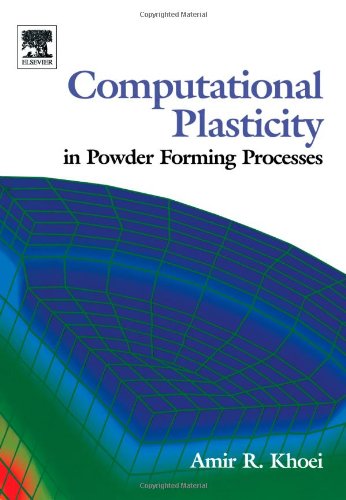
Computational Plasticity in Powder Forming Processes 1st Edition by Amir Khoei 9780080529707 0080446361

Original price was: $50.00.$35.00Current price is: $35.00.
Computational Plasticity in Powder Forming Processes 1st Edition by Amir Khoei – Ebook PDF Instant Download/Delivery: 9780080529707 0080446361
Full download Computational Plasticity in Powder Forming Processes 1st Edition after payment
Product details:
ISBN 10: 0080446361
ISBN 13: 9780080529707
Author: Amir Khoei
The powder forming process is an extremely effective method of manufacturing structural metal components with high-dimensional accuracy on a mass production basis. The process is applicable to nearly all industry sectors. It offers competitive engineering solutions in terms of technical performance and manufacturing costs. For these reasons, powder metallurgy is developing faster than other metal forming technology.
Computational Plasticity in Powder Forming Proceses takes a specific look at the application of computer-aided engineering in modern powder forming technologies, with particular attention given to the Finite Element Method (FEM). FEM analysis provides detailed information on conditions within the processed material, which is often more complete than can be obtained even from elaborate physical experiments, and the numerical simulation makes it possible to examine a range of designs, or operating conditions economically.
* Describes the mechanical behavior of powder materials using classical and modern constitutive theories.
* Devoted to the application of adaptive FEM strategy in the analysis of powder forming processes.
* 2D and 3D numerical modeling of powder forming processes are presented, using advanced plasticity models.
Computational Plasticity in Powder Forming Processes 1st Table of contents:
Chapter 1: INTRODUCTION
1.1 Metal forming processes
1.2 Design of forming process
1.3 Finite element analysis in metal forming
1.4 Powder compaction processes
1.5 Powder metallurgy technology
1.6 Mechanical behavior of powder
1.7 Numerical simulation of powder forming processes
Chapter 2: FINITE ELEMENT MODEL
2.1 Introduction
2.2 Governing equations for powder forming analysis
2.3 Lagrangian formulation
2.4 Finite element discretization
2.5 Time domain discretization
2.6 Nonlinear iterative strategy
2.7 Arbitrary Lagrangian-Eulerian method
2.8 ALE governing equations
Chapter 3: POWDER CONSTITUTIVE MODELS
3.1 Introduction
3.2 Generalized plasticity theory
3.3 Plasticity models for porous material
3.4 Plasticity models for granular materials
3.5 Plasticity models for powder materials
3.6 MCEC plasticity model
3.7 Double-surface plasticity model
3.8 The three-invariant single plasticity model
3.9 Integration of the constitutive relation
Chapter 4: BOUNDARY FRICTION MODEL
4.1 Introduction
4.2 Physical aspects of friction
4.3 Plasticity theory of friction
4.4 Modeling of friction
4.5 Continuum model of friction
Chapter 5: APPLICATION OF CAP PLASTICITY MODELS
5.1 Introduction
5.2 Experimental investigation
5.3 Parameter determination
5.4 Application of MCEC plasticity model
5.5 Application of three-invariant single plasticity model
Chapter 6: ERROR ESTIMATION AND ADAPTIVITY
6.1 Introduction
6.2 Adaptive FEM strategy
6.3 Error estimation
6.4 Adaptive mesh refinement
6.5 Adaptive mesh generator
6.6 Mapping of variables
6.7 Error estimates and adaptive time stepping
6.8 Numerical simulation results
Chapter 7: ADVANCED PLASTICITY MODELS
7.1 Introduction
7.2 Endochronic plasticity theory
7.3 Endochronic theory of plastic deviatoric deformation
7.4 Endochronic theory of plastic volumetric deformation
7.5 Endochronic theory of plastic volumetric and plastic deviatoric deformations
7.6 Endochronic theory of visco-plasticity
7.7 Multi-surface plasticity theory
7.8 Multi-surface theory of J2 plasticity
7.9 Multi-surface theory of pressure-dependent plasticity
Chapter 8: FINITE DEFORMATION PLASTICITY
8.1 Introduction
8.2 Finite deformation of endochronic plasticity
8.3 Numerical integration of hypoelasto-plastic equations
8.4 Finite deformation of endochronic visco-plasticity
8.5 Numerical examples of finite elasto- and visco-plasticity
8.6 Finite torsion of thin-walled tubes
Chapter 9: APPLICATION OF ADVANCED PLASTICITY MODELS
9.1 Introduction
9.2 Application of endochronic plasticity
9.3 Application of double-surface plasticity
9.4 Application of three-invariant single-cap plasticity
Chapter 10: DISCONTINUOUS DISPLACEMENTS AND LOCALIZATION
10.1 Introduction
10.2 Causes of Localization in Solid Mechanics
10.3 Governing equations of incompressible plasticity
10.4 Theory of Cosserat continuum
10.5 Adaptive strategy for discontinuous displacements
10.6 Numerical Simulation Results
Chapter 11: POWDER COMPACTION SOFTWARE
11.1 Introduction
11.2 Overview of the software environment
11.3 Pre-processing – Mesh generation
11.4 The analysis utility environment
11.5 Post-processing
People also search for Computational Plasticity in Powder Forming Processes 1st:
computational approaches to memory and plasticity
computational approaches to memory and plasticity 2024
computational methods for plasticity theory and applications
computational methods for plasticity theory and applications pdf
computational methods in elasticity and plasticity
Tags: Computational Plasticity, Powder Forming, Amir Khoei