

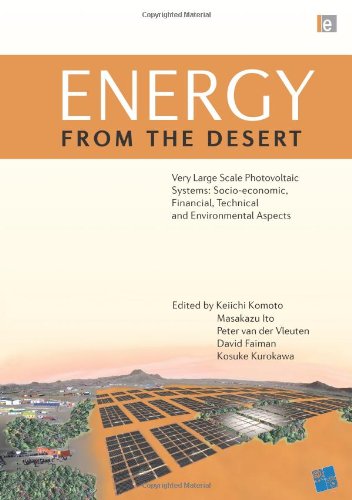
Energy from the Desert 1st edition by Keiichi Komoto, Masakuza Ito, Peter van der Vleuten, David Faiman, Kosuke Kurokawa ISBN B082WXSPZY 978-1136574641

Original price was: $50.00.$35.00Current price is: $35.00.
Energy from the Desert 1st edition by Keiichi Komoto, Masakuza Ito, Peter van der Vleuten, David Faiman, Kosuke Kurokawa – Ebook PDF Instant Download/Delivery: B082WXSPZY , 978-1136574641
Full download Energy from the Desert 1st edition after payment
Product details:
ISBN 10: B082WXSPZY
ISBN 13: 978-1136574641
Author: Keiichi Komoto, Masakuza Ito, Peter van der Vleuten, David Faiman, Kosuke Kurokawa
The world’s deserts are sufficiently large that, in theory, covering a fraction of their landmass with PV systems could generate many times the current primary global energy supply.
The Energy from the Desert two-volume set details the background and concept of Very Large Scale Photovoltaics (VLS-PC) and examines and evaluates their potential as viable power generation systems. The authors present case studies of both virtual and real projects based on selected regions (including the Mediterranean, Sahara, Chinese Gobi, Mongolian Gobi, Indian Thar, Australian Desert and the US) and their specific socio-economic dynamics, and argue that VLS-PV systems in desert areas will be readily achievable in the near future.
Energy from the Desert 1st Table of contents:
Chapter One Introduction
1.1 Objectives
1.2 The Concept of a VLS-PV System
1.2.1 Concept and definition
1.2.2 A synthesized scenario for network evolution
1.2.3 A step-by-step approach for project development
1.2.4 The potential advantages of VLS-PV
1.3 Project Development
Chapter Two World Energy and Environmental Issues
2.1 Energy Issues
2.2 Climate Change Issues
2.2.1 Trends in greenhouse gas emission
2.2.2 Future projections
2.2.3 Impacts of climate change
2.2.4 Climate change mitigation strategies and renewable energy
2.2.5 The response of international politics to climate change
2.3 Other Environmental Issues
2.3.1 Interaction among environmental issues (the vicious circle)
2.3.2 Deforestation and forest degradation
2.3.3 Desertification
2.3.4 The ecosystem
2.3.5 Water supply and sanitation
2.4 VLS-PV for a Sustainable Future
References
Chapter Three PV and Other Renewable Energy Options
3.1 Solar-Thermal Technologies
3.1.1 CSP technology features
3.1.2 Relative performance record
3.1.3 The case for VLS-PV
3.2 Conclusion
References
Chapter Four Socio-Economic Considerations
4.1 Introduction
4.2 Potential Benefits and Socio-Economic Aspects
4.2.1 Potential benefits for desert countries
4.2.1.1 Economic benefits
4.2.1.2 Social benefits
4.2.1.3 Security of energy supply
4.2.1.4 Environmental issues
4.2.1.5 Peace and poverty alleviation
4.2.1.6 International recognition
4.2.1.7 Development in related areas
4.2.2 Creation of a local market
4.2.2.1 Stand-alone systems
4.2.2.2 Grid-connected systems
4.2.2.3 Building integrated systems
4.2.2.4 Solar electricity plants
4.2.3 Creation of a local industry
4.2.3.1 Assembly of PV solar panels
4.2.3.2 Manufacturing of solar cells
4.2.3.3 Manufacturing of silicon
4.2.3.4 Installation, building and services
4.2.4 Education
4.2.4.1 Awareness creation
4.2.4.2 Transfer of system and application expertise
4.2.4.3 Transfer of technology
4.2.4.4 Transfer of policy matters
4.2.5 Major stakeholders
4.2.5.1 Renewable energy institutes
4.2.5.2 Energy companies
4.2.5.3 Government institutions
4.2.5.4 Financing institutions
4.2.5.5 Educational institutions
4.3 Desert Region Community Development
4.3.1 Concept
4.3.2 Revegetation by FoE Japan
4.3.3 Agricultural development
4.4 Developing Agricultural Systems with PV
4.4.1 Significance of introducing alternative energy sources to and from desert areas
4.4.2 Introducing new technology to developing regions
4.4.3 Limited water resources at present and in the future
4.4.4 Countering freshwater deficits and securing water for food production
4.4.5 Example of border irrigation and fall leaching complex in Gansu, China
4.4.6 Case study: Access of high-quality fresh water for sustainable irrigation
4.4.6.1 Scenario
4.4.6.2 Assumption
4.4.6.3 Economic aspects
4.4.6.4 Concluding remarks
4.5 Desalination Powered by Solar Energy
4.5.1 Water shortage and its socio-economic impact
4.5.1.1 Global water situation on the blue planet
4.5.1.2 Impact of water shortage
4.5.2 Principles of desalination
4.5.2.1 Thermally driven desalination technologies
4.5.2.2 Electrically driven desalination technologies
4.5.3 Solar powered desalination systems
4.5.3.1 Challenges and options for solar powered desalination systems
4.5.3.2 Solar thermally powered desalination systems
4.5.3.3 PV-powered desalination systems
4.5.4 Conclusion
References
Chapter Five Financial Aspects
5.1 Requirements for Financing VLS-PV
5.1.1 The implications of high capital intensity
5.1.2 The main project structures
5.1.3 Financing requirements
5.1.4 Financing cost to society
5.2 Proposal for A VLS-PV Business Model
5.2.1 Description of a VLS-PV system
5.2.2 Evaluation of the investment costs
5.2.3 Evaluation of the operating costs
5.2.4 The financing scheme
5.2.4.1 The availability fee mechanism
5.2.4.2 The PPA mechanism
5.2.4.3 Comparison between these two structures
5.2.5 Simulation methodology – calculating the PV electricity price
5.2.6 Conclusion
5.3 Case Studies – Preliminary Results
5.3.1 System configurations
5.3.1.1 Original model and financial model
5.3.2 Economic analysis
5.3.2.1 Initial cost
5.3.2.2 Annual cost
5.3.2.3 Generation cost
References
Chapter Six Recent and Future Trends in PV Technology
6.1 PV Cell and Module Technology for VLS-PV
6.1.1 PV cell and module technology
6.1.1.1 Crystalline silicon
6.1.1.2 Thin film
6.1.1.3 Other cell types
6.1.1.4 Modules
6.1.2 Considerations with respect to VLS-PV application
6.1.2.1 Energy payback
6.1.2.2 Material availability and environmental aspects
6.1.2.3 Commercial aspects including balance-of-system cost
6.1.2.4 Future development
6.1.2.5 Mass production issues and economy of scale
6.1.2.6 Grid parity
6.1.3 Summary
6.2 PV System Technology
6.2.1 Electric connections
6.2.1.1 General connection scheme
6.2.1.2 General characteristics of main components
6.2.2 Structures
6.2.3 Plant monitoring and security
6.2.4 Anti-theft methods
6.2.5 Energy yield
6.3 CPV and Tracking Technology
6.3.1 Tracking technology overview
6.3.1.1 Present situation of sun-tracking PV system implementation
6.3.1.2 Technology overview of sun-tracking systems
6.3.2 CPV technology overview
6.3.2.1 Historical overview
6.3.2.2 Deployment of CPV systems
6.3.2.3 A local assembly concept for tracking PV and CPV implementation
References
Chapter Seven MW-Scale PV System Installation Technologies
7.1 Recent Progress of MW-Scale PV Systems
7.2 Advanced Design of VLS-PV Systems
7.2.1 Some statements describing the typical current situation of VLS-PV
7.2.2 From today’s to tomorrow’s plant architecture
7.2.3 VLS-PV in the 50–100 MW range: Cooperation with grid owners
7.2.4 Components used for VLS-PV applications
7.2.4.1 Modules
7.2.4.2 Support structures and foundations
7.2.4.3 Support structures and tracking systems
7.2.4.4 Inverter units
7.2.4.5 Monitoring systems
7.2.4.6 MV transformers
7.2.5 Safety standards and security
7.2.6 Conclusion
7.3 System Architecture and Operation
7.3.1 System architecture of MW-scale PV systems
7.3.2 Inverters for LS-PV systems
7.3.3 Operation of MW-scale PV systems
7.3.3.1 Operation, equipment and tools
7.3.3.2 Energy yield
7.3.3.3 Warranties and securities
7.4 Array Structures, Civil Works and Foundations
7.4.1 Costs reduction by an new array structure design
7.4.1.1 Experience of actual design of 1 MW PV plant in the 1980s in Japan
7.4.1.2 Example of a simulation for 40 MW PV array field
7.4.1.3 Cost reduction by new design
7.4.2 Civil construction standards with restricted validity
7.4.3 Civil works: Conventional foundation systems
7.4.4 Civil works: Cost reduction by use of an innovative foundation system
7.4.5 Summary
References
Chapter Eight Future Technical Development for VLS-PV Systems
8.1 Matching VLS-PV Systems to Grid Requirements
8.1.1 Previous studies for Texas, USA
8.1.2 An Israel case study
8.1.2.1 Idealization: A 100 % flexible Israeli grid
8.1.2.2 Reduced grid flexibility for the Israeli grid
8.1.2.3 Solarizing the spinning reserve
8.1.2.4 Storage to the rescue
8.1.3 Conclusion
8.2 A Statistical Approach to Energy Storage
8.2.1 The model
8.2.2 Large storage capacity behaviour
8.2.2.1 Unmatched case
8.2.2.2 Matched case
8.2.3 Small storage capacity behaviour
8.2.4 Conclusion
8.3 Solar Hydrogen
8.3.1 The energetics of hydrogen production
8.3.2 The energetics of hydrogen packaging
8.3.2.1 Packaging by compression
8.3.2.2 Packaging by liquefaction
8.3.3.3 Packaging in the form of metal hydrides
8.3.3 The energetics of hydrogen delivery
8.3.3.1 Road transportation of gaseous hydrogen
8.3.3.2 Road transportation of liquid hydrogen
8.3.3.3 Transportation of gaseous hydrogen by pipeline
8.3.4 The energetics of hydrogen transfer
8.3.5 Conclusion
8.4 Expert Control Systems Based on Cloud Predictions
8.4.1 Intermittence of solar power
8.4.2 Types of weather: Partial cloudiness, scale of the problem
8.4.3 Grid sensitivity to power generators with variable output
8.4.4 Control systems for operation of power plant with intermittent resource
8.4.5 Predicting the moment of sun shading by clouds
8.4.5.1 Hardware for the simultaneous imaging of clouds and the sun
8.4.5.2 Algorithms and prototype software for cloud recognition and motion analysis
8.4.6 Conclusion
References
Chapter Nine Environmental and Ecological Impacts of VLS-PV
9.1 Lifecycle Analysis of Various Kinds of VLS-PV Systems
9.1.1 Methodology of LCA
9.1.1.1 LCA scheme
9.1.1.2 Energy payback time and CO2 emissions rate
9.1.2 Assumptions
9.1.2.1 Cases assumed
9.1.2.2 Geographical information
9.1.2.3 VLS-PV design and configuration
9.1.2.4 Array structures
9.1.2.5 Transportation
9.1.2.6 Waste management
9.1.2.7 Data preparation for this case study
9.1.3 Results
9.1.3.1 Comparison between concrete foundations and earth screws
9.1.3.2 Energy requirement and CO2 emissions
9.1.4 Conclusion
9.2 Estimation of Ecological Impacts of VLS-PV Development in the Gobi Desert
9.2.1 Overview of ecological footprint and ecological footprint analysis
9.2.1.1 Concept and definition of EF and BC
9.2.1.2 Approaches for average productivity and ability of absorption (sequestration): GAEZ and NPP
9.2.1.3 Examples of EQF, BC and EFA
9.2.2 Estimation of possible impacts of VLS-PV development
9.2.2.1 Assumptions
9.2.2.2 Results and discussion
9.2.3 Summary
References
Chapter Ten Analysis of Global Potential
10.1 Remote Sensing and Target Areas
10.1.1 About satellite images
10.1.2 Analysis areas
10.1.3 Definition of suitable areas for the VLS-PV
10.2 Method of Analysis
10.2.1 Pre-processing of analysis
10.2.2 Ground cover classification by maximum likelihood estimation
10.2.3 Undulating hills classification
10.2.4 Vegetation index
10.2.5 Integration
10.2.6 A comparison between proposed algorithm and previous algorithm
10.3 Analysis
10.3.1 Preparation of satellite images
10.3.2 Results of the evaluation of six areas
10.3.3 The ground truth
10.3.4 Solar energy potential
10.4 Conclusion
References
Chapter Eleven Case Study on the Sahara Desert
11.1 Introduction
11.2 Country Studies
11.2.1 Morocco
11.2.1.1 Introduction
11.2.1.2 Pilot projects in solar PV electrification
11.2.1.2.1 The Village Power project: 1992–1995 (500 households)
11.2.1.2.2 The SAER project: 1989–1992 (400 households)
11.2.1.2.3 The Pilot Program for Rural Electrification (PPER): 1993–1997 (1500 households)
11.2.1.2.4 The Solar Pumping Program
11.2.1.3 The generalization of rural electrification through solar PV
11.2.1.4 Grid connected solar PV systems (solar roofs and PV power plants)
11.2.1.4.1 The international context
11.2.1.4.2 The national context
11.2.2 Algeria
11.2.2.1 Introduction
11.2.2.2 Proposed site for PV power plants
2.2.2.3 PV technology options
11.2.2.4 Economic and financial viability of PV plants
11.2.2.5 Role of PV for sustainable economic and social development
11.2.3 Tunisia
11.2.3.1 Introduction
11.2.3.2 Energy issues in Tunisia
11.2.3.3 National PV programme
11.2.3.4 PV R&D in Tunisia
11.2.3.5 Potential of PV applications in Tunisia
11.2.3.6 Conclusion
11.2.4 Libya
11.2.4.1 Introduction
11.2.4.2 Total primary energy supply
11.2.4.3 Potential of VLS-PV
11.2.5 Egypt
11.2.5.1 Introduction
11.2.5.2 Potential of VLS-PV
11.3 CPV in the Sahara
11.3.1 Economic assumptions for VLS-PV (CPV) construction
11.3.2 Electricity tariff
11.3.3 The case studies
11.3.3.1 Morocco
11.3.3.2 Algeria
11.3.3.3 Tunisia
11.3.3.4 Libya
11.3.3.5 Egypt
11.3.4 Sensitivity analysis
11.3.5 Conclusion
11.4 Towards Developing Projects
11.5 Summary and Conclusions
References
Chapter Twelve Case Study on the Gobi Desert
12.1 Precise Cost and Financial Analysis
12.1.1 The project
12.1.1.1 Technical description
12.1.1.2 System cost assessment
12.1.1.3 Financial structure of the transaction
12.1.1.4 Estimation of total financial needs
12.1.2 Calculation of the minimum electricity price
12.1.3 Conclusion
12.2 Possible Installation Sites in the Gobi Desert
12.3 Preliminary Test of PV Power Systems Installed in Naran Soum and Tibet
12.4 Summary
References
Chapter Thirteen VLS-PV Roadmap
13.1 Future Directions in the 21st Century
13.2 Assumed Scenarios in Major Technology Streams
13.3 VLS-PV Roadmap Proposal
13.3.1 Cumulative installation
13.3.2 Annual installation
13.3.3 Transition of market size and annual expenditure for VLS-PV
13.3.4 VLS-PV installation by region
13.4 Summary and Conclusions
13.4.1 Global trends
13.4.2 VLS-PV trends
References
Annex
Chapter Fourteen Conclusions and Recommendations
14.1 Conclusions
14.2 Recommendations
People also search for Energy from the Desert 1st:
energy from the desert
solar energy desert
a desert energy pyramid
solar energy from the sun is contained in
which is the source of energy for the panels shown
Tags: Keiichi Komoto, Masakuza Ito, Peter van der Vleuten, David Faiman, Kosuke Kurokawa, the Desert