

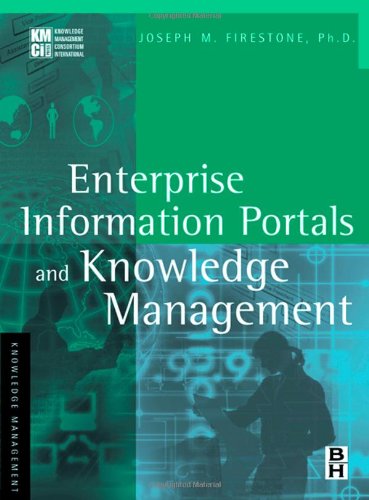
Enterprise Information Portals and Knowledge Management 1st Edition by Joseph Firestone ISBN 0750674741 978-0750674744


Original price was: $50.00.$35.00Current price is: $35.00.
Enterprise Information Portals and Knowledge Management 1st Edition by Joseph Firestone – Ebook PDF Instant Download/Delivery: 0750674741, 978-0750674744
Full download Enterprise Information Portals and Knowledge Management 1st edition after payment
Product details:
ISBN 10: 0750674741
ISBN 13: 978-0750674744
Author: Joseph Firestone
Is the Enterprise Information Portal (EIP) knowledge management’s killer app? Leading expert Joseph M. Firestone, the first author to formulate the idea of the Enterprise Knowledge Portal, breaks new ground and looks to the future with a practical, but comprehensive approach to enterprise portals and their relationship to knowledge management. Providing a clear and novel overview, Firestone tackles a wide range of topics ranging from functional EIP applications, estimating costs and benefits of EIPs, variations in EIP technical architecture, the role of intelligent agents, the nature of knowledge management, portal product/solution segmentation, portal product case studies, to the future of the EIP space. ‘Enterprise Information Portals and Knowledge Management’ is the book on portals you’ve been waiting for. It is the only book that thoroughly considers, explores, and analyzes: * The EIP orientation, outlook and evolution * A new methodology for estimating EIP benefits and costs * EIP and Enterprise Knowledge Portals (EKP) architecture * The approaching role of software agents in EIPs and EKPs * The current and future contribution of EIP and EKP solutions to Knowledge Management * The role of XML in portal architecture * A comprehensive, multi-dimensional, and forward-looking segmentation of EIP products accompanied by portal product case studies * Where EIP sector companies are headed and the pathways they will follow to get there
Enterprise Information Portals and Knowledge Management 1st Table of contents:
Part One—Introducing Enterprise Information Portals: Definition and Evolution
1 Introduction: Defining the Enterprise Information Portal
EIP definition is a political process
EIP definitions
Types of definition and synthesis
EIP technology and e-business
Conclusion
References
2 The Origin and Evolution of Enterprise Information Portals
Enterprise information portals (EIPs)
Structured data/information/knowledge management
Content management
EIPs: managing the structured/unstructured content relationship
Integrating EIP-based systems
Further EIP evolution
References
Part Two—Benefits of Enterprise Information Portals and Corporate Goals
3 Benefits of Enterprise Information Portals
Enterprise innovation and justification
EIP benefits
Conclusion
References
4 Estimating Benefits of Enterprise Information Portals: Concepts, Methodology, and Tools
Enterprise information portal benefits and corporate goals
A framework for EIP benefit estimates
Methodology and tools for estimating the benefits and costs of EIPs
Summary
References
Part Three—Architecture of Enterprise Information Portals and Enterprise Artificial Systems Integration
5 EIP Architectural Questions and Approaches: EASI and the Two Problems of IT
Introduction
Definition of enterprise artificial systems integration (EASI)
Types of EASI
The DIMS solution to the “islands of information” problem
The DIMS, federations, and the enterprise information portal
Solving the “islands of automation” problem
EIP integration and architecture
Summary
References
6 The Role of Intelligent Agents in EIPs
Introduction
Some definitions
Agents in PAI architecture
Agents as intelligent scaled-down business process engines
Conclusion: agents, EIPs, and the virtual enterprise
References
Part Four—On Knowledge and Knowledge Management
7 On Knowledge
Introduction
On definition
Definitions of knowledge
World 2 definitions
World 3 definitions
World 2 data, information, and knowledge
Business process hierarchies, decision cycles, and knowledge processing
A knowledge life cycle (KLC) framework
Tacit knowledge and explicit knowledge
Polanyi, implicit knowledge, and popper
Individual level world 2 knowledge and motivational hierarchies
Knowledge and culture
Modes of conversion and the KLC view
References
8 Knowledge Life Cycle Subprocesses
Introduction
Information acquisition
Individual and group (I&G) learning
Knowledge claim formulation
Knowledge claim validation or evaluation
Knowledge broadcasting
Knowledge-related searching and retrieving
Teaching
Knowledge sharing
Accelerated innovation
References
9 On Knowledge Management
Introduction: Approach to KM
Some definitions of knowledge management
Information management and knowledge management
Definition and specification of knowledge management and information management processes
More on how information management differs from knowledge management
How does culture relate to KM?
KM impact and innovation
Conclusion
References
Part Five—Artificial Knowledge Management Systems and the Role of XML
10 Knowledge Management and the AKMS/DKMS
Introduction
The NKMS and the AKMS
Knowledge and knowledge management processes, use cases, and the AKMS
The akms and the distributed knowledge management system (DKMS)
Conclusion
References
11 The Role of XML in Enterprise Information Portals
Introduction
XML in PAI architecture for EIPs
XML for messaging and connectivity in portal systems
XML in clients
XML in databases and content stores
XML and agents
XML resource description framework (RDF), XML topic maps (XTM), and Meaning Definition Language (MDL)
Conclusion
References
Part Six—EIP Frameworks, Portal Product Case Studies, and Applications to E-Business
12 A Forward Looking EIP Segmentation Framework
Introduction: The first EIP product segmentation
A forward-looking EIP product segmentation framework
The special importance of knowledge-processing and knowledge-management portals
Conclusion: A forward-looking EIP segmentation
References
13 The Enterprise Knowledge Portal and Its Architecture
Introduction: Enter the enterprise knowledge portal
A story about desktops, EIPs, and EKPs
What is the EKP?
EKP architecture and components
The essence of the EKP
The EKP, the akms/dkms, and EKP functional requirements
EKPs, knowledge sharing, and corporate culture
E-business knowledge portals
Are there any enterprise knowledge portals?
Types of knowledge portals
Conclusion
References
14 Decision Processing Portal Products
Introduction
Business Objects InfoView
Cognos UpFront
Conclusion
References
15 Content Management Portal Products
Introduction
Plumtree
Autonomy
Oracle9iAS portal
Enfish enterprise portal (KnowledgeTrack) product
Netegrity Interaction Server
Citrix (formerly Sequoia) XML Portal Server (XPs)
Verity Portal One™
Sun ONE Portal Server
Corechange Coreport Portal
Conclusion
References
16 Collaborative Portal Products
Introduction
TheBrain enterprise knowledge platform (BrainEKP)
Open Text myLivelink
Intraspect
IBM/Lotus
Conclusion
References
17 Decision Processing/ Content Management and Advanced Portal Products
Introduction
Decision processing/content management portal products
Hummingbird EIP
Viador E-Portal 6.4
Computer Associates CleverPath Portal 3.5
Brio.Portal
Sybase Enterprise Portal (EP) 2.5
TIBCO Active Portal™
Hyperwave eKnowledge Infrastructure
Additional considerations
Conclusion
References
18 Portal Technology, E-Business, Knowledge Processing, and Knowledge Management
Introduction: The migration of EIP technology into e-business
Information portals and e-business applications
Knowledge portals and e-business applications
Conclusion: Portal applications and the future of e-business
References
Part Seven—The Future of the EIP
19 EIP Development: Pathways to the Future
Introduction: pathways of EIP evolution
Increasing vendor consolidation
Increasing multifunctionality
Verticalization of EIPS/EKPs/EKPs
More comprehensive integration of EIP systems
Collaborative commerce and e-business “workplace” applications
Conclusion: knowledge processing, KM, and the EIP future
People also search for Enterprise Information Portals and Knowledge Management 1st :
enterprise information platform
enterprise portal definition
enterprise portals
enterprise information portal login page
enterprise information governance
Tags: Joseph Firestone, Enterprise Information, Knowledge Management