

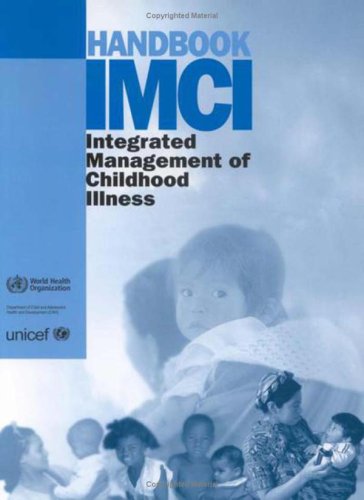
Handbook IMCI Integrated Management of Childhood Illness 1st Edition by World Health Organization ISBN 9241546441 978-9241546447

Original price was: $50.00.$35.00Current price is: $35.00.
Handbook IMCI Integrated Management of Childhood Illness 1st Edition by World Health Organization – Ebook PDF Instant Download/Delivery: 9241546441, 978-9241546447
Full download Handbook IMCI Integrated Management of Childhood Illness 1st Edition after payment
Product details:
ISBN 10: 9241546441
ISBN 13: 978-9241546447
Author: World Health Organization
The WHO/UNICEF guidelines for Integrated Management of Childhood Illness offer simple and effective methods to prevent and manage the leading causes of serious illness and mortality in young children. The clinical guidelines promote evidence-based assessment and treatment using a syndromic approach that supports the rational, effective, and affordable use of drugs. The IMCI model handbook provides a detailed explanation of the IMCI case management guidelines. It is organized into seven main parts: overview of the IMCI process; assess and classify the sick child age 2 months up to 5 years; assess and classify the sick young infant age 1 week up to 2 months; identify treatment; treat the sick child or the sick young infant; communicate and counsel; and give follow-up care.
The IMCI charts and related in-service training materials provided in this handbook are considered to be a generic version. The WHO Department of Child and Adolescent Health and Development created this handbook to help teaching institutions incorporate IMCI into academic programs for doctors, nurses and other health professionals. Teaching institutions are advised to adapt the handbook in two ways: (1) to ensure that all text charts and illustrations are consistent with nationally-adapted IMCI clinical guidelines, and (2) to ensure that its content and format corresponds to the teaching approach used by the institution.
Table of contents:
PART I: Integrated Management of Childhood Illness (IMCI)
1. The integrated case management process
2. Selecting the appropriate case management charts
3. Using the case management charts and case Recording Forms
PART II: The sick child age 2 months up to 5 years: Assess and classify
4. Assess and classify the sick child
5. When a child is brought to the clinic
6. General danger signs
7. Cough or difficult breathing
8. Diarrhoea
9. Fever
10. Ear problem
11. Malnutrition and anaemia
12. Immunization status
13. Other problems
PART III: The sick young infant age 1 week up to 2 months: Assess and classify
14. Overview of assess and classify
15. Assess and classify the sick young infant
PART IV: Identify treatment
16. Choose treatment priorities
17. Identify urgent pre-referral treatment
18. Identify treatment for patients who do not need urgent referral
PART V: Treat the sick child or the sick young infant
19. Overview of the types of treatment
20. Urgent referral
21. Appropriate oral drugs
22. Treating local infections
23. Extra fluid for diarrhoea and continued feeding
24. Immunizations
PART VI: Communicate and counsel
25. Use good communication skills
26. Teach the caretaker to give oral drugs at home
27. Teach the caretaker to treat local Infections at home
28. Counsel the mother about breastfeeding problems
29. Counsel the mother about feeding and fluids
30. Counsel the mother about when to return and about her own health
PART VII: Give follow-up care
31. Follow-up care for the sick child
32. Follow-up care for the sick young infant
People also search for:
handbook imci integrated management of childhood
handbook imci integrated management of childhood illness
borrow handbook imci integrated management of childhood illness
what is integrated management of childhood illness
what are the principles of imci
Tags: World Health Organization, Handbook IMCI, Integrated Management, of Childhood Illness