

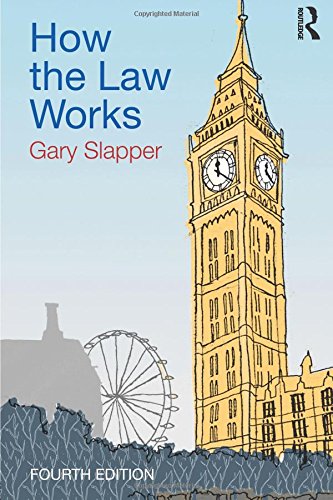

How the Law Works 4th Edition by Gary Slapper – Ebook PDF Instant Download/Delivery: 9781317218012, 1317218019
Full download How the Law Works 4th Edition after payment
Product details:
ISBN 10: 1317218019
ISBN 13: 9781317218012
Author: Gary Slapper
‘How the Law Works is a gem of a book, for law students and for everyone else. It is a must read for anyone interested in how society is shaped and controlled via law.’ Dr Steven Vaughan, solicitor, Senior Lecturer, Birmingham Law School ‘How the Law Works is a comprehensive, witty and easy-to-read guide to the law. I thoroughly recommend it to non-lawyers who want to improve their knowledge of the legal system and to potential students as an introduction to the law of England and Wales.’ HH Judge Lynn Tayton QC Reviews of the first edition: ‘A friendly, readable and surprisingly entertaining overview of what can be a daunting and arcane subject to the outsider.’ The Law Teacher ‘An easy-to-read, fascinating book . . . brimful with curios, anecdote and explanation.’ The Times How the Law Works is a refreshingly clear and reliable guide to today’s legal system. Offering interesting and comprehensive coverage, it makes sense of all the curious features of the law in day to day life and in current affairs. Explaining the law and legal jargon in plain English, it provides an accessible entry point to the different types of law and legal techniques, as well as today’s compensation culture and human rights law. In addition to explaining the role of judges, lawyers, juries and parliament, it clarifies the mechanisms behind criminal and civil law. How the Law Works is essential reading for anyone approaching law for the first time, or for anyone who is interested in an engaging introduction to the subject’s bigger picture.
How the Law Works 4th Table of contents:
1 The Importance of Law
The Nature of Law
The Rule of Law
Clear and Accessible Law
The Golden Metwand
Law and Social Change
The Law and Democracy
Further Reading
2 Judges
Profile of the Judiciary
Types of Judge
Judicial Appointments
Justices of the Supreme Court
The Heads of Division
Lords Justices of Appeal
High Court Judges
Part-time Judges
Judicial Animation of the Law
Battle of the Law-Makers
The Judiciary and The Administration of the Courts
Judges and Communicating with the Public
The Training of Judges
Judicial Independence
Judicial Impartiality
Removal of Judges from Office
Magistrates
Magistrates and Popular Justice
Further Reading
3 Lawyers
The Legal Profession
Lawyers and Fees
A Fusion of the Professions
Solicitors
Solicitors’ Training
Solicitors’ Rights of Audience
New Forms of Organisation for Lawyers
The Chartered Institute of Legal Executives
Barristers
Barristers’ Training and Organisation
Queen’s Counsel
Barristers’ Chambers
Other Help in the Courtroom
Legal Claims Against Lawyers
The Proliferation of Lawyers
Further Reading
4 Cases and the Courts
Cases that Changed the Law
The Case of Prohibitions (Prohibitions Del Roy) (1607)
Bushel’s Case (1670)
Milroy v Lord (1862)
Salomon v Salomon & Co Ltd (1897)
Carlill v Carbolic Smoke Ball Company (1893)
Donoghue v Stevenson (1932)
Woolmington v Director of Public Prosecutions (1935)
Central London Property Trust v High Trees Ltd (1947)
Associated Provincial Picture Houses Ltd v Wednesbury Corporation (1948)
Van Duyn v Home Office (1974)
HL v United Kingdom (2004)
The Common Law System
How the Common Law Developed
The Hierarchy of the Courts
The Supreme Court of the United Kingdom
The Court of Appeal
Divisional Courts
The High Court
The Crown Courts
The County Courts and the Family Court
The Magistrates’ Courts
The Coroners’ Courts
The European Court of Human Rights
Human Rights
The Right to Life
Prohibition of Torture
Prohibition of Slavery and Forced Labour
Right to Liberty and Security
Right to a Fair Trial
No Punishment without Law
Right to Respect for Private and Family Life
Freedom of Thought, Conscience and Religion
Freedom of Expression
Freedom of Assembly and Association
Right to Marry
Right Not to Be Discriminated Against
Further Reading
5 Case Technique
Titles
Ratio Decidendi
Obiter Dictum
Overruling
Distinguishing
Judicial development of the Law
Background
The Law
Dissenting Judgments
Law Reporting
News Reporting
Judging The System of Precedent
Further Reading
6 Interpreting Acts of Parliament
A Danger due to The State of the Premises
The Rules of Interpretation
The Literal Rule
The Golden Rule
The Mischief Rule
Presumption against Parliament Changing the Law
Presumption against Imposing Criminal Liability without Fault
Presumption against Retrospective Operation
Other Aids to Interpretation
Punctuation, Cross-headings and Side-notes
Other Words in the Same Act
Ejusdem Generis
Noscitur a Sociis
Expressio Unius Est Exclusio Alterius
Generalia Specialibus Non Derogant
Human Rights and Interpreting UK Law
A Rape Case
A Tenancy Case
The European Context
Statutory Interpretation, Justice and Truth
Legislation
Judgment
The Human Rights Act and the European Convention on Human Rights
Further Reading
7 Types of Law
Common Law and Civil Law
Common Law and Equity
Common Law and Statute Law
Public Law and Private Law
Constitutional and Administrative Law
Criminal Law and Civil Law
The Criminal Law
Civil Law
Further Reading
8 The Jury
The Law of Juries
When Juries are Used
Majority Verdicts
Judges as Jurors
Tale 1: The Seancers’ Tale
Tale 2: The Astrologer’s Tale
Tale 3: The Peace Campaigners’ Tale
Tale 4: The Recusant’s Tale
Tale 5: The Madame’s Tale
Tale 6: The Avenger’s Tale
Tale 7: The Expert’s Tale
Tale 8: The Bonded Juror’s Tale
Tale 9: The Cougher’s Tale
Tale 10: The Smoker’s Tale
Tale 11: The Crime Fighters’ Tale
Tale 12: The Optimist’s Tale
A Verdict
Further Reading
9 Language and Law
Latin and The Law
Punctuation
Legal Words that have Become Common
Names
Profane Language
Conciseness
Arcane Legal Words and Phrases
Further Reading
10 Miscellany
Ten Legal Literary Classics
Bleak House (1853), by Charles Dickens
Cannibalism and the Common Law (1984), by A.W.B. Simpson
The First Rumpole Omnibus (1983), by John Mortimer
The Merchant of Venice (1600), by William Shakespeare
The Old Munster Circuit (1939), by Maurice Healy
Orley Farm (1862), by Anthony Trollope
The Trial (1925), by Franz Kafka
To Kill A Mockingbird (1960), by Harper Lee
Uncommon Law: Being 66 Misleading Cases (1969), by A.P. Herbert
The Winslow Boy (1946), by Terence Rattigan
Ten Remarkable Witnesses
Ten Great Lawyers
Marcus Tullius Cicero (106–43 bc)
Domitius Ulpianus (c. ad 170–228)
Sir Thomas More (1478–1535)
Louis Dembitz Brandeis (1856–1941)
Clarence Darrow (1857–1938)
Mohandas Karamchand Gandhi (1869–1948)
William Henry Thompson (1885–1947)
Lord Denning of Whitchurch (1899–1999)
Nelson Mandela (1918–2013)
Lord Woolf (1933–)
Ten Classic Cases of Courtroom Misconduct
Ten Great Films for Those Interested in Law
Adam’s Rib (1949)
Witness for the Prosecution (1957)
12 Angry Men (1958)
Compulsion (1959)
Inherit the Wind (1960)
Victim (1961)
Qb VII (1974)
Class Action (1991)
Let Him Have It (1991)
My Cousin Vinny (1992)
Ten Classic Law School Witticisms
Ten Classic Judgment Openings
R v Barnsley Metropolitan Borough Council, ex parte Hook (1976)
Kieran Sutton v Kay Hutchinson (2005)
Beswick v Beswick (1966)
Palm Developments Ltd v Secretary of State for Communities and Local Government (2009)
Cummings v Granger (1976)
R (Mondelly) v The Commissioner of the Police for the Metropolis (2006)
Hinz v Berry (1970)
Miller v Jackson (1977)
Lloyds Bank Ltd v Bundy (1974)
Sidcup Building Estates Ltd v Sidery (1936)
Ten Classic Legal Mistakes
Ten Remarkable Pieces of Evidence
A Deadly Bath
A Subliminal Image
Platform
13, Euston Station
A Virile Member
The Haystack and the Bale
A Little Spanish Town
The Hailsham Confession Tape
The Palm Court Hotel, Malta
The Yo-Yo Cheerio 99 Advert
Miss Lillian Pelkey’s Petticoat
Ten Remarkable Passages of Judical Prose
People also search for How the Law Works 4th:
how the law of attraction works
how the lemon law works
how the law of attraction really works
how does the lemon law works
how the rule of law works in the united states
Tags:
Law Works,Gary Slapper