

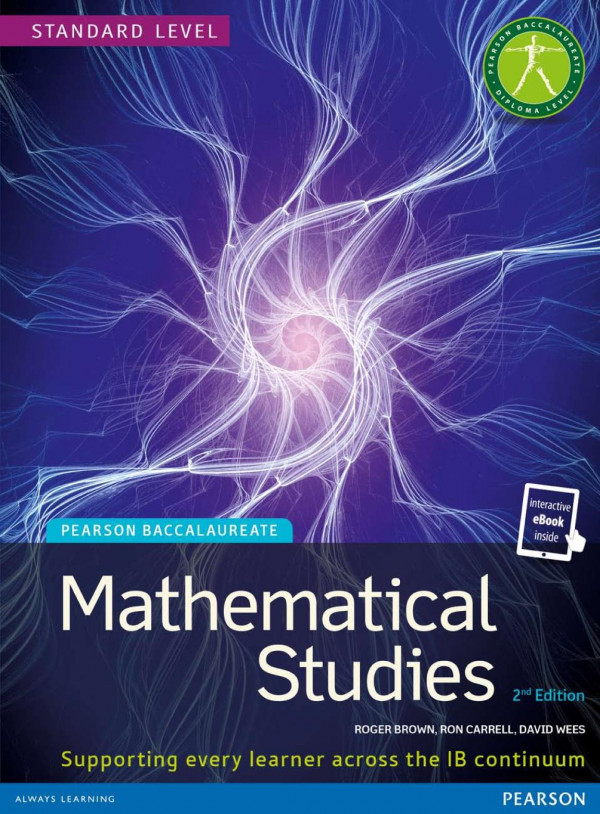
IB Mathematical Studies 2nd Edition by Roger Brown, Ron Carrell, David Wees ISBN 144793847X 9781447938477

Original price was: $50.00.$35.00Current price is: $35.00.
IB Mathematical Studies 2nd Edition by Roger Brown, Ron Carrell, David Wees – Ebook PDF Instant Download/Delivery: 144793847X, 9781447938477
Full download IB Mathematical Studies 2nd Edition after payment
Product details:
ISBN 10: 144793847X
ISBN 13: 9781447938477
Author: Roger Brown, Ron Carrell, David Wees
Written by expert IB teachers, examiners and curriculum specialists, and with comprehensive coverage of the latest syllabi, this resource uses clear explanations, worked examples and practice questions to develop students’ mathematical knowledge, as well as their logical and critical thinking.
Table of contents:
Chapter 1: Prior Learning Topics
-
1.1 Numbers
-
Classifying numbers
-
Order of operations
-
Number theory
-
Ratios, percentages and proportions
-
-
1.2 Fractions
-
Simplifying fractions
-
Multiplying fractions
-
Dividing fractions
-
Adding and subtracting fractions
-
-
1.3 Algebra
-
Expanding and factorizing
-
Rearranging formulae
-
Evaluating expressions
-
Solving linear equations in one variable
-
-
1.4 Algebra extended
-
Rewriting linear equations in two variables
-
Solving a system of linear equations in two variables
-
Order relations
-
Intervals on a real number line
-
-
1.5 Geometry
-
Basic concepts
-
Perimeter and areas of two-dimensional shapes
-
Plotting on the x-, y-coordinate plane
-
Midpoint of a line segment
-
Right triangles and Pythagoras’ theorem
-
Distance between two points
-
-
1.6 Financial mathematics
-
World currencies
-
Currency conversion
-
-
1.7 Statistics
-
Data collection
-
Bar charts
-
Pie charts
-
Pictograms
-
Chapter 2: Number and Algebra
-
2.1 Organization of numbers: Rational numbers, Real numbers
-
2.2 Numbers in calculations: Estimation
-
2.3 Standard form
-
2.4 International units of measure
-
2.5 Currency conversions, Commission
-
2.6 Simultaneous equations: Elimination, Substitution, Using your GDC
-
2.7 Quadratic equations: Factorizing, Quadratic formula, Using the GDC
Chapter 3: Geometry
-
3.1 The equation of a line
-
3.2 The gradient of a line
-
3.3 The intercepts of a line
-
3.4 Intersection of two lines
-
3.5 Parallel and perpendicular lines
Chapter 4: Mathematical Models
-
4.1 Relations and functions
-
4.2 Domain and range
-
4.3 Function notations
-
4.4 Linear functions
-
4.5 Linear model
-
4.6 Quadratic functions
-
4.7 Quadratic models
-
4.8 Exponential functions
-
4.9 Exponential models
Chapter 5: More Mathematical Models
-
5.1 Higher order polynomial functions
-
5.2 Rectangular hyperbolic functions
-
5.3 Unfamiliar functions
-
5.4 Solving equations involving combinations of unfamiliar functions
Chapter 6: More Geometry
-
6.1 Advanced right-angled trigonometry
-
6.2 Further right-angled trigonometry
-
6.3 The sine rule
-
6.4 The cosine rule
-
6.5 The area of a triangle
-
6.6 The geometry of three-dimensional solids
-
6.7 Application of three-dimensional geometry
Chapter 7: Sequences and Series
-
7.1 Arithmetic sequences
-
7.2 Arithmetic series
-
7.3 Geometric sequences
-
7.4 Geometric series
-
7.5 Compound interest
-
7.6 Financial maths on the calculator
-
7.7 Inflation and depreciation
Chapter 8: Sets
-
8.1 Introduction to set theory
-
8.2 Subsets and complements of sets
-
8.3 The union and intersection of sets
-
8.4 Introduction to Venn diagrams
-
8.5 Applications of Venn diagrams
-
8.6 Venn diagrams involving three sets
Chapter 9: Logic
-
9.1 Introduction to symbolic logic
-
9.2 Implication and equivalence
-
9.3 Negation and conjunction
-
9.4 Disjunction and exclusive disjunction
-
9.5 Truth tables
-
9.6 Inverse, converse, contrapositive
-
9.7 Logical equivalence, tautologies, and contradictions
Chapter 10: Probability
-
10.1 Diagrams for experiments
-
10.2 Classical probability
-
10.3 Mutually exclusive events
-
10.4 Combined events
-
10.5 Independent events
-
10.6 Dependent events
-
10.7 Conditional probability
-
10.8 The probability of ‘at least one’
-
10.9 Summarization of the laws of probability
-
10.10 Connecting independent and mutually exclusive events
Chapter 11: Descriptive Statistics
-
11.1 Classification of data
-
11.2 Discrete data
-
11.3 Continuous data
-
11.4 Measures of central tendency
-
11.5 Graphs of continuous data
-
11.6 Box-and-whisker diagram
-
11.7 Measures of dispersion
Chapter 12: Statistical Applications
-
12.1 The normal distribution
-
12.2 Line of best fit (regression line)
-
12.3 Hypothesis testing
-
12.4 The chi-square hypothesis test
-
12.5 The chi-square test – manual working
Chapter 13: Calculus
-
13.1 The definition of the derivative
-
13.2 The power rule
-
13.3 Gradients of curves and equations of tangents and normals
-
13.4 Increasing and decreasing functions
-
13.5 Applications of calculus
Chapter 14: Review Questions
Chapter 15: Practice Papers
-
Preparing for your IB exams
-
First practice exam
-
Second practice exam
-
Solutions to first practice exam
-
Solutions to second practice exam
Chapter 16: The Project
-
Time management during the project
-
The assessment criteria
-
Sample project ideas
-
Project checklist
-
Sample IB project – Relationship between temperature and precipitation
Chapter 17: Theory of Knowledge
People also search for:
ib mathematical studies sl
ib questionbank mathematical studies 3rd edition
mathematical studies vs mathematics ib
mathematical studies for the ib diploma
is ib math hard
Tags: Roger Brown, Ron Carrell, David Wees, IB Mathematical Studies