

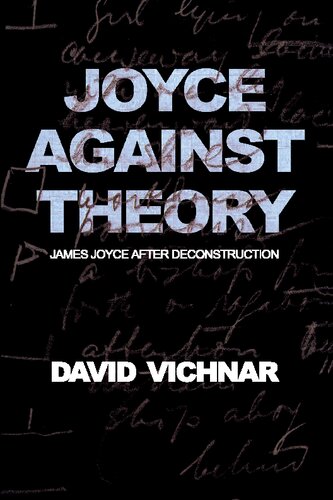
Joyce Against Theory 1st Edition by David Vichnar IBSN 8073083159 9788073083151
Original price was: $50.00.$35.00Current price is: $35.00.
Joyce Against Theory 1st Edition by David Vichnar – Ebook PDF Instant Download/Delivery: 8073083159, 9788073083151
Full download Joyce Against Theory 1st Edition after payment
Product details:
ISBN 10: 8073083159
ISBN 13: 9788073083151
Author: David Vichnar
“Joyce’s writing is itself theoretical through and through, and much can be gleaned from mapping the developments in Joyce studies that have, in their own variously focused theoretical readings, identified, analyzed, evaluated and creatively re-enacted the crucial gestures of Joyce’s texts.”
This study sets out to map the genealogy of a possible location of “Joyce” and “theory” in present-day James Joyce studies, demonstrating how the encounter between Joyce and theory changes the what and the how of reading, producing both a Joyce-again of theory and Joyce-inflected theory.
“Studies such as Vichnar’s are not only desirable for students new to theoretical Joyce, they are necessary. […] Vichnar has done what few critics are willing to do and has produced a book that presents an overview of Joyce theory with the necessary critical perspicacity to grant equal worth to each of these approaches. […] It is precisely in historicising the debates around theoretical Joyce that Vichnar’s book is most important.” (Arthur Rose, James Joyce Broadsheet)
David Vichnar is the editor of the online journal Hypermedia Joyce Studies, and of the essay collections Hypermedia Joyce (with Louis Armand; 2010), Thresholds: Essays on the International Prague Poetry Scene (edited, 2011) and, most recently, Praharfeast: James Joyce in Prague (with Michael Groden & David Spurr; 2012)
Joyce Against Theory 1st Table of contents:
Part I: The Joycean Avant-Garde and its Echoes
- Chapter 1: Preliminary Notes on the Novel, Experiment, and the Avant-Garde
- Contextualizing Joyce within broader literary modernism and the avant-garde.
- Discussion of experimental narrative techniques.
- Chapter 2: Joycean Avant-Garde: Parallax, Metempsychosis, Concretism, Forgery
- Deep dive into specific Joycean techniques that challenge conventional reading and invite theoretical inquiry.
- Examples from Ulysses and Finnegans Wake.
- Chapter 3: Joycean (?) Traditions: Hayman, Adams, Werner, Levitt
- Examination of early critical responses and their engagement with Joyce’s innovative methods.
- How initial interpretations laid groundwork for later theoretical approaches.
- Chapter 4: Post-Joyce
- The impact of Joyce on subsequent experimental writers and literary theory.
Part II: Francophone Receptions and Theoretical Engagements
- Chapter 5: “Equivalent Images, Analogous Sensations”: Nathalie Sarraute
- Analysis of Sarraute’s engagement with Joycean techniques and concepts.
- Chapter 6: “The Additional Step in Subverting the System”: Alain Robbe-Grillet
- Exploring how the nouveau roman connects with or departs from Joycean experimentalism.
- Chapter 7: “Forever Advancing on Shifting Sands”: Claude Simon
- Simon’s narrative techniques and their relation to Joyce’s complex textual structures.
- Chapter 8: “Anamnesis of Leitmotifs”: Robert Pinget
- Tracing thematic and structural echoes of Joyce in Pinget’s work.
- Chapter 9: “To Fail This Way, in a Superhuman Attempt”: Claude Mauriac
- Mauriac’s use of experimental forms and his relationship to the Joycean project.
- Chapter 10: “Do Whatever You Can to Get the Most Out of It”: Michel Butor
- Butor’s hypertextual and reader-centric approaches as a continuation of Joycean textual play.
Part III: Anglophone Engagements and Reinterpretations
- Chapter 11: “A Horroshow Crack on the Ooko or Earhole”: Anthony Burgess
- Burgess’s critical and creative responses to Joyce, particularly Finnegans Wake.
- Chapter 12: “The Einstein of the Novel”: B. S. Johnson
- Johnson’s experimental fiction and its Joycean influences.
- Chapter 13: “This Distanced Technique of Writing from the Unconscious”: Alan Burns
- Exploring Burns’s narrative experiments and their connection to Joycean interiority.
- Chapter 14: “The Voyce Crying in the Wilderness, Rejoice with Me”: Brigid Brophy
- Brophy’s feminist and experimental engagements with Joycean themes and language.
- Chapter 15: “A Death Wish and a Sense of Sin”: Ann Quin
- Quin’s experimental fiction and its Joycean echoes.
- Chapter 16: “Who’s She When She’s (Not) at Home”: Christine Brooke-Rose (1964–1975)
- Brooke-Rose’s postmodern and experimental approaches to language and narrative, building on Joyce.
- Chapter 17: “The Self Who Could Do More”: William Gaddis
- Gaddis’s complex, encyclopedic novels and their Joycean lineage.
- Chapter 18: “That Style Which Deliberately Exhausts Its Possibilities”: John Barth
- Barth’s postmodern metafiction and his engagement with literary precursors like Joyce.
- Chapter 19: “Never Cut When You Can Paste”: William H. Gass
- Gass’s theoretical and experimental writing, influenced by Joyce’s textual practices.
- Chapter 20: “The Book Remains Problematic, Unexhausted”: Donald Barthelme
- Barthelme’s short fiction and its playful, experimental engagement with language and narrative.
- Chapter 21: “Orpheus Puts Down Harp”: Thomas Pynchon
- Pynchon’s encyclopedic, multi-layered novels and their debt to Joycean complexity.
Part IV: Broader Theoretical Trajectories and Contemporary Resonances
- Chapter 22: “A New Mythology for the Space Age”: William S. Burroughs
- Burroughs’s cut-up technique and its relationship to Joycean linguistic experimentation.
- Chapter 23: Making Joyce “Part of the Landscape”: The American Reception
- How American criticism and literature absorbed and reinterpreted Joyce.
- Chapter 24: Joycean OULIPO, Oulipian Joyce: 1960–1978, Before and After
- The intersection of Joyce’s work with the Oulipo group’s constrained writing techniques.
- Chapter 25: “The Centenarian Still Seems Avant-Garde”: Experiment in the 21st Century
- The enduring relevance of Joycean experimentation in contemporary literature.
- Chapter 26: “The Funnymental Novel of Our Error”
- Further exploration of Finnegans Wake‘s unique theoretical challenges.
- Chapter 27: Joyce as Such / Tel Quel Joyce: 1960–1982, and Beyond
- The French reception of Joyce, particularly the Tel Quel group, and its theoretical implications.
- Chapter 28: Post-2000 Coda: Conceptual Joyce
- Contemporary approaches to Joyce, including conceptual writing and new materialisms.
- Chapter 29: Misinterpreting the Avant-Garde: Raczymow, Hadengue, Levé
- Critique of certain interpretations of the avant-garde in relation to Joyce.
- Chapter 30: Breaking “The Recursive Loops of Realism”: Mitchell, Hall, Home, Moore
- How contemporary authors continue to break from realistic conventions, drawing from Joyce.
- Chapter 31: “Crucial to the Health of the Ecosystem”: Amerika, Foster Wallace, Goldsmith, Danielewski, Cohen
- The influence of Joyce on contemporary experimental and postmodern writers, including hypermedia and digital literature.
People also search for Joyce Against Theory 1st:
joyce against theory
joyce a joyce
joyce agatone
joyce as theory
joyce carol oates against nature
Tags: David Vichnar, Joyce, Against, Theory