

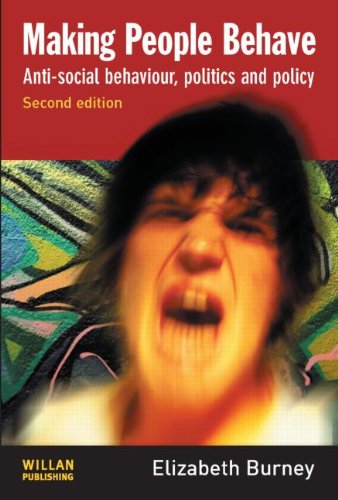
Making People Behave Anti social Behaviour Politics and Policy 2nd Edition by Elizabeth Burney 9781134026180 1134026188


Original price was: $50.00.$35.00Current price is: $35.00.
Making People Behave Anti social Behaviour Politics and Policy 2nd Edition by Elizabeth Burney – Ebook PDF Instant Download/Delivery: 9781134026180, 1134026188
Full download Making People Behave Anti social Behaviour Politics and Policy 2nd Edition after payment
Product details:
ISBN 10: 1134026188
ISBN 13: 9781134026180
Author: Elizabeth Burney
‘Anti-social behaviour’ has become a label attached to a huge range of nuisance and petty crime, and rarely out of the headlines as tackling this problem has become a central part of the British government’s crime control policy. At the same time ‘anti-social behaviour’ has provided the lever for control mechanisms ranging from the draconian to the merely bureaucratic, most notably in the shape of the Anti-Social Behaviour Order, or ASBO. This book seeks to explain why anti-social behaviour, as a focus of political rhetoric, legislative activity and social action, has gained such a high profile in Britain in recent years, and it provides a critical examination of current policies of enforcement and exclusion. It examines both the political roots of the variety of new measures which have been introduced and also the deeper social explanations for the unease expressed about anti-social behaviour more generally. This updated new edition of Making People Behave takes full account of recent legal and policy changes, including the ‘Respect’ agenda, as well as relevant research on the subject. It also contains two wholly new chapters, one of them devoted to the expanding web of behaviour controls, the other on Scotland which provides an alternative to the enforcement-oriented approach evident in England and Wales – complementing the wider coverage in the book of developments in North America and Europe.
Making People Behave Anti social Behaviour Politics and Policy 2nd Table of contents:
Chapter 1: Why ‘anti-social behaviour’?
- Disorder and fear
- What is anti-social behaviour?
- Structuring the scene
- Notes
Chapter 2: New Labour, new ideas
- Borrowing American theories
- Civil remedies
- Delivering local order
- Implementing the ASBO
- Gingering-up: the Anti-Social Behaviour Unit and the Anti-Social Behaviour Act 2003
- Targeting incivilities
- Alcohol – a new focus
- Spot-fines – another magic bullet
- Housing and bad behaviour
- Problem families
- The Respect agenda
- Focus on families and parents
- Compliance by threat
- Notes
Chapter 3: A short history of behaviour control
- Notes
Chapter 4: Engines of bad behaviour
- Communities and neighbourhoods
- The role of social housing
- Youth, again
- Analysing the ‘youth problem’
- Victimisation
- Deprivation
- Status change
- Mental health
- Masculinity
- Families and parents
- Intolerance
- Contested space
- Drugs, alcohol and incivilities
- Technology, noise and anti-social behaviour
- A culture of complaint?
- Notes
Chapter 5: The ASBO — law and practice
- The use of ASBOs
- The decline of the ASBO
- Prohibitions
- Enforcement
- Publicity
- Who receives ASBOs?
- Children
- People with mental disorders and other problems
- Social tenants
- Prostitutes and beggars
- Notes
Chapter 6: Expanding behaviour control
- The parenting order
- New police powers
- Alternative remedies under previous legislation
- Family intervention projects
- Further civil remedies
- Fixed penalty notices, Noise Act and by-laws
- Protection for victims and witnesses of anti-social behaviour
- Notes
Chapter 7: How different is Scotland?
- Enforcement through housing
- What next for action against anti-social behaviour in Scotland?
Chapter 8: Enforcement and problem-solving in the local context
- Crime control by local housing departments
- Local authorities and crime prevention
- Two places, two worlds
- Witnesses and evidence
- The role of mediation
- Discussion
- Notes
Chapter 9: Cultures of control — a European dimension Exercises
- Populist politics and public safety in the Netherlands
- Rotterdam’s social control
- The demand for tougher measures
- Street wardens
- The community court
- Children’s misbehaviour and youth trouble
- Neighbour problems
- What about Sweden?
- Youth problems
- Drugs and alcohol
- Public order
- Signs of polarisation?
- Discussion
- Postscript to second edition
- Notes
Chapter 10: Conclusions
- Networks of control
- Enforcement — the only answer?
- National comparisons
- Resistance to punitiveness?
- Rallying communities
People also search for Making People Behave Anti social Behaviour Politics and Policy 2nd:
what makes people behave differently or similarly
what makes people behave differently
how to influence people’s behavior
why do we behave differently
making behavior change stick
Tags:
Behave,Anti social Behaviour,Elizabeth Burney