

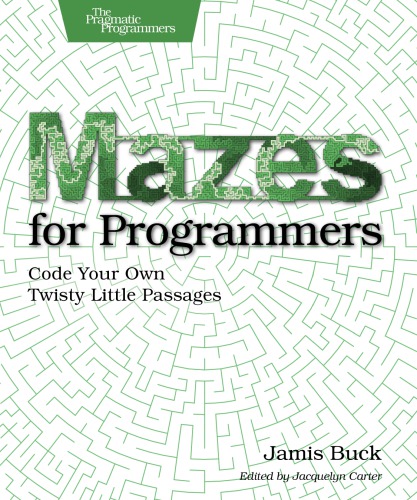
Mazes for Programmers Code Your Own Twisty Little Passages 1st Edition by Jamis Buck 9781680503968 1680503960

Original price was: $50.00.$35.00Current price is: $35.00.
Mazes for Programmers Code Your Own Twisty Little Passages 1st Edition by Jamis Buck – Ebook PDF Instant Download/Delivery: 9781680503968, 1680503960
Full download Mazes for Programmers Code Your Own Twisty Little Passages 1st Edition after payment
Product details:
ISBN 10: 1680503960
ISBN 13: 9781680503968
Author: Jamis Buck
Unlock the secrets to creating random mazes! Whether you’re a game developer, an algorithm connoisseur, or simply in search of a new puzzle, you’re about to level up. Learn algorithms to randomly generate mazes in a variety of shapes, sizes, and dimensions. Bend them into Moebius strips, fold them into cubes, and wrap them around spheres. Stretch them into other dimensions, squeeze them into arbitrary outlines, and tile them in a dizzying variety of ways. From twelve little algorithms, you’ll discover a vast reservoir of ideas and inspiration.
From video games to movies, mazes are ubiquitous. Explore a dozen algorithms for generating these puzzles randomly, from Binary Tree to Eller’s, each copiously illustrated and accompanied by working implementations in Ruby. You’ll learn their pros and cons, and how to choose the right one for the job.
You’ll start by learning six maze algorithms and transition from making mazes on paper to writing programs that generate and draw them. You’ll be introduced to Dijkstra’s algorithm and see how it can help solve, analyze, and visualize mazes. Part 2 shows you how to constrain your mazes to different shapes and outlines, such as text, circles, hex and triangle grids, and more. You’ll learn techniques for culling dead-ends, and for making your passages weave over and under each other. Part 3 looks at six more algorithms, taking it all to the next level. You’ll learn how to build your mazes in multiple dimensions, and even on curved surfaces.
Through it all, you’ll discover yourself brimming with ideas, the best medicine for programmer’s block, burn-out, and the grayest of days. By the time you’re done, you’ll be energized and full of maze-related possibilities!
Mazes for Programmers Code Your Own Twisty Little Passages 1st Table of contents:
Part 1: The Basics
Chapter 1: Your First Random Mazes
Preparing the Grid
The Binary Tree Algorithm
The Sidewinder Algorithm
Your Turn
Chapter 2: Automating and Displaying Your Mazes
Introducing Our Basic Grid
Implementing the Binary Tree Algorithm
Displaying a Maze on a Terminal
Implementing the Sidewinder Algorithm
Rendering a Maze as an Image
Your Turn
Chapter 3: Finding Solutions
Dijkstra’s Algorithm
Implementing Dijkstra’s
Finding the Shortest Path
Making Challenging Mazes
Coloring Your Mazes
Your Turn
Chapter 4: Avoiding Bias with Random Walks
Understanding Biases
The Aldous-Broder Algorithm
Implementing Aldous-Broder
Wilson’s Algorithm
Implementing Wilson’s Algorithm
Your Turn
Chapter 5: Adding Constraints to Random Walks
The Hunt-and-Kill Algorithm
Implementing Hunt-and-Kill
Counting Dead Ends
The Recursive Backtracker Algorithm
Implementing the Recursive Backtracker
Your Turn
Part 2: Next Steps
Chapter 6: Fitting Mazes to Shapes
Introducing Masking
Implementing a Mask
ASCII Masks
Image Masks
Your Turn
Chapter 7: Going in Circles
Understanding Polar Grids
Drawing Polar Grids
Adaptively Subdividing the Grid
Implementing a Polar Grid
Your Turn
Chapter 8: Exploring Other Grids
Implementing a Hex Grid
Displaying a Hex Grid
Making Hexagon (Sigma) Mazes
Implementing a Triangle Grid
Displaying a Triangle Grid
Making Triangle (Delta) Mazes
Your Turn
Chapter 9: Braiding and Weaving Your Mazes
Braiding Mazes
Cost versus Distance
Implementing a Cost-Aware Dikstra’s Algorithm
Introducing Weaves and Insets
Generating Weave Mazes
Your Turn
Part 3: More Algorithms
Chapter 10: Improving Your Weaving
Kruskal’s Algorithm
Implementing Randomized Kruskal’s Algorithm
Better Weaving with Kruskal
Implementing Better Weaving
Your Turn
Chapter 11: Growing With Prim’s
Introducing Prim’s Algorithm
Simplified Prim’s Algorithm
True Prim’s Algorithm
The Growing Tree Algorithm
Your Turn
Chapter 12: Combining, Dividing
Eller’s Algorithm
Implementing Eller’s Algorithm
Recursive Division
Implementing Recursive Division
Your Turn
Part 4: Shapes and Surfaces
Chapter 13: Extending Mazes into Higher Dimensions
Understanding Dimensions
Introducing 3D Mazes
Adding a Third Dimension
Displaying a 3D Maze
Representing Four Dimensions
Your Turn
Chapter 14: Bending and Folding Your Mazes
Cylinder Mazes
Möbius Mazes
Cube Mazes
Sphere Mazes
Your Turn
People also search for Mazes for Programmers Code Your Own Twisty Little Passages 1st:
mazes for programmers book
coding projects for fun
games for programmers
how to do blockly maze level 7
programming mazes
Tags: Mazes, Programmers, Jamis Buck