

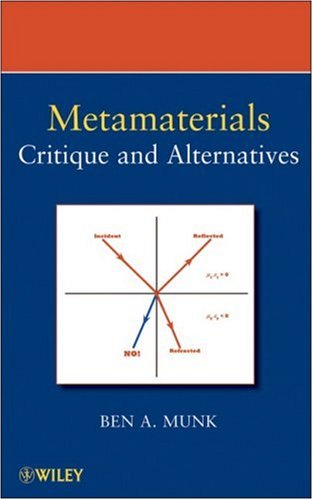
Metamaterials Critique and Alternatives 1st Edition by Benedikt Munk ISBN 0470377046 9780470377048

Original price was: $50.00.$35.00Current price is: $35.00.
Metamaterials: Critique and Alternatives 1st Edition by Benedikt A. Munk – Ebook PDF Instant Download/Delivery: 0470377046, 978-0470377048
Full download Metamaterials: Critique and Alternatives 1st Edition after payment
Product details:
ISBN 10: 0470377046
ISBN 13: 978-0470377048
Author: Benedikt A. Munk
Metamaterials: Critique and Alternatives 1st Edition: A Convincing and Controversial Alternative Explanation of Metamaterials with a Negative Index of Refraction
In a book that will generate both support and controversy, one of the world’s foremost authorities on periodic structures addresses several of the current fashions in antenna design―most specifically, the popular subject of double negative metamaterials. Professor Munk provides a comprehensive theoretical electromagnetic investigation of the issues and concludes that many of the phenomena claimed by researchers may be impossible. While denying the existence of negative refraction, the author provides convincing alternative explanations for some of the experimental examples in the literature.
Although the debate on this subject is just beginning, Professor Munk has received support by various numerical simulations, winning him the encouragement of numerous experts in the field. The issues that are raised here have not been addressed thoroughly by the metamaterials community, and this book will serve as a catalyst for much healthy debate and discussion.
Metamaterials: Critique and Alternatives is destined to become a classic resource for graduate students and researchers in electromagnetics, antenna theory, materials research, and chemistry.
Metamaterials: Critique and Alternatives 1st Edition Table of contents:
Chapter 1: Why Periodic Structures Cannot Synthesize Negative Indices of Refraction.
1.1 Introduction.
1.2 What Currently is Assumed about Veselago’s Medium.
1.3. Fantastic Designs Could be Realized if Veselago’s Material Existed.
1.4. How Veselago’s Medium is Envisioned to be Synthesized Using Periodic Structures.
1.5. How Does A Periodic Structure Refract.
1.6. On the Field Surrounding an Infinite Periodic Structure of Arbitrary Wire Elements Located in One or More Arrays.
1.7. On Increasing “Evanescent” Waves: a Fatal Misconception.
1.8 Preliminary Conclusion: Synthesizing Veselago’s Medium by a Periodic Structure Is Not Feasible.
1.9. On Transmission Line Dispersion: Backward Traveling Waves.
1.10. Regarding Veselago’s Conclusion: are There Deficiencies?
1.11. Conclusions.
1.12. Common Misconceptions.
References.
Chapter 2: On Cloaks and Reactive Radomes.
2.1. Cloaks.
2.2. Reactive Radomes.
2.3. Common Misconceptions.
2.4. Concluding Remarks.
References.
Chapter 3: Absorbers with Windows: Absorb at Some Frequencies While Transparent at Others. also Rasorbers.
3.1. Introduction.
3.2. Statement of the Problem.
3.3. Concept.
3.4. Conceptual Designs.
3.5. Extension to Arbitrary Polarization.
3.6. The High Frequency Band.
3.7. Complete Conceptual Rasorber Design.
3.8. Practical Designs.
3.9. Other applications of traps: multiband arrays.
References.
Chapter 4: On Designing Absorbers for Oblique Angle of Incidence.
4.1. Lagarkov’s and Classical Designs.
4.2. The Salisbury Screen.
4.3. Scan Compensation.
4.4. Frequency Compensation.
4.5. The Circuit Analog Absorbers.
4.6. Other Designs: Comparison and Discussion.
4.7. Conclusion.
References.
Chapter 5. The Titan Antenna: An Alternative to Magnetic Ground Planes.
5.1. Introduction.
5.2. Layout of the Antenna.
5.3. On Double-Band Matching in General.
5.4. Matching of the Sleeve Elements.
5.5. Further Matching: The Main Distribution Network.
5.6. The Balun.
5.7. The Radiation Pattern.
5.8. Something that Sounds Too Good To Be True, It Usually Is!
5.9. Efficiency Measurements.
5.10. A Common Misconception.
5.11. We Put the magnetic Ground Plane to Rest!
5.12. Conclusions.
References.
Chapter 6: Summary and Concluding Remarks.
6.1 Background.
6.2 The Features of Veselago’s Material.
6.3 What Can a Periodic Structure Actually Simulate?
6.4 Did Veselago Choose the Wrong Branch Cut?
6.5 Could we Ever Have a Negative Index of Refraction?
6.6 Could Veselago Have Avoided the Wrong Solution?
6.7 So What Came Out Of It?
6.8 Is Publishing the Ultimate Goal in Scientific Research?
6.9 What Excites a Scientist?
6.10 How Far Have We Gone in Our Self-Deception?
6.11 But Didn’t Anyone Suspect Anything?
6.12 How Realistic Are Small Arrays?
People also search for Metamaterials: Critique and Alternatives 1st Edition:
critique available materials and appropriate techniques
critiquing meta analysis
difference between meta analysis and case study
difference meta analysis and systematic review
difference between meta analysis and content analysis
examples of metamaterials
Tags:
Benedikt Munk,Metamaterials,Critique,Alternatives