

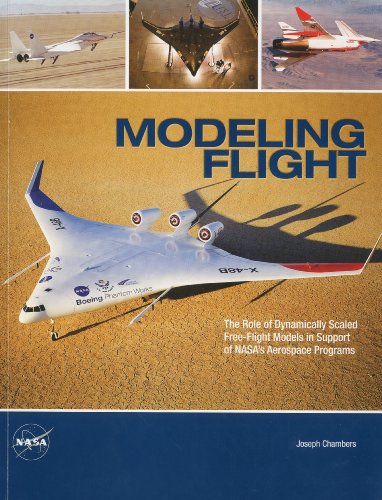
Modeling Flight The Role of Dynamically Scaled Free Flight Models in Support of NASA’s Aerospace Programs 1st Edition by Joseph Chambers, National Aeronautics and Space Administration ISBN 1494743299 9781494743291


Original price was: $50.00.$35.00Current price is: $35.00.
Modeling Flight: The Role of Dynamically Scaled Free-Flight Models in Support of NASA’s Aerospace Programs 1st Edition by Joseph R. Chambers, National Aeronautics and Space Administration – Ebook PDF Instant Download/Delivery: 1494743299, 978-1494743291
Full download Modeling Flight: The Role of Dynamically Scaled Free-Flight Models in Support of NASA’s Aerospace Programs 1st Edition after payment
Product details:
ISBN 10: 1494743299
ISBN 13: 978-1494743291
Author: Joseph R. Chambers, National Aeronautics and Space Administration
Modeling Flight: The Role of Dynamically Scaled Free-Flight Models in Support of NASA’s Aerospace Programs 1st Edition: The state of the art in aeronautical engineering has been continually accelerated by the development of advanced analysis and design tools. Used in the early design stages for aircraft and spacecraft, these methods have provided a fundamental understanding of physical phenomena and enabled designers to predict and analyze critical characteristics of new vehicles, including the capability to control or modify unsatisfactory behavior. For example, the relatively recent emergence and routine use of extremely powerful digital computer hardware and software has had a major impact on design capabilities and procedures. Sophisticated new airflow measurement and visualization systems permit the analyst to conduct micro- and macro-studies of properties within flow fields on and off the surfaces of models in advanced wind tunnels. Trade studies of the most efficient geometrical shapes for aircraft can be conducted with blazing speed within a broad scope of integrated technical disciplines, and the use of sophisticated piloted simulators in the vehicle development process permits the most important segment of operations—the human pilot—to make early assessments of the acceptability of the vehicle for its intended mission. Knowledgeable applications of these tools of the trade dramatically reduce risk and redesign, and increase the marketability and safety of new aerospace vehicles. Arguably, one of the more viable and valuable design tools since the advent of flight has been testing of subscale models. As used herein, the term “model” refers to a physical article used in experimental analyses of a larger full-scale vehicle. The reader is probably aware that many other forms of mathematical and computer-based models are also used in aerospace design; however, such topics are beyond the intended scope of this document. Model aircraft have always been a source of fascination, inspiration, and recreation for humans since the earliest days of flight. Within the scientific community, Leonardo da Vinci, George Cayley, and the Wright brothers are examples of early aviation pioneers who frequently used models during their scientific efforts to understand and develop flying machines. Progress in the technology associated with model testing in worldwide applications has firmly established model aircraft as a key element in new aerospace research and development programs. Models are now routinely used in many applications and roles, including aerodynamic data gathering in wind tunnel investigations for the analysis of full-scale aircraft designs, proof-of-concept demonstrators for radical aeronautical concepts, and problem-solving exercises for vehicles already in production. The most critical contributions of aerospace models are to provide confidence and risk reduction for new designs and to enhance the safety and efficiency of existing configurations. The objective of the material presented here is to provide the reader with an overview of some of the more interesting free-flight model testing techniques that have been developed and the role that the testing has played in fundamental and applied research, as well as in support of the development of some of the Nation’s more important civil and military aerospace programs. The material also includes discussions of the development of the specialized facilities and equipment required for dynamic model tests.
Modeling Flight: The Role of Dynamically Scaled Free-Flight Models in Support of NASA’s Aerospace Programs 1st Edition Table of contents:
- Background
- Objectives
- Role of Free-Flight Testing
- Principles of Dynamic Scaling
- Rigid-Body Dynamic Models
- Incompressible Flow
- Compressible Flow
- Limitations and Interpretation of Results
- Historical Development by the NACA and NASA
- Spin Research Facilities
- The Langley 20-Foot Spin Tunnel
- Wind Tunnel Free-Flight Research Facilities
- The Langley 12-Foot Free-Flight Tunnel
- The Langley Full-Scale Tunnel
- The Ames Hypervelocity Free-Flight Facilities
- The Ames 40-by-80-Foot Tunnel
- Outdoor Free-Flight Facilities and Ranges
- Langley Unpowered Drop Models
- Dryden Unpowered Drop Models
- Langley Powered Free-Flight Models
- Langley Control Line Facility
- Ames Powered Free-Flight Models
- Dryden Powered Free-Flight Models
- Wallops Rocket-Boosted Models
- Selected Applications
- Dynamic Stability and Control
- Low-Speed Research
- High-Speed Research: Rocket-Propelled Models
- Supersonic Tests at Ames
- Unconventional Configurations
- The Early Days
- V/STOL Configurations
- Parawing Configurations
- Variable Geometry
- Space Capsules
- Reentry Vehicles and Lifting Bodies
- Supersonic Transports
- Vehicle/Store Separation
- Advanced Civil Aircraft
- Wake Vortex Hazard
- Towed Vehicles
- Concept Demonstrators
- Summary
- Flight at High Angles of Attack
- Fighters
- Summary
- Spinning and Spin Recovery
- Background
- Military Configurations
- General-Aviation Configurations
- Skewed Wing Configuration
- Summary
- Spin Entry and Poststall Motions
- Spin Entry
- Military Configurations
- General-Aviation Configurations
- Jet Transport Upset Recovery
- Tumbling
- Other Studies
- Summary
- Associated Test Techniques
- Aerodynamic Data
- Static Tests
- Forced-Oscillation Tests
- Free-to-Roll Tests
- Rotary-Balance Tests
- Free-to-Pitch Tests
- Future Perspectives
People also search for Modeling Flight: The Role of Dynamically Scaled Free-Flight Models in Support of NASA’s Aerospace Programs 1st Edition:
flight dynamics model
modeling and role-modeling theory
modeling and role-modeling
aircraft dynamics from modeling to simulation pdf
airplane flight dynamics
Tags:
Joseph Chambers,National Aeronautics and Space Administration,Modeling Flight The Role,Dynamically Scaled,Free Flight,Models,Support,NASA’s,Aerospace,Programs