

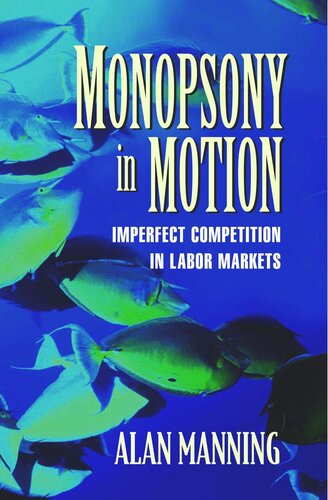
Monopsony in Motion Imperfect Competition in Labor Markets 1st edition by Alan Manning 9781400850679 1400850673


Original price was: $50.00.$35.00Current price is: $35.00.
Monopsony in Motion Imperfect Competition in Labor Markets 1st edition by Alan Manning – Ebook PDF Instant Download/Delivery: 9781400850679, 1400850673
Full download Monopsony in Motion Imperfect Competition in Labor Markets 1st edition after payment
Product details:
ISBN 10: 1400850673
ISBN 13: 9781400850679
Author: Alan Manning
What happens if an employer cuts wages by one cent? Much of labor economics is built on the assumption that all the workers will quit immediately. Here, Alan Manning mounts a systematic challenge to the standard model of perfect competition. Monopsony in Motion stands apart by analyzing labor markets from the real-world perspective that employers have significant market (or monopsony) power over their workers. Arguing that this power derives from frictions in the labor market that make it time-consuming and costly for workers to change jobs, Manning re-examines much of labor economics based on this alternative and equally plausible assumption. The book addresses the theoretical implications of monopsony and presents a wealth of empirical evidence. Our understanding of the distribution of wages, unemployment, and human capital can all be improved by recognizing that employers have some monopsony power over their workers. Also considered are policy issues including the minimum wage, equal pay legislation, and caps on working hours. In a monopsonistic labor market, concludes Manning, the “free” market can no longer be sustained as an ideal and labor economists need to be more open-minded in their evaluation of labor market policies. Monopsony in Motion will represent for some a new fundamental text in the advanced study of labor economics, and for others, an invaluable alternative perspective that henceforth must be taken into account in any serious consideration of the subject.
Monopsony in Motion Imperfect Competition in Labor Markets 1st Table of contents:
PART ONE: BASICS
1 Introduction
1.1 The Advantages of a Monopsonistic Perspective
1.2 Objections to Monopsony and Oligopsony
1.3 Monopsony or Matching or Both?
1.4 Antecedents
1.5 Summary of Chapters and Main Results
2 Simple Models of Monopsony and Oligopsony
2.1 Static Partial Equilibrium Models of Monopsony
2.2 A Simple Model of Dynamic Monopsony
2.3 A Generalized Model of Monopsony
2.4 A General Equilibrium Model of Oligopsony
2.5 Perfect Competition and Monopsony
2.6 A Simple Measure of Monopsony Power
2.7 Positive and Normative Aspects of Monopsony and Oligopsony
2.8 Implications and Conclusions
Appendix 2
3 Efficiency in Oligopsonistic Labor Markets
3.1 Free Entry of Firms
3.2 Endogenous Recruitment Activity
3.3 Elasticity in Labor Supply: Free Entry of Workers
3.4 Elasticity in Labor Supply: Heterogeneity in Reservation Wages
3.5 Heterogeneity in Reservation Wages and Free Entry of Firms
3.6 Multiple Equilibria in Models of Oligopsony: An Application to Ghettoes
3.7 Conclusions
Appendix 3
4 The Elasticity of the Labor Supply Curve to an Individual Firm
4.1 The Employer Size–Wage Effect
4.2 Competing Explanations for the Employer Size–Wage Effect
4.3 Reverse Regressions
4.4 Estimating Models of Dynamic Monopsony
4.5 Estimating the Wage Elasticity of Separations
4.6 The Proportion of Recruits from Employment
4.7 The Elasticity of the Labor Supply Curve Facing the Firm
4.8 The Estimation of Structural Equilibrium Search Models of the Labor Market
4.9 Conclusions
Appendix 4A
Appendix 4B
PART TWO: THE STRUCTURE OF WAGES
5 The Wage Policies of Employers
5.1 The Discriminating Monopsonist
5.2 Non-Manipulable Wage Discrimination
5.3 Empirical Evidence
5.4 Conclusions
Appendix 5
6 Earnings and the Life Cycle
6.1 The Earnings Losses of Displaced Workers
6.2 Sample Selection in the Cross-Sectional Earnings Profile
6.3 The Cross-Sectional Returns to Experience and Tenure in a Job-Shopping Model
6.4 Empirical Approaches to the Estimation of the Life-Cycle Profile in Earnings
6.5 Estimating the Return to Job Mobility
6.6 The Life-Cycle Profile of Earnings for Older Men
6.7 Conclusions
Appendix 6A
Appendix 6B
7 Gender Discrimination in Labor Markets
7.1 The Gender Pay Gap
7.2 Monopsony and the Gender Pay Gap
7.3 The Elasticity in Labor Supply to the Firm and the Market
7.4 Money and Motivation
7.5 Gender Differences in the Returns to Job Mobility
7.6 Gender Differences in the Wage Elasticity of Separations
7.7 Human Capital Explanations of the Gender Pay Gap
7.8 The Effect of UK Equal Pay Legislation
7.9 Prejudice and Monopsony
7.10 Conclusions
8 Employers and Wages
8.1 Explaining the Correlations between Employer Characteristics and Wages
8.2 Monopsony and Compensating Wage Differentials
8.3 Choice of Working Conditions
8.4 Mandated Benefits
8.5 Hours of Work
8.6 Conclusion
Appendix 8
PART THREE: LABOR DEMAND AND SUPPLY
9 Unemployment, Inactivity, and Labor Supply
9.1 Endogenizing Job Search Activity
9.2 Unemployment and Inactivity
9.3 The Job Search of the Employed
9.4 Quits
9.5 Involuntary Unemployment
9.6 Efficiency Wages and Monopsony
9.7 Conclusions
Appendix 9
10 Vacancies and the Demand for Labor
10.1 The Interpretation of Vacancy Statistics
10.2 Filling Vacancies
10.3 The Technology of Matching: Random versus Balanced Matching
10.4 Empirical Evidence on Random and Balanced Matching
10.5 Estimating the Labor Cost Function
10.6 Lay-Offs
10.7 Conclusions
Appendix 10
11 Human Capital and Training
11.1 Acquiring Education
11.2 Employer-Provided General Training
11.3 On-the-Job Specific Training
11.4 Empirical Analyses of Training
11.5 Conclusion
Appendix 11
PART FOUR: WAGE-SETTING INSTITUTIONS AND CONCLUSIONS
12 The Minimum Wage and Trade Unions
12.1 The Minimum Wage and the Distribution of Wages: Spikes and Spillovers
12.2 The Minimum Wage and Changes in US Wage Inequality
12.3 The Minimum Wage and Employment
12.4 Models of Trade Unions
12.5 Trade Unions and Wages
12.6 Conclusions
Appendix 12A
Appendix 12B
13 Monopsony and the Big Picture
13.1 The Sources of Monopsony Power
13.2 A Sense of Perspective
13.3 Monopsony and Labor Market Policy
13.4 Future Directions
13.5 Conclusions
Data Sets Appendix
United States
United Kingdom
Bibliography
Index
People also search for Monopsony in Motion Imperfect Competition in Labor Markets 1st:
monopsony examples in real life
what is meant by monopsony
what is monopsony example
monopsony in a sentence
monopsony in labor markets
Tags:
Monopsony,Motion,Alan Manning