

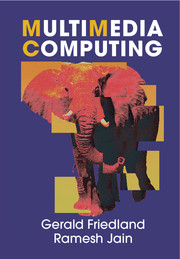
Multimedia Computing 1st edition by Gerald Friedland, Ramesh Jain 9781139984638 1139984632

Original price was: $50.00.$35.00Current price is: $35.00.
Multimedia Computing 1st edition by Gerald Friedland, Ramesh Jain – Ebook PDF Instant Download/Delivery: 9781139984638, 1139984632
Full download Multimedia Computing 1st edition Jain after payment
Product details:
ISBN 10: 1139984632
ISBN 13: 9781139984638
Author: Gerald Friedland, Ramesh Jain
Humans are the best functioning example of multimedia communication and computing – that is, we understand information and experiences through the unified perspective offered by our five senses. This innovative textbook presents emerging techniques in multimedia computing from an experiential perspective in which each medium – audio, images, text, and so on – is a strong component of the complete, integrated exchange of information or experience. The authors’ goal is to present current techniques in computing and communication that will lead to the development of a unified and holistic approach to computing using heterogeneous data sources. Gerald Friedland and Ramesh Jain introduce the fundamentals of multimedia computing, describing the properties of perceptually encoded information, presenting common algorithms and concepts for handling it, and outlining the typical requirements for emerging applications that use multifarious information sources. Designed for advanced undergraduate and beginning graduate courses, the book will also serve as an introduction for engineers and researchers interested in under
Multimedia Computing 1st Table of contents:
1. Introduction
- Organization of This Book
- Recommended Reading
2. Multimedia: A Definition
- Communication in Human Society
- Evolution of Computing and Communication Technology
- Why Multimedia Computing?
- Multimedia: A More Formal Definition
- Recommended Reading
- Exercises
3. Elements of Multimedia Computing
- Experience and Information
- Objects and Events
- Perception
- Perceptual Cycle
- Challenges in Multimedia Systems
- Semantic Gap
- Context and Content
- Recommended Reading
- Exercises
4. Introduction to Sensors
- Types of Sensors
- Properties of Sensors
- Digitization
- Recommended Reading
- Exercises
5. Sound
- The Physics of Sounds
- Observed Properties of Sound
- Recording and Reproduction of Sound
- Microphones
- Reproduction of Sound
- Production of Sound
- Exercises
6. Light
- What Is Light?
- Observed Properties of Light
- Recording Light
- Reproducing Light
- Perception of Light
- Color Spaces
- Light Production
- Recommended Reading
- Exercises
7. Multimedia Documents
- What Is a Document?
- Evolving Nature of Documents
- Stages in Document Creation
- Basic Elements of a Multimedia Authoring Environment
- Representation of a Multimedia Document
- Current Authoring Environments
- Recommended Reading
- Exercises
8. Multimodal Integration and Synchronization
- Multimodal Integration
- Sensor Integration in Multimedia Computing
- Introduction to Synchronization
- Content Synchronization
- Temporal Synchronization
- Synchronization Levels in a System
- Specification of Synchronization
- Deadlines
- Spatial Synchronization
- Recommended Reading
- Exercises
9. Multimedia Systems
- Components of a Multimedia System
- Different Configurations of Multimedia Nodes
- QoS and QoE
- Different Modes of Media Delivery
- Live Video
- Emerging Systems
- Recommended Reading
- Exercises
10. The Human Factor
- Principles of User Interface Design
- Privacy
- Security
- Safety
- Recommended Reading
- Exercises
11. Fundamentals of Compression
- Run-Length Coding
- Information Content and Entropy
- Compression Algorithms
- Weakness of Entropy-Based Compression Methods for Multimedia Data
- Recommended Reading
- Exercises
12. Lossy Compression
- Mathematical Foundation: Vector Quantization
- Perceptual Quantization
- Differential Coding
- Recommended Reading
- Exercises
13. Advanced Perceptual Compression
- Discrete Fourier Transform (DFT)
- Discrete Cosine Transform (DCT)
- The Convolution Theorem
- JPEG
- Psychoacoustics
- MP3
- Perceptual Video Compression
- Recommended Reading
- Exercises
14. Speech Compression
- Properties of a Speech Coder
- Linear Predictive Coding (LPC)
- CELP
- GSM
- Recommended Reading
- Exercises
15. Multimedia Information Retrieval
- Databases
- Structured, Unstructured, and Semistructured Data
- Classic Information Retrieval and Search
- From Information Retrieval to Multimedia Information Retrieval
- Content-Based Retrieval
- Recommended Reading
- Exercises
16. Signal Processing Primer
- Sampling and Quantization
- Levels of Computation
- Thresholding
- Linear Operations
- Nonlinear Filters
- Filter by Example
- Graphical Filters
- Notions for Visual Filters
- Edges
- Segmentation Using Split and Merge
- Recommended Reading
- Standards
- Exercises
17. Multimedia Content Analysis
- From Monomedia to Multimedia Content Analysis
- Setup of a Multimedia Content Analysis Experiment
- Features
- Supervised Learning
- Unsupervised Modeling
- Error Measurement and Evaluation
- Final Remarks
- Recommended Reading
- Exercises
18. Content Analysis Systems
- Speech Activity Detection
- Large Vocabulary Automatic Speech Recognition
- Optical Character Recognition
- Speaker Recognition
- Speaker Diarization
- Face Detection and Face Recognition
- Acoustic Event Detection
- Visual Object Recognition and Tracking
- Multimedia Content Analysis Systems
- Recommended Reading
- Exercises
19. Content and Context
- Connecting Data and Users
- Content and Context
- Context-Only Image Search: Commercial Systems
- Device Parameters
- Recommended Reading
- Exercises
20. Future Topics
- How to Predict the Future
- Future Topics in Multimedia
- Recommended Reading
- Exercises
People also search for Multimedia Computing 1st:
bachelor of science in entertainment and multimedia computing
entertainment and multimedia computing
bs entertainment and multimedia computing
entertainment and multimedia computing jobs
diploma in multimedia computing
Tags:
Multimedia Computing,Gerald Friedland,Ramesh Jain