

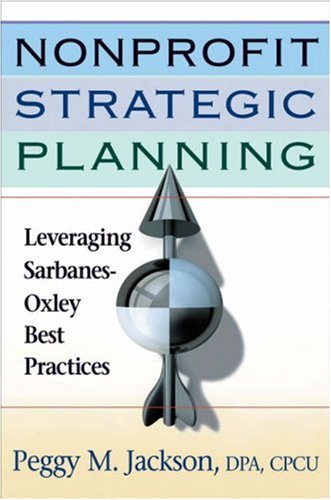
Nonprofit Strategic Planning Leveraging Sarbanes Oxley Best Practices 1st Edition by Peggy M Jackson ISBN 0470180609 9780470180600


Original price was: $50.00.$35.00Current price is: $35.00.
Nonprofit Strategic Planning Leveraging Sarbanes Oxley Best Practices 1st Edition by Peggy M Jackson – Ebook PDF Instant Download/Delivery: 0470180609, 9780470180600
Full download Nonprofit Strategic Planning Leveraging Sarbanes Oxley Best Practices 1st Edition after payment
Product details:
ISBN 10: 0470180609
ISBN 13: 9780470180600
Author: Peggy M Jackson
Praise for
Nonprofit Strategic Planning
Leveraging Sarbanes-Oxley Best Practices
“A robust nonprofit sector is a vital part of a civil society. Keeping the sector strong through effective strategic planning and implementation is a critical assignment. As a thought leader in the nonprofit sector, Dr. Jackson’s book on the relationship of Sarbanes-Oxley best practices with strategic planning is an invaluable resource for nonprofit governing boards and employees. Her step-by-step, practical approach is easy to read and, more important, provides a specific road map to effective planning.”
-Larry Brewster, Dean, College of Professional Studies University of San Francisco
“Dr. Jackson’s practical and straightforward approach to creating a strategic plan is quite refreshing. I believe that more and more nonprofits understand that they need to be run just as any business needs to be run-with focus, clarity, and purpose. The ideas and methodology stress the importance of sound risk management and the rewards of having such a plan in place. I can assure you that the executive director of every nonprofit I represent will receive a copy of this book.”
-Joseph L. DeLucchi, Vice President CAL Insurance & Associates, Inc.
Nonprofit Strategic Planning Leveraging Sarbanes Oxley Best Practices 1st Table of contents:
Part I: Understanding the Landscape: Nonprofits, Governance, and Accountability
- Chapter 1: The Evolving Environment for Nonprofits
- Public trust and the need for accountability.
- Increased scrutiny from donors, regulators, and the public.
- The “post-Enron” and “post-SOX” era for all organizations.
- Defining strategic planning in the nonprofit context.
- Chapter 2: Core Principles of Nonprofit Governance
- Roles and responsibilities of the Board of Directors.
- Fiduciary duties (duty of care, loyalty, obedience).
- Importance of transparency and ethical conduct.
- Chapter 3: The Sarbanes-Oxley Act: Key Provisions and Their Spirit
- Brief overview of relevant SOX sections (e.g., corporate responsibility, enhanced financial disclosures, auditor independence, internal controls, whistle-blower protection).
- Translating the spirit of SOX to nonprofit governance, even without direct legal obligation.
Part II: Integrating SOX Principles into Strategic Planning
- Chapter 4: Strategic Planning Fundamentals for Nonprofits
- Defining mission, vision, and values.
- SWOT analysis and environmental scanning.
- Goal setting and objective development.
- Action planning and implementation.
- Chapter 5: Enhancing Board Oversight through Strategic Planning
- Board engagement in strategic planning processes.
- Establishing clear oversight roles aligned with SOX principles (e.g., audit committee functions).
- Ethical leadership and board conduct.
- Chapter 6: Financial Integrity and Transparency in Strategic Planning
- Strengthening financial reporting and internal controls.
- The role of the finance committee.
- Ensuring financial accountability in strategic initiatives.
- Leveraging external audits.
- Chapter 7: Whistle-blower Protection and Ethical Culture
- Developing effective whistle-blower policies as a strategic imperative.
- Fostering a culture of ethical conduct and compliance.
- Communicating ethical standards throughout the organization.
- Chapter 8: Document Retention and Destruction Policies
- Establishing clear policies for records management.
- Compliance with legal requirements and best practices.
- Importance in protecting the organization.
Part III: Implementation, Communication, and Sustaining Best Practices
- Chapter 9: Action Planning for SOX-Aligned Strategies
- Translating strategic goals into actionable plans.
- Assigning responsibilities and timelines.
- Resource allocation.
- Chapter 10: Communication Strategies: Building Trust with Stakeholders
- Communicating transparency and accountability to donors, funders, and the public.
- Annual reports, website presence, and public relations.
- The link between trust and fundraising success.
- Chapter 11: Monitoring, Evaluation, and Adaptation
- Establishing key performance indicators (KPIs) for strategic goals.
- Regular review and evaluation processes.
- Adapting the strategic plan in response to changing environments and new best practices.
- Chapter 12: Sustaining a Culture of Accountability and Ethics
- Continuous training and development for board and staff.
- Regular review of policies and procedures.
- Leading by example: The role of executive leadership.
People also search for Nonprofit Strategic Planning Leveraging Sarbanes Oxley Best Practices 1st:
nonprofit strategic planning leveraging sarbanes
nonprofit strategic management
nonprofit strategic planning
nonprofit financial strategic plan
nonprofit strategic planning consultant
Tags: Peggy M Jackson, Nonprofit, Strategic Planning