

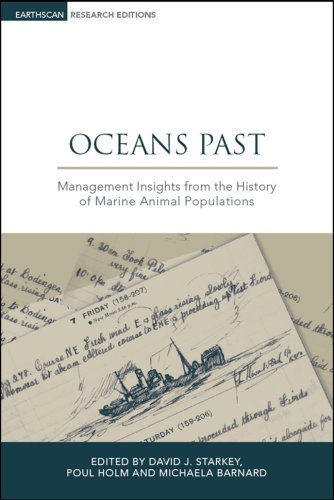
Oceans Past Management Insights from the History of Marine Animal Populations 1st edition by David Starkey, Poul Holm, Michaela Barnard 9781136560354 1136560351


Original price was: $50.00.$35.00Current price is: $35.00.
Oceans Past Management Insights from the History of Marine Animal Populations 1st edition by David Starkey, Poul Holm, Michaela Barnard – Ebook PDF Instant Download/Delivery: 9781136560354, 1136560351
Full download Oceans Past Management Insights from the History of Marine Animal Populations 1st edition after payment
Product details:
ISBN 10: 1136560351
ISBN 13: 9781136560354
Author: David Starkey, Poul Holm, Michaela Barnard
“A fascinating volume, which establishes marine environmental history as a major new discipline for academics, as well as an exciting way to bring history and the natural world alive for the public.” – Andrew A. Rosenberg, University of New Hampshire
“The HMAP project is to be congratulated on this book, which presents vivid, evidence-based reconstructions of historical fisheries and the prolific ecosystems in which they were embedded.” – Tony J. Pitcher, University of British Columbia
“The ingenuity and scholarship of the authors allow us to see how human societies have depended on and influenced marine living resources, from periwinkles to whales.” – Mike Sinclair, Bedford Institute of Oceanography
“This book exalts the surprisingly fruitful marriage of historians and marine scientists—a union that has proven to be one of the most exciting developments in ocean research in recent years.” – Katherine Richardson, University of Copenhagen
For centuries, the seas appeared to offer limitless supplies of food and other resources, with their waters viewed as a cornucopia never to be exhausted. However, in more recent times, episodes such as the extreme exploitation and subsequent collapse of cod populations in the Grand Banks off Newfoundland have exposed the fallaciousness of this view.
Yet, far too often, the lessons from our historical interactions with marine animals are little known, let alone learned.
Based on research from the History of Marine Animal Populations project, Oceans Past examines the complex relationship our forebears had with the sea and the animals that inhabit it. This volume presents eleven studies, covering topics such as fisheries, invasive species, offshore technology, and marine environmental history. These studies bring together the perspectives of historians and marine scientists to enhance understanding of ocean management across the past, present, and future.
In doing so, the book highlights the influence that changes in marine ecosystems have on the politics, welfare, and culture of human societies.
Oceans Past Management Insights from the History of Marine Animal Populations 1st Table of contents:
Figures
Acknowledgements
List of Contributors
List of Acronyms and Abbreviations
Foreword
1 Oceans Past History Meets Marine Science
References
2 Invasive or Native? The Case History of the Common Periwinkle Snail (Littorina littorea) in Northeast North America
Littorina littorea: Ecology, historical distribution and impacts
The cryptogenic status of Littorina littorea
Historical evidence
Archaeological evidence
Ecological evidence
Molecular genetics evidence
Conclusions and significance
Acknowledgements
References
3 Social Conflict, Over-Fishing and Disease in the Florida Sponge Fishery, 1849–1939
Marine sponge biology and uses
Manning the Key West sponge fishery from Bahamian waters, 1839–1890
Prosperity and unintentional conservation, 1890–1905
Technological revolution and competition in the marketplace, 1905–1910
Competition and violence on the water, 1910–1939
Conservation ethics in a time of scarcity
Disease, over-fishing and the unravelling of Florida’s coral reef ecosystems
Acknowledgements
References
4 ‘Quite the Choicest Protein Dish’ The Costs of Consuming Seafood in American Restaurants, 1850–2006
Menus as evidence
Analysing the Menus
Menu price changes since circa 1850
Case 1: Canvas-back duck
Case 2: Abalone
Case 3: American lobster
Conclusion
5 Baiting Our Memories The Impact of Offshore Technology Change on Inshore Species Around Cape Cod, 1860–1895
References
6 Mapping Historic Fishing Grounds in the Gulf of Maine and Northwest Atlantic Ocean
Historical sources
Fishing charts
Fishing logbooks
Methods
Recreating the geography of the 19th-century grounds
Daily Catch Records (DCRs)
Discussion
Acknowledgements
References
7 There She Blew! Yankee Sperm Whaling Grounds, 1760–1920
Methods and sources
Where the grounds were
Names
Geographical boundaries
When the grounds were visited
Opening up, major use and decline
Information from the literature
Information from ‘Townsend extracts’
Conclusions and further work
Acknowledgements
References
8 Depletion within a Decade The American 19th-Century North Pacific Right Whale Fishery
Materials and methods
Results
Conclusion
Acknowledgements
References
9 Sperm Whale Catches and Encounter Rates during the 19th and 20th Centuries An Apparent Paradox
Removal estimates
Oil production based on American whaling voyages
Oil yield per whale
Hunting losses
Were 19th-century removals underestimated?
Population structure
Encounter rates proportional to whale abundance
Equilibrium population dynamics
Conclusion
Appendix 1: Completeness of voyage-based data
Appendix 2: Behavioural heterogeneity and encounter rates
Movement patterns and encounter rates
Rates of decline in encounter rates
Acknowledgements
References
10 Understanding the Dynamics of Fisheries and Fish Populations Historical Approaches from the 19th Century
Baer’s investigations into fisheries history
Scandinavian herring studies
Conclusion
Acknowledgements
References
11 A Political History of Maximum Sustained Yield, 1945–1955
Conflict over fisheries in the Pacific
Defining maximum sustained yield
Escalating tensions in global fisheries
The Rome Conference
Opposition among scientists
Conclusion
References
Afterword: Lost and Found in the Past
Limits to knowledge
Vastness of the present state
Reasoning from the parts to the whole
Surprise interventions from outside
Blinders we put on ourselves
Invisibility of the lost past
Found in the past
References
Index
People also search for Oceans Past Management Insights from the History of Marine Animal Populations 1st:
oceans church pastor
cut and paste continents and oceans worksheet
continents and oceans cut and paste free
the oceans have become overpopulated in the past
oceans calling past lineups
Tags:
Oceans Past,David Starkey,Poul Holm,Michaela Barnard