

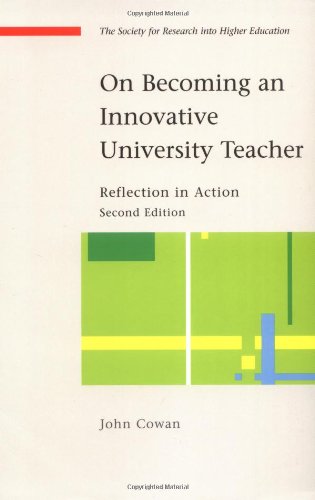
On Becoming an Innovative University Teacher 2nd Edition by John Cowan 9780335224630 0335224636

Original price was: $50.00.$35.00Current price is: $35.00.
On Becoming an Innovative University Teacher 2nd Edition by John Cowan – Ebook PDF Instant Download/Delivery: 9780335224630, 0335224636
Full download On Becoming an Innovative University Teacher 2nd Edition after payment
Product details:
ISBN 10: 0335224636
ISBN 13: 9780335224630
Author: John Cowan
“This innovative and readable book is not something to be cherry-picked for quick hints and tips. It is a work to be read and re-read and savoured for its humanity, sagacity, practicality and reflection upon the all-important relationships between teaching and learning and the teacher and the learner.” British Journal of Educational Technology “…a delightful and unusual reflective journey…the whole book is driven by a cycle of questions, examples, strategies and generalizations from the examples. In all, it is the clearest example of practise-what-you-preach that I have seen.” John Biggs, Honorary Professor of Psychology, University of Hong Kong “This is a unique book, written by a well-known figure in HE who has broad experience and a long track record as an exemplary and caring teacher…The book is unique because it is written in a very personal manner, with a sharing of the author’s varied experiences and great enthusiasm for the processes of teaching and communication.” Jenny Moon, Bournemouth Media Centre and Independent Consultant “[Cowan’s] innovative approach to the authorship of a well researched and practical book is worthy of particular mention…Practitioners that are keen to allow spaces for innovative approaches to professional development in learners will find this text readable and thought provoking.” Teaching in Higher Education On Becoming an Innovative University Teacher shows readers how to plan and run innovative activities to engage their students in effective reflective learning. The book uses an unusual and accessible method: each chapter begins by posing a question with which university and college teachers can be expected to identify; then answers the question by presenting a series of examples, thereafter the writer frankly airs his own second thoughts on what he has offered. In the second edition of this popular book, Cowan maintains his relaxed and readable style, and the book features revised coverage to make it even more accessible and useful. The examples have been updated throughout and a new chapter looks at innovation and reflection in the context of contemporary higher education. This is key reading for all university teachers, whether new or experienced, who want to revitalise their teaching.
On Becoming an Innovative University Teacher 2nd Table of contents:
Chapter 01 Introduction
On the structure of this text
Using questions to focus my inputs
Working from examples and generalizing
Using everyday language
Summary
Chapter 02 What is Meant in Education by ‘Reflecting’?
Outline
Example 2.1: Developing enquiry skills
Example 2.2: Mastering algorithmic procedures
Example 2.3: Study skills for isolated and inexperienced students
Example 2.4: ‘Unpicking log-jams’
Example 2.5: Piloting reflective review
Example 2.6: Concentrating on one’s own priorities
Example 2.7: Assessing your own work
Other examples
Non-examples
Generalization
Some second thoughts
Chapter 03 What Does Reflection Have to Offer in Higher Education?
Outline
Example 3.1: Reflective learning activity in mathematics
Example 3.2: Reflective learning activity in economics
Example 3.3: Reflective learning activity in classics
Comment on Examples 3.1–3.3
Example 3.4: The demand from society for increased capability
Example 3.5: A need for reflective learning and analysis – in a professional curriculum
Example 3.6: An institutional change towards reflective learning
Other examples
Non-examples
Generalization
Before you test this, some second thoughts from me
Chapter 04 On What Models Can We Base Reflective Learning and Teaching?
Introduction
Outline
Model 4.1: The Kolb cycle
Model 4.2: Socio-constructivist Kolb
Model 4.3: The ideas of Scho¨n – and beyond
Model 4.4: The Cowan diagram
Model 4.5: Self-assessment
Different purposes, questions and approaches to reflection
Generalizations
Testing my own generalizations
User evaluations
Before you test this, some second thoughts from me
Chapter 05 How Does Analytical Reflection Affect Learning?
Outline
Example 5.1: Reflective analysis emphasizes processes rather than content
Example 5.2: Reflective analysis prompts thinking about thinking – and thinking about thinking abo
Example 5.3: Using time out – for reflective analysis of process-in-action
Comment
Example 5.4: Reflective analysis leads to more purposeful reactions to tuition
Example 5.5: Reflective analysis deepens understanding of values in a discipline
Example 5.6: Analysing a tutorial experience focuses subsequent participation
Generalization
Before you test this, some second thoughts from me
Chapter 06 How Does Evaluative Reflection Affect Learning?
Outline
Confirming vocabulary
An interim reflection on my text
Example 6.1: Self-assessing – to the teachers’ criteria
Example 6.2: Self-assessing to own criteria, following the teacher’s method
Example 6.3: Students reflect on the making of judgements about their learning
Other examples
What generalization can be taken from this review?
Before you test this, some second thoughts from me
Chapter 07 What Can We Do to Encourage Students to Reflect Effectively?
First, a digression: what is ‘teaching’?
Outline
Example 7.1: Needs emerge from an experience
Example 7.2: Structured dialogue
Example 7.3: A letter-writing task prompts reflection-on-and-for-action
Example 7.4: Self-assessment
Facilitation through tutor intervention
Example 7.5: Teachers prompt movement round the Kolb cycle
Example 7.6: Tutors intervene to occasion reflection-in-action
Example 7.7: A teacher intervenes by providing an input
Example 7.8: A structured activity provokes reflections-on-action
Other examples
Possible non-examples
Generalizations
Before you test this, some second thoughts from me
A final thought
Chapter 08 How Can You Adapt Ideas from My Teaching, for Yours?
Introduction
Outline
Example 8.1: Framework A fits engineering, classics and social sciences
The underlying framework – framework A
Using framework A in classics
Using framework A yet again – in social sciences
Active experimentation – for you
Example 8.2: Framework B fits social sciences, engineering and biology
The underlying framework – framework B
Using framework B – in a class activity in first level fluid mechanics
Verdict
Using framework B in biology
Example 8.3: Framework C, transferred to other areas
The underlying framework – framework C
Using framework C in staff development
Using framework C in connection with project work
Verdict
Overall generalization
A second thought from me
Chapter 09 Why and How Should We Start Innovating Nowadays?
Outline
Much of what should be in our curricula is new
Resources are being reduced, again and again
The range of abilities within student groups is ever widening
We are expected (if not almost obliged) to harness IT in meeting our challenges
We need to ensure valid assessment, in the face of changes
Intermediate second thoughts from me – at this point
First, some general advice to innovators
Now, some rather more specific and personal advice, to individuals
Generalization
Further second thoughts (third thoughts?)
Chapter 10 How Can Such Innovations Be Evaluated?
Introduction
Example 10.1: Questionnaires
Example 10.2: A ‘letter’ to the tutor or course team
Example 10.3: ‘Taking in each other’s washing’
Example 10.4: Talk-aloud protocols
Example 10.5: Interpersonal Process Recall (IPR)
Example 10.6: Drafting a letter to next year’s students
Example 10.7: Observing and noting facts
Example 10.8: Immediate rehearsal and review of learning
Example 10.9: Dynamic lists of questions
Example 10.10: Reflective learning journals
Other examples
Generalizations
Comments
Before you test this, some second thoughts from me
Chapter 11 Where Should You Read about Other Work in This Field?
Introduction
Coverage
Going deeper into reflection in learning – the literature
Principles and current educational emphases in higher education
The pedagogical context – current thinking on promoting metacognition and deep learning
A closely associated topic – current practices and thinking about self-assessment
Beyond feedback and evaluation, to a methodology for action research
Returning to the starting point – the rationale for student-centred learning
Some second thoughts from me
An opportunity for self-evaluation
Just one, but very important, additional second thought – or question
Chapter 12 Postscript
Second thoughts on the structure of this text
Second thoughts regarding the questions which I have chosen to answer
Second thoughts on what I’ve missed out
Why do I ‘teach’ in this way?
The three important qualities for effective teaching
An inclusive example
Is this approach to teaching worth it?
A confession
People also search for On Becoming an Innovative University Teacher 2nd:
how to be an innovative teacher
what is innovation in teacher education
being innovative in education
how to be innovative in the classroom
academic innovations teachers lounge
Tags:
Becoming,Innovative,University Teacher,John Cowan