

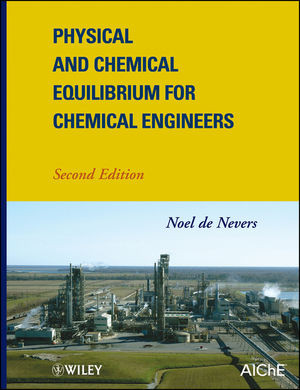
Physical and Chemical Equilibrium for Chemical Engineers 2nd Edition by Noel De Nevers 1118135342 9781118135341


Original price was: $50.00.$35.00Current price is: $35.00.
Physical and Chemical Equilibrium for Chemical Engineers 2nd Edition by Noel De Nevers – Ebook PDF Instant Download/DeliveryISBN: 1118135342, 9781118135341
Full download Physical and Chemical Equilibrium for Chemical Engineers 2nd Edition after payment
Product details:
ISBN 10: 1118135342
ISBN 13: 9781118135341
Author: Noel De Nevers
NOEL de NEVERS, PhD, followed five years of working for Chevron with thirty-seven years as a Professor in the Chemical Engineering Department of the University of Utah. His textbooks (and research papers) are in fluid mechanics, thermodynamics, and air pollution control engineering. He regularly consults as an expert on explosions, fires, and toxic exposures.
In addition to technical work, he has three “de Nevers’s Laws” in a Murphy’s Laws compilation and won the title “Poet Laureate of Jell-O Salad” in a Salt Lake City competition, with three limericks and a quatrain. He has climbed the Grand Teton, Mt. Rainier, Mt. Whitney, Kala Pattar, and Mt. Kilimanjaro, and is the official discoverer of Private Arch in Arches National Park.
Physical and Chemical Equilibrium for Chemical Engineers 2nd Table of contents:
1 Introduction to Equilibrium
1.1 Why Study Equilibrium?
1.2 Stability and Equilibrium
1.3 Time Scales and the Approach to Equilibrium
1.4 Looking Ahead, Gibbs Energy
1.5 Units, Conversion Factors, and Notation
1.6 Reality and Equations
1.7 Phases and Phase Diagrams
1.8 The Plan of this Book
1.9 Summary
References
2 Basic Thermodynamics
2.1 Conservation and Accounting
2.2 Conservation of Mass
2.3 Conservation of Energy; the First Law of Thermodynamics
2.4 The Second Law of Thermodynamics
2.4.1 Reversibility
2.4.2 Entropy
2.5 Convenience Properties
2.6 Using the First and Second Laws
2.7 Datums and Reference States
2.8 Measurable and Immeasurable Properties
2.9 Work and Heat
2.10 The Property Equation
2.11 Equations of State (EOS)
2.11.1 EOSs Based on Theory
2.11.2 EOSs Based on Pure Data Fitting
2.12 Corresponding States
2.13 Departure Functions
2.14 The Properties of Mixtures
2.15 The Combined First and Second Law Statement; Reversible Work
2.16 Summary
References
3 The Simplest Phase Equilibrium Examples and Some Simple Estimating Rules
3.1 Some General Statements About Equilibrium
3.2 The Simplest Example of Phase Equilibrium
3.2.1 A Digression, the Distinction between Vapor and Gas
3.2.2 Back to the Simplest Equilibrium
3.3 The Next Level of Complexity in Phase Equilibrium
3.4 Some Simple Estimating Rules: Raoult’s and Henry’s “Laws”
3.5 The General Two-Phase Equilibrium Calculation
3.6 Some Simple Applications of Raoult’s and Henry’s Laws
3.7 The Uses and Limits of Raoult’s and Henry’s Laws
3.8 Summary
References
4 Minimization of Gibbs Energy
4.1 The Fundamental Thermodynamic Criterion of Phase and Chemical Equilibrium
4.2 The Criterion of Equilibrium Applied to Two Nonreacting Equilibrium Phases
4.3 The Criterion of Equilibrium Applied to Chemical Reactions
4.4 Simple Gibbs Energy Diagrams
4.4.1 Comparison with Enthalpy and Entropy
4.4.2 Gibbs Energy Diagrams for Pressure-Driven Phase Changes
4.4.3 Gibbs Energy Diagrams for Chemical Reactions
4.5 Le Chatelier’s Principle
4.6 Summary
References
5 Vapor Pressure, the Clapeyron Equation, and Single Pure Chemical Species Phase Equilibrium
5.1 Measurement of Vapor Pressure
5.2 Reporting Vapor-Pressure Data
5.2.1 Normal Boiling Point (NBP)
5.3 The Clapeyron Equation
5.4 The Clausius–Clapeyron Equation
5.5 The Accentric Factor
5.6 The Antoine Equation and Other Data-Fitting Equations
5.6.1 Choosing a Vapor-Pressure Equation
5.7 Applying the Clapeyron Equation to Other Kinds of Equilibrium
5.8 Extrapolating Vapor-Pressure Curves
5.9 Vapor Pressure of Solids
5.10 Vapor Pressures of Mixtures
5.11 Summary
References
6 Partial Molar Properties
6.1 Partial Molar Properties
6.2 The Partial Molar Equation
6.3 Tangent Slopes
6.4 Tangent Intercepts
6.5 The Two Equations for Partial Molar Properties
6.6 Using the Idea of Tangent Intercepts
6.7 Partial Mass Properties
6.8 Heats of Mixing and Partial Molar Enthalpies
6.8.1 Differential Heat of Mixing
6.8.2 Integral Heat of Mixing
6.9 The Gibbs–Duhem Equation and the Counterintuitive Behavior of the Chemical Potential
6.10 Summary
References
7 Fugacity, Ideal Solutions, Activity, Activity Coefficient
7.1 Why Fugacity?
7.2 Fugacity Defined
7.3 The Use of the Fugacity
7.4 Pure Substance Fugacities
7.4.1 The Fugacity of Pure Gases
7.4.2 The Fugacity of Pure Liquids and Solids
7.5 Fugacities of Species in Mixtures
7.6 Mixtures of Ideal Gases
7.7 Why Ideal Solutions?
7.8 Ideal Solutions Defined
7.8.1 The Consequences of the Ideal Solution Definition
7.9 Why Activity and Activity Coefficients?
7.10 Activity and Activity Coefficients Defined
7.11 Fugacity Coefficient for Pure Gases and Gas Mixtures
7.12 Estimating Fugacities of Individual Species in Gas Mixtures
7.12.1 Fugacities from Gas PvT Data
7.12.2 Fugacities from an EOS for Gas Mixtures
7.12.3 The Lewis and Randall (L-R) Fugacity Rule
7.12.4 Other Mixing Rules
7.13 Liquid Fugacities from Vapor-Liquid Equilibrium
7.14 Summary
References
8 Vapor–Liquid Equilibrium (VLE) at Low Pressures
8.1 Measurement of VLE
8.2 Presenting Experimental VLE Data
8.3 The Mathematical Treatment of Low-Pressure VLE Data
8.3.1 Raoult’s Law Again
8.4 The Four Most Common Types of Low-Pressure VLE
8.4.1 Ideal Solution Behavior (Type I)
8.4.2 Positive Deviations from Ideal Solution Behavior (Type II)
8.4.3 Negative Deviations from Ideal Solution Behavior (Type III)
8.4.4 Azeotropes
8.4.5 Two-Liquid Phase or Heteroazeotropes (Type IV)
8.4.6 Zero Solubility and Steam Distillation
8.4.7 Distillation of the Four Types of Behavior
8.5 Gas–Liquid Equilibrium, Henry’s Law Again
8.6 The Effect of Modest Pressures on VLE
8.6.1 Liquids
8.6.2 Gases, the L-R Rule
8.7 Standard States Again
8.8 Low-Pressure VLE Calculations
8.8.1 Bubble-Point Calculations
8.8.1.1 Temperature-Specified Bubble Point
8.8.1.2 Pressure-Specified Bubble Point
8.8.2 Dew-Point Calculations
8.8.2.1 Temperature-Specified Dew Point
8.8.2.2 Pressure-Specified Dew Point
8.8.3 Isothermal Flashes (T- and P-Specified Flashes)
8.8.4 Adiabatic Flashes
8.9 Traditional K-Factor Methods
8.10 More Uses for Raoult’s Law
8.10.1 Nonvolatile Solutes, Boiling-Point Elevation
8.10.2 Freezing-Point Depression
8.10.3 Colligative Properties of Solutions
8.11 Summary
References
9 Correlating and Predicting Nonideal VLE
9.1 The Most Common Observations of Liquid-Phase Activity Coefficients
9.1.1 Why Nonideal Behavior?
9.1.2 The Shapes of Ln, G X Curves
9.2 Limits on Activity Coefficient Correlations, the Gibbs–Duhem Equation
9.3 Excess Gibbs Energy and Activity Coefficient Equations
9.4 Activity Coefficients at Infinite Dilution
9.5 Effects of Pressure and Temperature on Liquid-Phase Activity Coefficients
9.5.1 Effect of Pressure Changes on Liquid-Phase Activity Coefficients
9.5.2 Effect of Temperature Changes on Liquid-Phase Activity Coefficients
9.6 Ternary and Multispecies VLE
9.6.1 Liquid-Phase Activity Coefficients for Ternary Mixtures
9.7 Vapor-Phase Nonideality
9.8 VLE from EOS
9.9 Solubility Parameter
9.10 The Solubility of Gases in Liquids, Henry’s Law Again
9.11 Summary
References
10 Vapor–Liquid Equilibrium (VLE) at High Pressures
10.1 Critical Phenomena of Pure Species
10.2 Critical Phenomena of Mixtures
10.3 Estimating High-Pressure VLE
10.3.1 Empirical K-Value Correlations
10.3.2 Estimation Methods for Each Phase Separately, Not Based on Raoult’s Law
10.3.3 Estimation Methods Based on Cubic EOSs
10.4 Computer Solutions
10.5 Summary
References
11 Liquid–Liquid, Liquid–Solid, and Gas–Solid Equilibrium
11.1 Liquid–Liquid Equilibrium (LLE)
11.2 The Experimental Determination of LLE
11.2.1 Reporting and Presenting LLE Data
11.2.2 Practically Insoluble Liquid Pairs at 25°C
11.2.3 Partially Soluble Liquid Pairs at 25°C
11.2.4 Miscible Liquid Pairs at 25°C
11.2.5 Ternary LLE at 25°C
11.2.6 LLE at Temperatures Other Than 25°C
11.3 The Elementary Theory of LLE
11.4 The Effect of Pressure on LLE
11.5 Effect of Temperature on LLE
11.6 Distribution Coefficients
11.7 Liquid–Solid Equilibrium (LSE)
11.7.1 One-Species LSE
11.7.2 The Experimental Determination of LSE
11.7.3 Presenting LSE Data
11.7.4 Eutectics
11.7.5 Gas Hydrates (Clathrates)
11.8 The Elementary Thermodynamics of LSE
11.9 Gas–Solid Equilibrium (GSE) at Low Pressures
11.10 GSE at High Pressures
11.11 Gas–Solid Adsorption, Vapor–Solid Adsorption
11.11.1 Langmuir’s Adsorption Theory
11.11.2 Vapor-solid Adsorption, BET Theory
11.11.3 Adsorption from Mixtures
11.11.4 Heat of Adsorption
11.11.5 Hysteresis
11.12 Summary
References
12 Chemical Equilibrium
12.1 Introduction to Chemical Reactions and Chemical Equilibrium
12.2 Formal Description of Chemical Reactions
12.3 Minimizing Gibbs Energy
12.4 Reaction Rates, Energy Barriers, Catalysis, and Equilibrium
12.5 The Basic Thermodynamics of Chemical Reactions and Its Convenient Formulations
12.5.1 The Law of Mass Action and Equilibrium Constants
12.6 Calculating Equilibrium Constants from Gibbs Energy Tables and then Using Equilibrium Constants to Calculate Equilibrium Concentrations
12.6.1 Change of Reactant Concentration, Reaction Coordinate
12.6.2 Reversible and Irreversible Reactions
12.7 More on Standard States
12.8 The Effect of Temperature on Chemical Reaction Equilibrium
12.9 The Effect of Pressure on Chemical Reaction Equilibrium
12.9.1 Ideal Solution of Ideal Gases
12.9.2 Nonideal Solution, Nonideal Gases
12.9.3 Liquids and Solids
12.10 The Effect of Nonideal Solution Behavior
12.10.1 Liquid-Phase Nonideality
12.11 Other Forms of K
12.12 Summary
References
13 Equilibrium in Complex Chemical Reactions
13.1 Reactions Involving Ions
13.2 Multiple Reactions
13.2.1 Sequential Reactions
13.2.2 Simultaneous Reactions
13.2.3 The Charge Balance Calculation Method and Buffers
13.3 Reactions with More Than One Phase
13.3.1 Solubility Product
13.3.2 Gas-Liquid Reactions
13.4 Electrochemical Reactions
13.5 Chemical and Physical Equilibrium in Two Phases
13.5.1 Dimerization (Association)
13.6 Summary
References
14 Equilibrium with Gravity or Centrifugal Force, Osmotic Equilibrium, Equilibrium with Surface Tension
14.1 Equilibrium with Other Forms of Energy
14.2 Equilibrium in the Presence of Gravity
14.2.1 Centrifuges
14.3 Semipermeable Membranes
14.3.1 Osmotic Pressure
14.4 Small is Interesting! Equilibrium with Surface Tension
14.4.1 Bubbles, Drops and Nucleation
14.4.2 Capillary Condensation
14.5 Summary
References
15 The Phase Rule
15.1 How Many Phases Can Coexist in a Given Equilibrium Situation?
15.2 What Does the Phase Rule Tell Us? What Does It Not Tell Us?
15.3 What is a Phase?
15.4 The Phase Rule is Simply Counting Variables
15.5 More On Components
15.5.1 A Formal Way to Find the Number of Independent Equations
15.6 The Phase Rule for One- and Two-Component Systems
15.7 Harder Phase Rule Problems
15.8 Summary
References
16 Equilibrium in Biochemical Reactions
16.1 An Example, the Production of Ethanol from Sugar
16.2 Organic and Biochemical Reactions
16.3 Two More Sweet Examples
16.4 Thermochemical Data for Biochemical Reactions
16.5 Thermodynamic Equilibrium in Large Scale Biochemistry
16.6 Translating between Biochemical and Chemical Engineering Equilibrium Expressions
16.6.1 Chemical and Biochemical Equations
16.6.2 Equilibrium Constants
16.6.3 pH and Buffers
16.6.4 Ionic Strength
16.7 Equilibrium in Biochemical Separations
16.8 Summary
People also search for Physical and Chemical Equilibrium for Chemical Engineers 2nd:
chemical reaction in chemical engineering
what is chemical equilibrium in chemistry
physical chemistry equilibrium
chemical equilibrium vs physical equilibrium
a chemical equilibrium
Tags: Physical, Chemical Equilibrium, Chemical Engineers, Noel De Nevers