

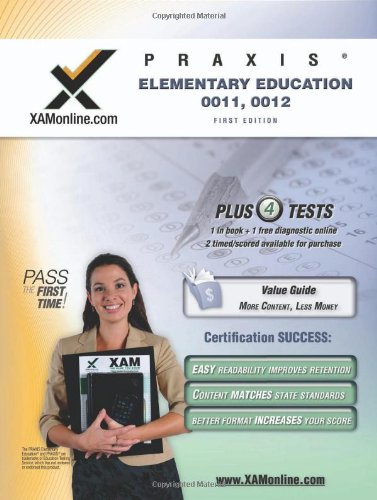
PRAXIS Elementary Education 0011 0012 Test Prep Teacher Certification Test Prep Study Guide XAM PRAXIS 1st Edition by Sharon Wynne ISBN 1607870282 978-1607870289

Original price was: $50.00.$35.00Current price is: $35.00.
PRAXIS Elementary Education 0011 0012 Test Prep Teacher Certification Test Prep Study Guide XAM PRAXIS 1st Edition by Sharon Wynne – Ebook PDF Instant Download/Delivery: 1607870282 , 978-1607870289
Full download PRAXIS Elementary Education 0011 0012 Test Prep Teacher Certification Test Prep Study Guide XAM PRAXIS 1st edition after payment
Product details:
ISBN 10: 1607870282
ISBN 13: 978-1607870289
Author: Sharon Wynne
Includes 23 competencies/skills found on the PRAXIS Elementary Education test and 120 sample-test questions. This guide, aligned specifically to standards prescribed by the Educational Testing Service, covers the sub-areas of Reading/Language Arts; Mathematics; Science or Social Studies; and Interdisciplinary Instruction.
PRAXIS Elementary Education 0011 0012 Test Prep Teacher Certification Test Prep Study Guide XAM PRAXIS 1st Table of contents:
Domain I United States History
Skill 1.1: Physical geography of North America
Skill 1.2: Native American peoples
Skill 1.3: European exploration and colonization
Skill 1.4: American Revolution
Skill 1.5: Establishing a new nation
Skill 1.6: Early years of the new nation
Skill 1.7: Continued national development
Skill 1.8: Civil War era
Skill 1.9: Emergence of the modern United States
Skill 1.10: Progressive era and the First World War through the New Deal
Skill 1.11: Second World War
Skill 1.12: Post-Second World War period
Skill 1.13: Recent developments
Domain II World History
Skill 2.1: Human society to approximately 3000 BCE
Skill 2.2: Development of early civilizations: Circa 3000–1500 BCE
Skill 2.3: Ancient empires and civilizations: circa 1700 BCE–500 CE (India, China, Ancient Western Asia, Mediterranean, Africa)
Skill 2.4: Disruption and reversal: circa 500–1400 CE (nomadic migrations [Huns to Mongols], Byzantine Empire, Eastern Europe, rise and expansion of Islam, feudalism in North and Central Europe, Mayans and Chavin culture)
Skill 2.5: Emerging global interactions: circa 1400–1800 CE
Skill 2.6: Political and Industrial Revolutions, Nationalism: 1750–1914
Skill 2.7: Conflicts, ideologies, and evolutions in the 20th century: 1900–1991
Skill 2.8: Contemporary trends: 1991–present (changing geopolitical map of the world, regional and global economic and environmental interdependence, the welfare state, liberation movements, and globalization)
Domain III Government/Civics/Political Science
Skill 3.1: Political theory: major political concepts, major political theorists, political orientations (e.g., liberal, conservative)
Skill 3.2: United States government and politics: constitutional underpinnings; federalism; powers, structure, and processes of national political institutions; civil liberties and civil rights, political beliefs and behaviors; political parties, interest groups, and mass media
Skill 3.3: Comparative government and politics: forms of government (e.g., parliamentary, federal); major regime types (e.g., democracy, autocracy); major types of electoral systems; foreign policy
Skill 3.4: International relations: theories of international relations (e.g., realism, liberalism); international relations in practice (e.g., conflict, cooperation, diplomacy); powers and problems of international organizations and international law
Domain IV Geography
Skill 4.1: The world in spatial terms: use of maps to acquire, process, and report information from a spatial perspective; longitude and latitude and their purposes; map projection, map type, and scale
Skill 4.2: Places and regions: location of major regions, countries and cities of the world; formal, functional, and perceptual characteristics of places; cultural diffusion and spatial patterns of economic activities
Skill 4.3: Physical systems: processes that shape the pattern of the Earth’s surface including plate tectonics, geomorphic processes, erosion, transportation, and deposition; characteristics and spatial distribution of ecosystems on Earth’s surface; weather systems; climate patterns
Skill 4.4: Human systems: population topics such as demographic transition, settlement patterns and migration; spatial patterns of ethnicity, language, and religion; political aspects including frontiers and boundaries; cooperation and conflict among people and nations; globalization of economies
Skill 4.5: Environment and society: environmental perceptions, environmental impacts and the modification of the environment by human populations, renewable and nonrenewable resources
Skill 4.6: The uses of geography: application of geographic concepts to interpret the past, the present, and to plan for the future
Domain V Economics
Skill 5.1: Microeconomics I: scarcity, choice and opportunity costs, economic systems, comparative advantage and trade, supply and demand, elasticity, market efficiency and the role of government
Skill 5.2: Microeconomics II: production and cost, product markets and behavior of firms, factor markets and distribution of income
Skill 5.3: Macroeconomics I: measures of economic performance, national income accounting, unemployment, inflation, and business cycle
Skill 5.4: Macroeconomics II: national income determination, fiscal policy, money and banking, monetary policy, international finance and investment, and economic growth
Domain VI Behavioral Sciences
Skill 6.1: Sociology: socialization, social organization, social institutions, the study of populations, multicultural diversity, social problems
Skill 6.2: Anthropology: human culture and cultural change
Skill 6.3: Psychology: basic concepts, such as learning and perception, human growth and development, personalit
People also search for PRAXIS Elementary Education 0011 0012 Test Prep Teacher Certification Test Prep Study Guide XAM PRAXIS 1st :
praxis elementary education 5001
praxis elementary education 7001
praxis elementary education prep
praxis elementary education exam
praxis elementary education quizlet
Tags: Sharon Wynne, PRAXIS Elementary, Study Guide