

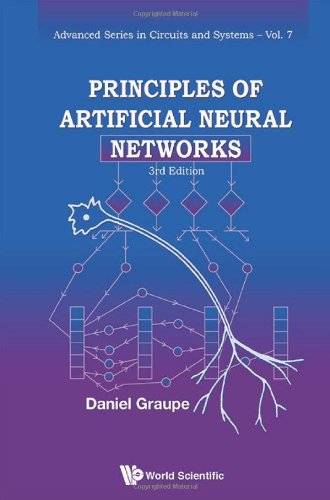
Principles of Artificial Neural Networks 3rd Edition by Daniel Graupe 9789814522731 9814522732

Original price was: $50.00.$35.00Current price is: $35.00.
Principles of Artificial Neural Networks 3rd Edition by Daniel Graupe – Ebook PDF Instant Download/Delivery:9789814522731, 9814522732
Full download Principles of Artificial Neural Networks 3rd Edition after payment
Product details:
ISBN 10: 9814522732
ISBN 13: 9789814522731
Author: Daniel Graupe
Artificial neural networks are most suitable for solving problems that are complex, ill-defined, highly nonlinear, of many and different variables, and/or stochastic. Such problems are abundant in medicine, in finance, in security and beyond.This volume covers the basic theory and architecture of the major artificial neural networks. Uniquely, it presents 18 complete case studies of applications of neural networks in various fields, ranging from cell-shape classification to micro-trading in finance and to constellation recognition — all with their respective source codes. These case studies demonstrate to the readers in detail how such case studies are designed and executed and how their specific results are obtained.The book is written for a one-semester graduate or senior-level undergraduate course on artificial neural networks. It is also intended to be a self-study and a reference text for scientists, engineers and for researchers in medicine, finance and data mining.
Principles of Artificial Neural Networks 3rd Table of contents:
Chapter 1. Introduction and Role of Artificial Neural Networks
Chapter 2. Fundamentals of Biological Neural Networks
Chapter 3. Basic Principles of ANNs and Their Early Structures
3.1 Basic Principles of ANN Design
3.2 Basic Network Structures
3.3 The Perceptron’s Input-Output Principles
3.4 The Adaline (ALC)
Chapter 4. The Perceptron
4.1. The Basic Structure
4.2. The Single-Layer Representation Problem
4.3. The Limitations of the Single-Layer Perceptron
4.4. Many-Layer Perceptrons
4.A. Perceptron Case Study: Identifying Autoregressive Parameters of a Signal (AR Time Series Identification)
Chapter 5. The Madaline
5.1. Madaline Training
5.A. Madaline Case Study: Character Recognition
Chapter 6. Back Propagation
6.1. The Back Propagation Learning Procedure
6.2. Derivation of the BP Algorithm
6.3. Modified BP Algorithms
6.A. Back Propagation Case Study: Character Recognition
6.B. Back Propagation Case Study: The Exclusive-OR (XOR) Problem (2-Layer BP)
6.C. Back Propagation Case Study: The XOR Problem — 3 Layer BP Network
6.D. Average Monthly High and Low Temperature Prediction Using Backpropagation Neural Networks
Chapter 7. Hopfield Networks
7.1. Introduction
7.2. Binary Hopfield Networks
7.3. Setting of Weights in Hopfield Nets — Bidirectional Associative Memory (BAM) Principle
7.4. Walsh Functions
7.5. Network Stability
7.6. Summary of the Procedure for Implementing the Hopfield Network
7.7. Continuous Hopfield Models
7.8. The Continuous Energy (Lyapunov) Function
7.A. Hopfield Network Case Study: Character Recognition
7.B. Hopfield Network Case Study: Traveling Salesman Problem
7.C. Cell Shape Detection Using Neural Networks
Chapter 8. Counter Propagation
8.1. Introduction
8.2. Kohonen Self-Organizing Map (SOM) Layer
8.3. Grossberg Layer
8.4. Training of the Kohonen Layer
8.5. Training of Grossberg Layers
8.6. The Combined Counter Propagation Network
8.A. Counter Propagation Network Case Study: Character Recognition
Chapter 9. Large Scale Memory Storage and Retrieval (LAMSTAR) Network
9.1. Motivation
9.2. Basic Principles of the LAMSTAR Neural Network
9.3. Detailed Outline of the LAMSTAR Network
9.4. Forgetting Feature
9.5. Training vs. Operational Runs
9.6. Operation in Face of Missing Data
9.7. Advanced Data Analysis Capabilities
9.8. Modified Version: Normalized Weights
9.9. Concluding Comments and Discussion of Applicability
9.A. LAMSTAR Network Case Study: Character Recognition
9.B. Application to Medical Diagnosis Problems
9.C. Predicting Price Movement in Market Microstructure via LAMSTAR
9.D. Constellation Recognition
Chapter 10. Adaptive Resonance Theory
10.1. Motivation
10.2. The ART Network Structure
10.3. Setting-Up of the ART Network
10.4. Network Operation
10.5. Properties of ART
10.6. Discussion and General Comments on ART-I and ART-II
10.A. ART-I Network Case Study: Character Recognition
10.B. ART-I Case Study: Speech Recognition
Chapter 11. The Cognitron and the Neocognitron
11.1. Background of the Cognitron
11.2. The Basic Principles of the Cognitron
11.3. Network Operation
11.4. Cognitron’s Network Training
11.5. The Neocognitron
Chapter 12. Statistical Training
12.1. Fundamental Philosophy
12.2. Annealing Methods
12.3. Simulated Annealing by Boltzman Training of Weights
12.4. Stochastic Determination of Magnitude of Weight Change
12.5. Temperature-Equivalent Setting
12.6. Cauchy Training of Neural Network
12.A. Statistical Training Case Study: A Stochastic Hopfield Network for Character Recognition
12.B. Statistical Training Case Study: Identifying AR Signal Parameters with a Stochastic Perceptron Model
Chapter 13. Recurrent (Time Cycling) Back Propagation Networks
13.1. Recurrent/Discrete Time Networks
13.2. Fully Recurrent Networks
13.3. Continuously Recurrent Back Propagation Networks
13.A. Recurrent Back Propagation Case Study: Character Recognition
Problems
People also search for Principles of Artificial Neural Networks 3rd :
principles of neural networks
structure of artificial neural networks
basic principle of artificial intelligence
principles of neural design pdf
principles of neural design
Tags:
Daniel Graupe,Principles,Artificial