

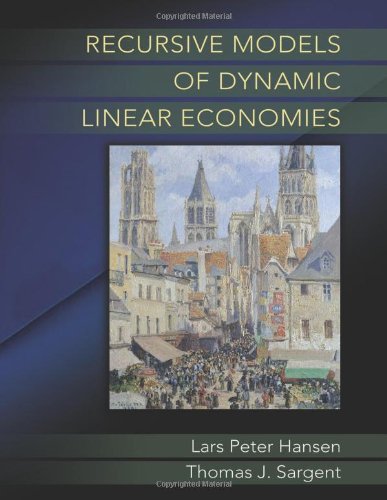
Recursive Models of Dynamic Linear Economies 1st Edition by Lars Peter Hansen, Thomas Sargent 9781400848188 1400848180

Original price was: $50.00.$35.00Current price is: $35.00.
Recursive Models of Dynamic Linear Economies 1st Edition by Lars Peter Hansen, Thomas Sargent – Ebook PDF Instant Download/Delivery:9781400848188, 1400848180
Full download Recursive Models of Dynamic Linear Economies 1st Edition after payment
Product details:
ISBN 10: 1400848180
ISBN 13: 9781400848188
Author: Lars Peter Hansen, Thomas J. Sargent
A guide to the economic modeling of household preferences, from two leaders in the field A common set of mathematical tools underlies dynamic optimization, dynamic estimation, and filtering. In Recursive Models of Dynamic Linear Economies, Lars Peter Hansen and Thomas Sargent use these tools to create a class of econometrically tractable models of prices and quantities. They present examples from microeconomics, macroeconomics, and asset pricing. The models are cast in terms of a representative consumer. While Hansen and Sargent demonstrate the analytical benefits acquired when an analysis with a representative consumer is possible, they also characterize the restrictiveness of assumptions under which a representative household justifies a purely aggregative analysis. Hansen and Sargent unite economic theory with a workable econometrics while going beyond and beneath demand and supply curves for dynamic economies. They construct and apply competitive equilibria for a class of linear-quadratic-Gaussian dynamic economies with complete markets. Their book, based on the 2012 Gorman lectures, stresses heterogeneity, aggregation, and how a common structure unites what superficially appear to be diverse applications. An appendix describes MATLAB programs that apply to the book’s calculations.
Recursive Models of Dynamic Linear Economies 1st Table of contents:
Part I: Overview
1. Theory and Econometrics
1.1. Introduction
1.2. A Class of Economies
1.3. Computer Programs
1.4. Organization
1.5. Recurring Mathematical Ideas
Part II: Tools
2. Linear Stochastic Difference Equations
2.1. Introduction
2.2. Notation and Basic Assumptions
2.3. Prediction Theory
2.4. Transforming Variables to Uncouple Dynamics
2.4.1. Deterministic Seasonals
2.4.2. Indeterministic Seasonals
2.4.3. Univariate Autoregressive Processes
2.4.4. Vector Autoregressions
2.4.5. Polynomial Time Trends
2.4.6. Martingales with Drift
2.4.7. Covariance Stationary Processes
2.4.8. Multivariate ARMA Processes
2.4.9. Prediction of a Univariate First-Order ARMA
2.4.10. Growth
2.4.11. A Rational Expectations Model
2.4.12. Method of Undetermined Coefficients
2.5. Concluding Remarks
3. Efficient Computations
3.1. Introduction
3.2. The Optimal Linear Regulator Problem
3.3. Transformations to Eliminate Discounting and Cross-Products
3.4. Stability Conditions
3.5. Invariant Subspace Methods
3.5.1. Px as Lagrange Multiplier
3.5.2. Invariant Subspace Methods
3.6. Doubling Algorithm
3.7. Partitioning the State Vector
3.8. Periodic Optimal Linear Regulator
3.9. A Periodic Doubling Algorithm
3.10. Linear Exponential Quadratic Gaussian Control
3.10.1. Doubling Algorithm for a Risk-Sensitive Problem
Appendices
A. Concepts of Linear Control Theory
B. Symplectic Matrices
C. Alternative Forms of the Riccati Equation
Part III: Components of Economies
4. Economic Environments
4.1. Information
4.2. Taste and Technology Shocks
4.3. Production Technologies
4.4. Examples of Production Technologies
4.4.1. Other Technologies
4.5. Household Technologies
4.6. Examples of Household Technologies
4.7. Square Summability
4.8. Summary
5. Optimal Resource Allocations
5.1. Planning Problem
5.2. Lagrange Multipliers
5.3. Dynamic Programming
5.4. Lagrange Multipliers as Gradients of Value Function
5.5. Planning Problem as Linear Regulator
5.6. Allocations for Five Economies
5.6.1. Brock-Mirman (1972) or Hall (1978) Model
5.6.2. A Growth Economy Fueled by Habit Persistence
5.6.3. Lucas’s Pure Exchange Economy
5.6.4. An Economy with a Durable Consumption Good
5.6.5. Computed Examples
5.7. Hall’s Model
5.8. Higher Adjustment Costs
5.9. Altered Growth Condition
5.10. A Jones-Manuelli (1990) Economy
5.11. Durable Consumption Goods
5.12. Summary
Appendices
A. Synthesizing a Linear Regulator
B. A Brock-Mirman (1972) or Hall (1978) Model
5.B.1. Uncertainty
5.B.2. Optimal Stationary States
6. A Commodity Space
6.1. Valuation
6.2. Price Systems as Linear Functionals
6.3. A One-Period Model under Certainty
6.4. One Period under Uncertainty
6.5. An Infinite Number of Periods and Uncertainty
6.5.1. Conditioning Information
6.6. Lagrange Multipliers
6.7. Summary
Appendices
A. Mathematical Details
Part IV: Representations and Properties
8. Statistical Representations
8.1. The Kalman Filter
8.2. Innovations Representation
8.3. Convergence
8.3.1. Computation of Time-Invariant Kalman Filter
8.4. Factorization of Likelihood Function
8.4.1. Initialization Assumptions
8.4.2. Possible Nonexistence of Stationary Distribution
8.5. Spectral Factorization Identity
8.6. Wold and Autoregressive Representations
8.7. Frequency Domain Estimation
8.8. Approximation Theory
8.9. Aggregation over Time
8.10. Simulation Estimators
Appendices
A. Initialization of Kalman Filter
B. Zeros of Characteristic Polynomial
C. Serially Correlated Measurement Errors
D. Innovations in yt+1 as Functions of wt+1 and ηt+1
E. Innovations in a Permanent Income Model
Part V: Additional Topics
14. Periodic Models of Seasonality
14.1. Three Models of Seasonality
14.2. A Periodic Economy
14.3. Asset Pricing
14.4. Prediction Theory
14.5. Term Structure of Interest Rates
14.6. Conditional Covariograms
14.7. A Stacked and Skip-Sampled System
14.8. Covariances of the Stacked and Skip-Sampled Process
14.9. Tiao-Grupe Formula
14.9.1. State-Space Realization of Tiao-Grupe Formula
14.10. Periodic Hall Model
14.11. Periodic Innovations Representations for a Periodic Model
Appendices
A. Disguised Periodicity
A. MATLAB Programs
References
People also search for Recursive Models of Dynamic Linear Economies 1st:
recursive models of dynamic linear economies pdf
types of dynamic models
linear vs dynamic
dynamics of linear systems
recursive linear models of dynamic economics
Tags:
Lars Peter Hansen,Thomas Sargent,Recursive Models