

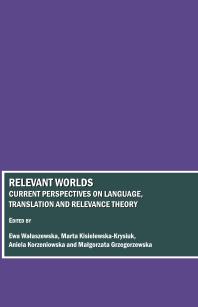
Relevant Worlds Current Perspectives on Language Translation and Relevance Theory 1st Edition by Ewa Walaszewska,Marta Kisielewska Krysiuk,Aniela Korzeniowska,Malgorzata Grzegorzewska ISBN 144381508X 9781443815086


Original price was: $50.00.$35.00Current price is: $35.00.
Relevant Worlds Current Perspectives on Language Translation and Relevance Theory 1st Edition by Ewa Wałaszewska; Marta Kisielewska-Krysiuk; Aniela Korzeniowska; Malgorzata Grzegorzewska – Ebook PDF Instant Download/Delivery: 144381508X, 9781443815086
Full download Relevant Worlds Current Perspectives on Language Translation and Relevance Theory 1st Edition after payment
Product details:
ISBN 10: 144381508X
ISBN 13: 9781443815086
Author: Ewa Wałaszewska; Marta Kisielewska-Krysiuk; Aniela Korzeniowska; Malgorzata Grzegorzewska
The present volume examines Relevance Theory, one of the most influential pragmatic approaches to communication rooted in human cognition, by testing both its internal coherence and its applicability to such forms of communication as translation and literature.
Part I addresses a wide range of issues which, over recent years, have been of central interest to pragmatists, including relevance theorists, but may well appeal to readers less familiar with pragmatic theory. The papers discuss selected pragmatic phenomena as diverse as conversational humour, politeness, echoicity, garden-path utterances, the explicit-implicit distinction and the role of inferential processes in communication, with a view to applying, evaluating and revisiting the basic tenets of Relevance Theory.
Part II is devoted to various aspects of translation. The papers test the applicability of Relevance Theory, depending on the subject, the genre and the aim of the given translation. Most of the articles analyse specific areas of translation practice, for example the translation of popular science, legal texts, film and fiction.
A collection of papers on varied linguistic and cultural phenomena, this book will be a valuable resource for scholars and students of pragmatics (including cognitive and experimental pragmatics), semantics, sociolinguistics and Translation Studies.
Table of contents:
-
Introduction
-
Current Perspectives on Language, Translation and Relevance Theory
Part I: Relevance Theory and Language
-
Chapter One: The Online Processing of Garden-Path Utterances: Accessibility-Driven or Relevance-Driven
-
Chapter Two: Why the Average Speaker Does Not Appreciate the Role of Inferential Processes in Communication
-
Chapter Three: Wittiness in the Visual Rhetoric of Advertising and the Quest for Relevance
-
Chapter Four: What’s in the Punchline?
-
Chapter Five: Conversational Humour as a Power Game
-
Chapter Six: Banter – an Attempt at a Relevance-Theoretic Account
-
Chapter Seven: On Echoic Imperatives: A Relevance-Theoretic Approach
-
Chapter Eight: The Procedure Meaning of the Chinese Conjunction danshi/dan
Part II: Relevance Theory and Translation
-
Chapter Nine: The Performance of Relevance Theory in Translation Studies
-
Chapter Ten: ‘Prime Eagle’ and ‘Poor Tit’ in a Quagmire of Translation – on Processing Cost Savers
-
Chapter Eleven: Explicitation in Simultaneous Interpreting – the Quest for Optimal Relevance
-
Chapter Twelve: The Translation of EU Texts and Relevance
-
Chapter Thirteen: Theory of Relevance in the Translation of Official Documents
-
Chapter Fourteen: Translating Appellatives in Polish Soap Operas into English
-
Chapter Fifteen: Translation and Relevance in the Early Modern Period
-
Chapter Sixteen: Paradise Lost: Caught in-between. John Milton’s Poem as a ‘Translated’ Version of Heroic Epic and a Source Text for Modern Translations
-
Chapter Seventeen: How the Relevance Principle Helps to Figure out when ‘the Fifth’ Should Be Translated as ‘the Fourth’. On Shifts of Coherence in Translation
-
Chapter Eighteen: James Kelman’s You Have to Be Careful in the Land of the Free: Relevance Theory and National Identity in Translation
-
Bibliographical Note
-
Subject Index
-
Name Index
People also search for:
relevant worlds current perspectives on language translation
relevant language
language and worldview
relevant google translate
relevant translation
Tags: Ewa Walaszewska, Marta Kisielewska Krysiuk, Aniela Korzeniowska, Malgorzata Grzegorzewska, Relevant Worlds, Language Translation, Relevance Theory, Current Perspectives