

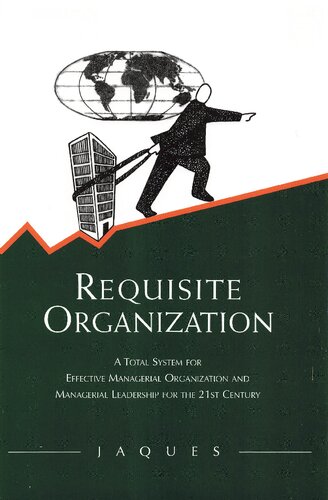
Requisite Organization A Total System for Effective Managerial Organization and Managerial Leadership for the 21st Century 2nd Edition by Elliott Jaques 9781886436046 1886436045


Original price was: $50.00.$35.00Current price is: $35.00.
Requisite Organization A Total System for Effective Managerial Organization and Managerial Leadership for the 21st Century 2nd Edition by Elliott Jaques – Ebook PDF Instant Download/Delivery:9781886436046, 1886436045
Full download Requisite Organization A Total System for Effective Managerial Organization and Managerial Leadership for the 21st Century 2nd Edition after payment
Product details:
ISBN 10: 1886436045
ISBN 13: 9781886436046
Author: Elliott Jaques
Based on Elliott Jaques latest research, this is a thorough revision of a book that has established itself as a classic in its field. Jaques has written a practical high-level, how-to book, that applies to all kinds of working organizations – industrial, commercial, service and public. He sets out a totally new way of doing business. Step by step, he builds up the concepts, and then introduces the working procedures to enable CEOs and senior executives, managers, and HR specialists, to develop requisite organization for themselves – in other words, organization which enhances creativity, productive effectiveness, human satisfaction and excellent morale. Requisite Organization challenges all of our current methods and assumptions in the field of organization, leadership and management, and presents a unified total management system built upon a rigorous theoretical base, Stratified Systems Theory. Any enterprise can gain a competitive edge in the short-term by introducing new products and services. In the long-term, however, an adaptive and successful enterprise calls for soundly structured organization with effective staffing and managerial leadership at every level – a requisite organization.
Requisite Organization A Total System for Effective Managerial Organization and Managerial Leadership for the 21st Century 2nd Table of contents:
PART ONE: INTRODUCTION
1 A Major Finding: Human Nature Explains Hierarchy
2 Achieving Effective Organization for Sustained Success
3 Requisite Organization, Managerial Leadership and Society
4 The Managerial Accountability Hierarchy (MAH)
5 The Board, The Chairperson and the CEO
6 Requisite Organization of the MAH
7 The Employment Society
8 The Growth of Topsy
9 Gimmicks and Panaceas
10 Science, Alchemy, and Language
11 Some Ingredients of a Scientific Recipe
12 Stratified Systems Theory: A Systems Approach
PART TWO: OF HUMAN CAPABILITY OR HUMAN NATURE AT WORK
13 Outputs, Tasks, and Work
14 Motivation: Or Why People Work
15 Requisite Organization and Trust
16 Values: The Driving Force
17 Leadership and Organizational Values
18 Human Work and Individual Capability
19 Work and Problem Solving
20 Thoughts and Words in Knowledge and Decision-Making
21 Decision-Making or Computers Will Never Think
22 The Four Methods of Mental Processing
23 The Five Orders of Information Complexity
24 Mental Processing, Capability and Time-Horizon
25 On Knowledge
26 Skilled Knowledge: Doing without Thinking
27 Personality Factors & “Competencies”
28 The Maturation of Individual Potential Throughout Life
29 Natural Growth of Potential Capability and Time-Horizon
30 Future Potential Casts Its Shadow Before
31 Affirmation and Release of Individual Potential
32 Coda: The Nature of Human Nature and How to Change Individual Behavior
PART THREE: ORGANIZATIONAL STRUCTURE OF THE MAH
Section One: The Universal Underlying Pattern of Organization Strata of the MAH
33 From Extant to Requisite Organization
34 Red Tape Bureaucracy
35 Managerial Accountability: Key to Good Organization
36 Minimum Managerial Accountability and Authority
37 Time-Span as Measure of Level of Work in a Role
38 Evidence that Time-Span Measures Level of Work
39 Time-Span Measurement
40 Time-Span and Regular Structure of Management Levels
41 Universal Pattern of Requisite Organization Strata
42 The Corporate Collegium
Section Two: Functional Alignment
43 Meaning of Requisite Functional Alignment
44 Major Functions Required in an MAH
45 Differentiation of Functions with Stratum
46 Corporate Alignment: Mainstream Operational Functions
47 Str-VI/VII BU: Single BU Corporate Organization
48 Corporate Alignment: HQ Strategic Staff Functions
49 Stratum V: Business Unit (BU)
50 Product/Service Development Functions
51 Marketing and Sales Functions
52 Production Functions at Stratum IV
53 The Mutual Recognition Unit (MRU)
54 The First-Line Mutual Knowledge Output Team
55 Programming Staff Specialist Function (Pr)
56 Human Resource Staff Specialist Function (HR)
57 Technology Staff Specialist Function (T)
58 Business Unit Control and Services Functions
Section Three: The Structure of Task Delegation
59 Direct Output and Individual Contributors
60 Direct Output and Delegated Direct Output
61 Individual Contributors as Managers
62 Delegating Innovative Project Work
63 Delegation of Values
Section Four: Categories of Role Complexity or How Complex is a Problem?
64 What is Problem Complexity?
65 Str-I Complexity: Direct Action Tasks
66 Str-II Role Complexity: Diagnostic Accumulative Tasks
67 Str-III Role Complexity: Alternative Serial Paths
68 Str-IV Role Complexity: Parallel Processing Tasks
69 Str-V Role Complexity: Unified Direct Action
70 Str-VI Role Complexity: Cumulative Processing/Conceptual Abstract
71 Str-VII Complexity: Serial Strategic Options
72 Determining the Level of Task Complexity
Section Five: Structure of Differential Compensation
73 Compensation Structure: Some Problems and Obstacles
74 Compensation: Personal Effectiveness Related Pay
75 Compensation: Role Classification and Grading
76 Compensation: Fueling the Structure with Dollars
Section Six: Role Relationships or How People Work Together
77 General Features of Role Relationships
78 Role Relationships: Definitions
79 TARRs: The Manager-Subordinate Role Relationship
80 TARRs: Manager-and Subordinate-Once-Removed
81 Assistants to First-Line Managers
82 Digression: Non-Role Non-Relationships—Deputies, etc.
83 Project Teams: Attached Subordinates
84 Project Teams: Attached Colleagues
85 Outposting
86 Task Initiating Role Relationships (TIRRs)
87 TIRRs: Collateral Accountability and Authority
88 TIRRs: Advisory Accountability and Authority
89 TIRRs: Service-Getting and-Giving Accountability and Authority
90 TIRRs: Monitoring Accountability and Authority
91 TIRRs: Coordinative Accountability and Authority
92 TIRRs: Auditing Accountability and Authority
93 TIRRs: Prescribing Accountability and Authority
94 Summary of TIRRs and TARRs
PART FOUR: MANAGERIAL LEADERSHIP PRACTICES
Section One: Introduction
95 Leadership: Definitions and Prime Conditions
96 How Far is it From a Manager to a Subordinate
97 Manager-Subordinate Leadership: Span of Control
98 TARR Team Working: Special Study and Project Teams
Section Two: Immediate Manager-Subordinate Managerial Leadership
99 Manager-Subordinate Leadership: Introduction Manager-Subordinate Leadership:
100 Managerial Team Working
101 Context Setting
102 Planning
103 Who Makes the Plans?
104 Stratum-Specific Planning Horizons
105 Task Assignment 1
106 Task Assignment 2
107 Personal Effectiveness Appraisal 1
108 Personal Effectiveness Appraisal 2
109 Personal Effectiveness Appraisal 3
110 Induction and Coaching
111 Deselection and Dismissal
112 Continual Improvement
113 Establishing New Roles
114 Managerial Leadership Appraisal
Section Three: MoR-SoR Managerial Leadership
115 Cross-Functional Work Flow
116 Human Resource Development
117 Evaluation of Potential Capability of SoRs
118 Mentoring & Career Development
119 Selection and Appointment
120 Analysis of Talent Pool
121 Appeals Procedure
Section Four: Organizational Leadership Practices
122 Information Sub-System
123 Str-VII & VI
124 Downsizing and Lay-Off
125 Succession at the Top
126 Top Level HR Planning and Succession
127 “Archimedes’ Principle” of Organization
128 How to Grow a Business
129 Mergers, Acquisitions and Restructuring
PART FIVE: IMPLEMENTATION AND CONCLUSION
130 From Extant to Requisite Structure
131 Project Flow Chart
132 Managerial Leadership Teaching and Training and A Final Summing Up
AFTERTHOUGHTS
133 Organizational Epistemology or “How To Tell An Objective Fact From An Opinion”
133 Some Examples of the Practical Value of Knowing the Difference Between an Entity, a Property of an Entity, and an Attribute of an Entity
134 Trust as the Foundation of Requisite Organization Etymology of Trust, Freedom, Liberty, & Justice
135 The Nature of Human Nature Paranoiagenic Versus Philogenic Organization
136 Civil Service & Military Organizations, & Associations
137 The 5-D World of Human Life
People also search for Requisite Organization A Total System for Effective Managerial Organization and Managerial Leadership for the 21st Century 2nd:
elliott jaques requisite organization
elliott jaques requisite organization pdf
requisite organization pdf
requisite organization theory
requisite organization international institute
Tags: Elliott Jaques, Requisite, Organization