

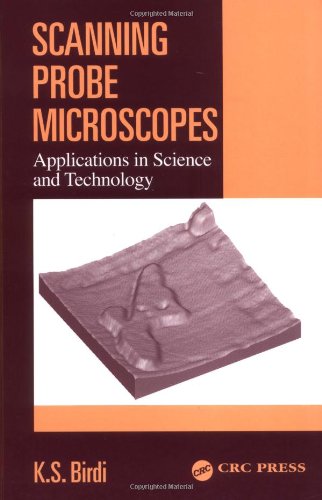
Scanning Probe Microscopes Applications in Science and Technology 1st Edition by K S Birdi ISBN 0203011074 9780849309304


Original price was: $50.00.$35.00Current price is: $35.00.
Scanning Probe Microscopes Applications in Science and Technology 1st Edition by K. S. Birdi – Ebook PDF Instant Download/Delivery: 0203011074, 9780849309304
Full download Scanning Probe Microscopes Applications in Science and Technology 1st Edition after payment
Product details:
ISBN 10: 0203011074
ISBN 13: 9780849309304
Author: K. S. Birdi
Scanning Probe Microscopes: Applications in Science and Technology explains, analyzes, and demonstrates the most widely used microscope in the family of microscopes — the scanning probe microscope. Beginning with an introduction to the development of SPMs, the author introduces the basics of scanning tunneling and atomic force microscopes (STMs and AFMs) along with other types of SPMs. He describes the different apparatus, delineates the method of calibration, and provides extensive references and experimental procedures.
Each subsequent chapter explores a different kind of molecular species or system. Lipid-like molecules and the contribution of SPMs to our understanding of self-assembly monolayers receive particular attention, as do applications involving macromolecules, such as DNA, and those related to nanotechnology.
The author brings to this project his recent, intensive involvement with state-of-the-art STM and AFM microscopes and provides both basic and advanced information in a single volume. While useful to seasoned researchers, Scanning Probe Microscopes will prove especially valuable to newcomers to the field, both as a textbook and as a guide to the expansive literature.
Table of contents:
Scanning Probe Microscopes (SPMs)
-
Scanning Tunneling Microscope
-
Electron Tunneling
-
Atomic Force Microscope (AFM)
-
Modes of Operation of AFM
-
Simultaneous AFM and Scanning Near-Field Fluorescence (SNOM and SNOM-AFM)
-
Friction Force Microscopy (FFM)
-
STM and AFM Studies under Fluids
-
Sample Preparation Procedures for STM and AFM
-
Calibration and Image Analysis of STM and AFM
-
Comparative Studies of Diverse Molecules by STM and AFM
Lipid-Like Molecules on Solids and SAMs
-
Collapsed Lipid Monolayers (Self-Assembly)
-
Domain Patterns in Monomolecular Film Assemblies
-
Mixed Lipid Molecule Assemblies
-
Holes in LB Films of Self-Assembly Monolayers
-
Visualization of Vesicles by AFM
-
LB Films of Liquid Crystals
-
STM and AFM Studies of Diverse Molecules on Solids
-
STM Studies on the Effect of Functional Group
Biopolymers and Synthetic Polymers Structures by STM and AFM
-
DNA Structures by STM and AFM
-
SPM Studies of Three-Dimensional Protein Structures
-
Protein Adsorption Studies by AFM
-
Biological Macromolecular Structures
-
Synthetic Polymers Studies by SPMs
-
Mixed Monolayers of Macromolecules and Lipids
-
Diverse Macromolecular Properties as Studied by SPMs
-
Monolayers of Synthetic Polyamino Acids
-
Biopolymer SAM Structures at Interfaces by STM and AFM
Crystal Structures by STM and AFM
-
Crystal Structures of Small Molecules
-
Surface Adsorption Studies by SPMs
-
Macromolecule Crystals by STM and AFM
Studies of Solid Surfaces by SPMs
-
Wetting Properties of Solid Surfaces
-
AFM Analyses of Surface Acid-Base Properties
-
Measurement of Attractive and Repulsive Forces by Atomic Force Microscope (AFM)
Diverse Applications of SPMs (STM and AFM, etc.) and Nanotechnology
-
STM and AFM in Organic Chemistry
-
Semiconductor Study by SPM
-
STM and AFM in Inorganic Chemistry
-
Nanolithography and Nanomachining
-
Qualitative and Quantitative Analyses at Nanoscale
-
Application of SPMs under Dynamic Conditions
-
Application of AFM to Immunodiagnostic Systems
-
Applications of STM and AFM in Industry
-
SPM Studies of Nanoscale Reactors
-
Nanoscale Evaluation of Surface Roughness by SPMs
-
Application of STM and AFM in Pollution Control
-
Friction Force Microscope (FFM)
-
Time-Resolved Analyses by STM
People also search for:
scanning probe microscopes
scanning probe microscope images
scanning probe microscope advantages and disadvantages
scanning probe microscope facts
scanning probe microscope disadvantages
what is a scanning probe microscope used for
Tags: K S Birdi, Scanning Probe Microscopes, Applications, Science, Technology