

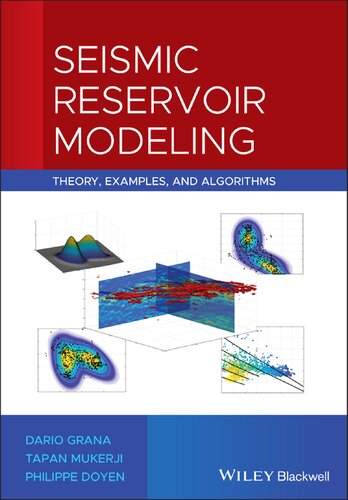
Seismic Reservoir Modeling Theory Examples and Algorithms 1st Edition by Dario Grana, Tapan Mukerji, Philippe Doyen ISBN 1119086183 9781119086185


Original price was: $50.00.$35.00Current price is: $35.00.
Seismic Reservoir Modeling Theory Examples and Algorithms 1st Edition by Dario Grana, Tapan Mukerji, Philippe Doyen – Ebook PDF Instant Download/Delivery: 1119086183, 9781119086185
Full download Seismic Reservoir Modeling Theory Examples and Algorithms 1st Edition after payment
Product details:
ISBN 10: 1119086183
ISBN 13: 9781119086185
Author: Dario Grana, Tapan Mukerji, Philippe Doyen
Seismic reservoir characterization aims to build 3-dimensional models of rock and fluid properties, including elastic and petrophysical variables, to describe and monitor the state of the subsurface for hydrocarbon exploration and production and for CO₂ sequestration. Rock physics modeling and seismic wave propagation theory provide a set of physical equations to predict the seismic response of subsurface rocks based on their elastic and petrophysical properties. However, the rock and fluid properties are generally unknown and surface geophysical measurements are often the only available data to constrain reservoir models far away from well control. Therefore, reservoir properties are generally estimated from geophysical data as a solution of an inverse problem, by combining rock physics and seismic models with inverse theory and geostatistical methods, in the context of the geological modeling of the subsurface. A probabilistic approach to the inverse problem provides the probability distribution of rock and fluid properties given the measured geophysical data and allows quantifying the uncertainty of the predicted results. The reservoir characterization problem includes both discrete properties, such as facies or rock types, and continuous properties, such as porosity, mineral volumes, fluid saturations, seismic velocities and density.
Seismic Reservoir Modeling: Theory, Examples and Algorithms presents the main concepts and methods of seismic reservoir characterization. The book presents an overview of rock physics models that link the petrophysical properties to the elastic properties in porous rocks and a review of the most common geostatistical methods to interpolate and simulate multiple realizations of subsurface properties conditioned on a limited number of direct and indirect measurements based on spatial correlation models. The core of the book focuses on Bayesian inverse methods for the prediction of elastic petrophysical properties from seismic data using analytical and numerical statistical methods. The authors present basic and advanced methodologies of the current state of the art in seismic reservoir characterization and illustrate them through expository examples as well as real data applications to hydrocarbon reservoirs and CO₂ sequestration studies.
Table of contents:
1: Review of Probability and Statistics
1.1: Introduction to Probability and Statistics
1.2: Probability
1.3: Statistics
1.3.1: Univariate Distributions
1.3.2: Multivariate Distributions
1.4: Probability Distributions
1.4.1: Bernoulli Distribution
1.4.2: Uniform Distribution
1.4.3: Gaussian Distribution
1.4.4: Log-Gaussian Distribution
1.4.5: Gaussian Mixture Distribution
1.4.6: Beta Distribution
1.5: Functions of Random Variable
1.6: Inverse Theory
1.7: Bayesian Inversion
2: Rock Physics Models
2.1: Rock Physics Relations
2.1.1: Porosity – Velocity Relations
2.1.2: Porosity – Clay Volume – Velocity Relations
2.1.3: P-Wave and S-Wave Velocity Relations
2.1.4: Velocity and Density
2.2: Effective Media
2.2.1: Solid Phase
2.2.2: Fluid Phase
2.3: Critical Porosity Concept
2.4: Granular Media Models
2.5: Inclusion Models
2.6: Gassmann’s Equations and Fluid Substitution
2.7: Other Rock Physics Relations
2.8: Application
3: Geostatistics for Continuous Properties
3.1: Introduction to Spatial Correlation
3.2: Spatial Correlation Functions
3.3: Spatial Interpolation
3.4: Kriging
3.4.1: Simple Kriging
3.4.2: Data Configuration
3.4.3: Ordinary Kriging and Universal Kriging
3.4.4: Cokriging
3.5: Sequential Simulations
3.5.1: Sequential Gaussian Simulation
3.5.2: Sequential Gaussian Co-Simulation
3.6: Other Simulation Methods
3.7: Application
4: Geostatistics for Discrete Properties
4.1: Indicator Kriging
4.2: Sequential Indicator Simulation
4.3: Truncated Gaussian Simulation
4.4: Markov Chain Models
4.5: Multiple-Point Statistics
4.6: Application
5: Seismic and Petrophysical Inversion
5.1: Seismic Modeling
5.2: Bayesian Inversion
5.3: Bayesian Linearized AVO Inversion
5.3.1: Forward Model
5.3.2: Inverse Problem
5.4: Bayesian Rock Physics Inversion
5.4.1: Linear – Gaussian Case
5.4.2: Linear – Gaussian Mixture Case
5.4.3: Non-linear – Gaussian Mixture Case
5.4.4: Non-linear – Non-parametric Case
5.5: Uncertainty Propagation
5.6: Geostatistical Inversion
5.6.1: Markov Chain Monte Carlo Methods
5.6.2: Ensemble Smoother Method
5.6.3: Gradual Deformation Method
5.7: Other Stochastic Methods
6: Seismic Facies Inversion
6.1: Bayesian Classification
6.2: Bayesian Markov Chain Gaussian Mixture Inversion
6.3: Multimodal Markov Chain Monte Carlo Inversion
6.4: Probability Perturbation Method
6.5: Other Stochastic Methods
7: Integrated Methods
7.1: Sources of Uncertainty
7.2: Time-Lapse Seismic Inversion
7.3: Electromagnetic Inversion
7.4: History Matching
7.5: Value of Information
8: Case Studies
8.1: Hydrocarbon Reservoir Studies
8.1.1: Bayesian Linearized Inversion
8.1.2: Ensemble Smoother Inversion
8.1.3: Multimodal Markov Chain Monte Carlo Inversion
8.2: CO₂ Sequestration Study
People also search for:
seismic gap theory
waterfall model theory
seismic design methods
gravity model theory
reservoir modeling
oil reservoir modeling
Tags: Dario Grana, Tapan Mukerji, Philippe Doyen, Seismic, Reservoir, Modeling, Theory, Examples, Algorithms