

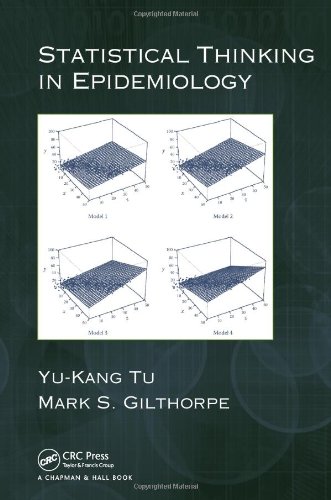
Statistical Thinking in Epidemiology 1st Edition by Yu Kang Tu, Mark S Gilthorpe ISBN 1420099914 9781420099911


Original price was: $50.00.$35.00Current price is: $35.00.
Statistical Thinking in Epidemiology 1st Edition by Yu-Kang Tu, Mark S. Gilthorpe – Ebook PDF Instant Download/Delivery: 1420099914, 9781420099911
Full download Statistical Thinking in Epidemiology 1st Edition after payment
Product details:
ISBN 10: 1420099914
ISBN 13: 9781420099911
Author: Yu-Kang Tu, Mark S. Gilthorpe
While biomedical researchers may be able to follow instructions in the manuals accompanying the statistical software packages, they do not always have sufficient knowledge to choose the appropriate statistical methods and correctly interpret their results. Statistical Thinking in Epidemiology examines common methodological and statistical problems in the use of correlation and regression in medical and epidemiological research: mathematical coupling, regression to the mean, collinearity, the reversal paradox, and statistical interaction.
Statistical Thinking in Epidemiology is about thinking statistically when looking at problems in epidemiology. The authors focus on several methods and look at them in detail: specific examples in epidemiology illustrate how different model specifications can imply different causal relationships amongst variables, and model interpretation is undertaken with appropriate consideration of the context of implicit or explicit causal relationships. This book is intended for applied statisticians and epidemiologists, but can also be very useful for clinical and applied health researchers who want to have a better understanding of statistical thinking.
Throughout the book, statistical software packages R and Stata are used for general statistical modeling, and Amos and Mplus are used for structural equation modeling.
Table of contents:
-
Vector Geometry of Linear Models for Epidemiologists
-
Path Diagrams and Directed Acyclic Graphs
-
Mathematical Coupling and Regression to the Mean in the Relation between Change and Initial Value
-
Analysis of Change in Pre-/Post-Test Studies
-
Collinearity and Multicollinearity
-
Is ‘Reversal Paradox’ a Paradox?
-
Testing Statistical Interaction
-
Finding Growth Trajectories in Lifecourse Research
-
Partial Least Squares Regression for Lifecourse Research
-
Concluding Remarks
People also search for:
statistical thinking in epidemiology
statistical methods in epidemiology
what is statistical thinking
statistical thinking in healthcare
statistical thinking example
Tags: Yu Kang Tu, Mark S Gilthorpe, Statistical Thinking, Epidemiology