

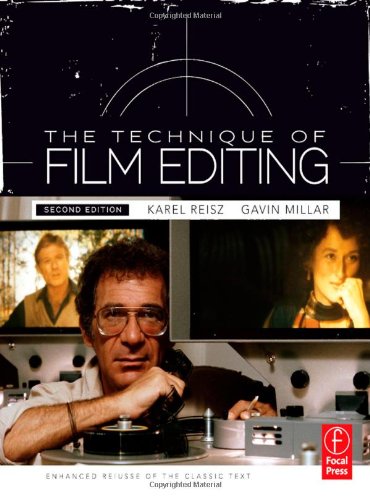
Technique of Film Editing Reissue of 2nd Edition by Karel Reisz, GAVIN MILLAR ISBN 0240521854 9780240521855

Original price was: $50.00.$35.00Current price is: $35.00.
Technique of Film Editing Reissue of 2nd Edition by Karel Reisz, GAVIN MILLAR – Ebook PDF Instant Download/Delivery: 0240521854, 9780240521855
Full download Technique of Film Editing Reissue of 2nd Edition after payment
Product details:
ISBN 10: 0240521854
ISBN 13: 9780240521855
Author: Karel Reisz, GAVIN MILLAR
Enhanced version of the seminal text on editing includes a new foreword, a new afterword, a revamped cover and layout, as well as a lower price!
The single most comprehensive and engaging volume on film editing. Reisz and Millar introduce readers to every aspect of the editor’s craft, providing a concise history of editing and describing editing style as it applies to every genre of moviemaking, including many types of narrative and documentary films. The particular demands of wide-screen filmmaking, cinema verite, and the avant-garde are also covered.
Reisz and Millar’s account of the differences between smooth and abrupt editing and their remarkable sense of editing for dramatic effect rather than for realism make this book essential for apprentice editors, as well as those who want to know how filmmakers understand their work.
Technique of Film Editing Reissue of 2nd Table of contents:
Part I: Theory of Editing
- Chapter 1: The Nature of Editing
- The illusion of continuity.
- Editing as a psychological process.
- The difference between “cutting” and “editing.”
- Chapter 2: The Principles of Editing
- Rhythm and tempo.
- Pacing and dramatic emphasis.
- The importance of the shot.
- Chapter 3: The Editor’s Approach to the Material
- Reading the script with an editor’s eye.
- Working with rushes (dailies).
- Developing a structure for the film.
Part II: The Practice of Editing
- Chapter 4: Cutting for Dramatic Emphasis
- Building tension.
- Controlling emotional response.
- The role of close-ups and reaction shots.
- Chapter 5: Continuity Editing
- Matching action.
- Maintaining screen direction and spatial relationships.
- The 180-degree rule and its exceptions.
- Eyeline matching.
- Chapter 6: Montage and Discontinuity
- Soviet montage theory (Kuleshov effect, Pudovkin, Eisenstein).
- Jump cuts and other forms of deliberate discontinuity.
- Editing for symbolic or thematic impact.
- Chapter 7: Dialogue Scenes
- Cutting dialogue for naturalism and dramatic rhythm.
- Overlapping dialogue.
- The use of reaction shots in conversation.
- Chapter 8: Action Sequences
- Building excitement and clarity in action.
- Pacing and cutting speed in chases, fights, etc.
- Chapter 9: The Role of Sound in Editing
- Sound as a transitional device.
- Parallel and contrapuntal sound.
- Dialogue, music, and effects.
- Sound bridges.
- Chapter 10: Editing Documentaries and Newsreels
- Specific challenges and techniques for non-fiction film.
- Structuring factual material.
- The role of voice-over.
- Chapter 11: Editing Animation
- The unique considerations of editing animated sequences.
- Timing and character movement.
Part III: The Evolution of Editing
- Chapter 12: Early Developments (1895-1925)
- From Lumière to Griffith.
- The discovery of continuity.
- Early Russian experiments.
- Chapter 13: The Golden Age of Hollywood and Beyond (1925-1950s)
- Classical Hollywood style and its conventions.
- Influence of sound on editing.
- Innovations by influential editors.
- Chapter 14: Post-War Cinema and New Waves (1950s-1970s)
- French New Wave and its rejection of classical continuity.
- The influence of television.
- The rise of auteur theory and its impact on editing.
- Chapter 15: Editing in the Digital Age (A likely addition or update for later reissues)
- The impact of non-linear editing systems.
- New possibilities and challenges.
- The enduring relevance of fundamental principles.
People also search for Technique of Film Editing Reissue of 2nd:
technique of film editing reissue of
technique of film editing reissue of 2nd edition
editing techniques film
evolution of film editing
types of film editing
Tags: Karel Reisz, GAVIN MILLAR, Technique, Film Editing Reissue