

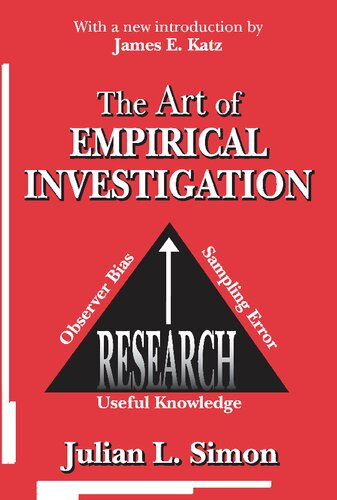
The Art of Empirical Investigation 1st Edition by Julian Simon ISBN 135130562X 9781351305624
Original price was: $50.00.$35.00Current price is: $35.00.
The Art of Empirical Investigation 1st Edition by Julian Simon – Ebook PDF Instant Download/Delivery: 135130562X, 9781351305624
Full download The Art of Empirical Investigation 1st Edition after payment
Product details:
ISBN 10: 135130562X
ISBN 13: 9781351305624
Author: Julian Simon
The Art of Empirical Investigation 1st Edition:
Julian Simon was known for his methodical, and often controversial, writings challenging conventional beliefs about overpopulation, pollution, disappearing farmland, and the scarcity of energy sources and raw materials. But throughout his works is a common theme: that responsible, unbiased research and examination of the data is indispensable to formulating a well-informed and accurate opinion. The Art of Empirical Investigation teaches student, professor, researcher, and those interested in ascertaining the truth about social issues just how to proceed.
The Art of Empirical Investigation is a textbook on the basics of social-scientific research. It discusses all the important empirical methods used in social science, and its examples, drawn from a wide variety of academic and applied fields, illustrate the use of each method in its most appropriate context. The actual decisions a researcher must make at every stage of a project are emphasized, as well as obstacles to knowledge–such as observer bias, deception, unreliability of data, and sampling costs–and how to overcome them. Presupposing nothing, the book introduces the reader to the foundations of empirical social-science research, regardless of a specific field. It also makes an important contribution to beginning researchers’ understanding of an operational definition of causality, which cuts through philosophical obscurity and teaches the researcher how to decide whether or not a given relationship is causal.
The Art of Empirical Investigation 1st Edition Table of contents:
-
Part One: The process of social-science research
- Introduction
- The language of research: definitions and validity
- Basic concepts of research
- Types of empirical research
- Theory, model, hypothesis, and empirical research
- Choosing appropriate proxies for theoretical variables
-
Part Two: Research decisions and procedures
- The steps in an empirical research study
- How to assess the potential value of research projects
- Sampling
- Experiments: pro, con, and how to do them
- Designing experiments
- Non-experimental designs for studying relationships
- Surveys: pro, con, and how to do them
- Other qualitative and quantitative techniques
- Classifying, measuring, and scaling
- Scaling human responses
- Data handling, adjusting, and summarizing
-
Part Three: The obstacles to social-science knowledge and ways to overcome them
- The concept of obstacles in the search for empirical knowledge
- Obstacles created by the humanness of the observer (Appendix on interviewing)
- Complexities and intractability of the human mind (Appendix on questionnaire construction)
- Obstacles to obtaining adequate subject matter
- Obstacles to the study of changes over time
- Obstacles to the search for causal relationships
- The master obstacle: cost
-
Part Four: Extracting the meaning of data
- Analysis of simple data: association and regression
- Searching for relationships: analysis of complex data
- Inferential statistics: introduction
- Probability and hypothesis testing by the Monte Carlo method
- Hypothesis testing with measured data
- Correlation and other statistical issues
- How big a sample?
- The concept of causality in social science, with notes on prediction, law, explanation, and function
-
Part Five: Epilogue
- The nature, powers, and limits of social science
People also search for The Art of Empirical Investigation 1st Edition:
the art of scientific investigation pdf
empirical art
empirical investigations
the art of scientific investigation
what are the characteristics of an empirical question
empirical investigation example
Tags:
Julian Simon,The Art,Empirical,Investigation