

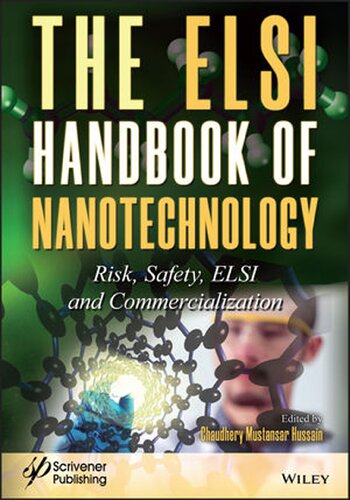
The ELSI Handbook of Nanotechnology Risk Safety ELSI and Commercialization 1st Edition by Chaudhery Mustansar Hussain ISBN 1119591600 978-1119591603

Original price was: $50.00.$35.00Current price is: $35.00.
The ELSI Handbook of Nanotechnology Risk Safety ELSI and Commercialization 1st Edition by Chaudhery Mustansar Hussain – Ebook PDF Instant Download/Delivery: 1119591600, 978-1119591603
Full download The ELSI Handbook of Nanotechnology Risk Safety ELSI and Commercialization 1st edition after payment
Product details:
ISBN 10: 1119591600
ISBN 13: 978-1119591603
Author: Chaudhery Mustansar Hussain
This Handbook focuses on the recent advancements in Safety, Risk, Ethical Society and Legal Implications (ESLI) as well as its commercialization of nanotechnology, such as manufacturing. Nano is moving out of its relaxation phase of scientific route, and as new products go to market, organizations all over the world, as well as the general public, are discussing the environmental and health issues associated with nanotechnology. Nongovernmental science organizations have long since reacted; however, now the social sciences have begun to study the cultural portent of nanotechnology. Societal concerns and their newly constructed concepts, show nanoscience interconnected with the economy, ecology, health, and governance. This handbook addresses these new challenges and is divided into 7 sections: Nanomaterials and the Environment; Life Cycle Environmental Implications of Nanomanufacturing; Bioavailability and Toxicity of Manufactured Nanoparticles in Terrestrial Environments; Occupational Health Hazards of Nanoparticles; Ethical Issues in Nanotechnology; Commercialization of Nanotechnology; Legalization of Nanotechnology.
The ELSI Handbook of Nanotechnology Risk Safety ELSI and Commercialization 1st Table of contents:
1 Nanomaterials and the Environment
1.1 Introduction
1.2 Applications of Nanomaterials for Environment
1.3 Limitations of Environmental Nanomaterials
1.4 Future Scope of Environmental Nanomaterials
1.5 Conclusion
References
2 Highly Efficient Graphene-Based Nanocomposites for Environmental Application
2.1 Features of the Organic Pollutants Adsorption
2.2 Adsorption Materials – Graphene-Based Nanocomposites
2.3 Determining the Adsorption Activity
2.4 Conclusion
Acknowledgment
References
3 A Concise Account of the Studies Conducted on the Transport, Fate, Transformation and Toxicity of Engineered Nanomaterials
3.1 Introduction
3.2 Transport of Engineered Nanomaterials
3.3 Fate and Transformation of Engineered Nanomaterials
3.4 Toxicity
3.5 Existing Challenges
3.6 Conclusion
References
4 Nanotechnologies and Advanced Smart Materials: The Case of Architecture and Civil Engineering
4.1 Introduction
4.2 Management of Complexity
4.3 Advanced Materials: Definitions, Characteristics, Properties
4.4 Classification Criteria: High Performance and Smart Materials
4.5 Innovations in the Nanotechnology Field for Building Materials
4.6 Applications of Nanostructured Materials in Architecture
4.7 Nanostructured Cementitious Materials: High Performance and Ecoefficiency
4.8 Conclusions
References
5 Life Cycle Environmental Implications of Nanomanufacturing
5.1 Introduction
5.2 Manufacturing of Nanomaterials
5.3 Nanomaterials and Their Entry into the Environment
5.4 How is the Environment Subjected to Nanomaterials?
5.5 Implications of Nanomaterials in the Environment
5.6 Potential Health Risks and Environmental Impact of Nanomaterials
5.7 Impact of Long-Term Exposure to Graphene-Based Materials In Vivo
5.8 Antimicrobial Activity of Graphene and Graphene Oxide Particles
5.9 Interaction between Two-Dimension (2D) Nanomaterials and the Environment
5.10 Positive Effects of Nanomaterials on the Environment
5.11 Negative Effects of Nanomaterials on the Environment
5.12 Life Cycle Assessment (LCA)
5.13 Four Phases of Life Cycle Assessment (LCA)
5.14 Environmental Nanomaterials (ENMs) Life Cycle
5.15 Application of LCA to Nanomaterials
5.16 Conclusions
References
6 Addressing Nanotoxicity: Green Nanotechnology for a Sustainable Future
6.1 Introduction
6.2 Nanotoxicity: A Multifaceted Challenge
6.3 Physicochemical Properties of Nanomaterials Influencing Nanotoxicity
6.4 Green Nanotechnology: A Proactive Approach to Minimize Nanotoxicity
6.5 Conclusion
Acknowledgment
References
7 Nanotechnology: Occupational Health Hazards of Nanoparticles and Legalization Challenges
7.1 Introduction
7.2 Hazard and Toxicology of Nanoparticles
7.3 Nanoparticle Absorption
7.4 Instruments and Methods for Detection of Nanoparticles
7.5 Hazard Assessment of Nanoparticles
7.6 Risk Assessment and Management of Nanoparticles
7.7 Hazard Control
7.8 Federal Regulatory Compliance
7.9 Summary
References
8 Bringing Awareness to the Darker Side of Nanoparticles
8.1 What is Nano-Sized Particle or Nanoparticle?
8.2 Interaction of Nanoparticle with Living System: Its Effects and Mechanism
8.3 Toxicological Study of Different Nanoparticles
8.4 Future Aspect
Acknowledgment
References
9 Mode of Transfer, Toxicity and Negative Impacts of Engineered Nanoparticles on Environment, Human and Animal Health
9.1 Introduction
9.2 Different Engineered Nanoparticles (ENPs) and Their Commercial Uses
9.3 Exposure of ENPs to the Environment
9.4 Hazards and Nanotoxicity of ENPs on Soil Communities
9.5 Health Effects on Humans and Animals
9.6 Detection of Nanotoxicity and Its Challenges
9.7 Conclusion and Future Needs
References
10 The Impact of Nanomaterials in Aquatic Systems
10.1 Introduction
10.2 Sources of Nanomaterials
10.3 Transport and Environmental Fate of Nanomaterials
10.4 The Toxicity of Nanomaterials in Aquatic Systems
10.5 Future Research Directions
10.6 Conclusion
References
11 Nanotechnology in the Dairy Industry: Benefits and Risks
11.1 Introduction
11.2 Associated Colloids (Micelles)
11.3 Nanoemulsions
11.4 Nanoparticles
11.5 Biopolymers
11.6 Nanofibers
11.7 Nanocapsules
11.8 Nanotubes
11.9 Nanofilter and Nanofiltration
11.10 Food Packaging
11.12 Part 1: Dairy Production Using Natural Nanoparticles
11.13 Part 2: The Use of Nanoparticles of Abiotic Origin for Dairy Production
11.14 Part 3: Toxicity and Risks Related to Nanotechnology
Acknowledgment
References
12 A Survey of Nanotechnology for Rocket Propulsion: Promises and Challenges
Glossary
12.1 Background
12.2 Introduction to Nanoenergetic Materials
12.3 Objectives and Contents
12.4 nMe Production and Active Al Content
12.5 Particle Passivation and Coating
12.6 Chemical and Mechanical Activation
12.7 Rheology and Mechanical Properties
12.9 Augmented Steady Ballistic Properties
12.10 Effects of nAl on Unsteady Burning and Ignition
12.11 Safety of Energetic Particles and Formulations
12.12 Aging of Energetic Particles and Formulations
12.13 Concluding Remarks
Acknowledgments
References
13 Toxicity and Regulatory Concerns for Nanoformulations in Medicine
13.1 Introduction
13.2 Definition of Nanomedicine – Crucial for Regulation
13.3 Epidemiological Studies on the Health Hazard
13.4 Deposition of Particles in the Organism
13.5 Occupational Safety in Medical Facilities
13.6 Studies on Biological Effects of TiO2 Nanoparticles
13.7 Studies on Biological Effects of Fe2O3 Nanoparticles
13.8 Studies on Biological Effects of SiO2 Particles
13.9 Effect of Nanoparticles at the Cellular and Molecular Level
13.10 Toxicity of Dendrimers
13.11 Toxicity of Quantum Dots
13.12 Environmental Issues
13.13 Regulatory Measures
13.14 Conclusions
References
14 A Way to Create a Sustainable Environment: Green Nanotechnology – With an Emphasis on Noble Metals
14.1 Introduction
14.2 Nanoparticles
14.3 Fabrication
14.4 Applications of Noble NPs
14.5 Conclusion and Future Perspectives
References
15 Modern Development with Green Polymer Nanocomposites: An Overview
15.1 Introduction
15.2 Classification
15.3 Methods of Preparation
15.4 Properties
15.5 Applications of Green Polymer Nanocomposite
15.6 Conclusion and Future Prospects
People also search for The ELSI Handbook of Nanotechnology Risk Safety ELSI and Commercialization 1st :
elsi pdf
elsi panel
handbook of nanoethics
elsi 2
elsi ethical