

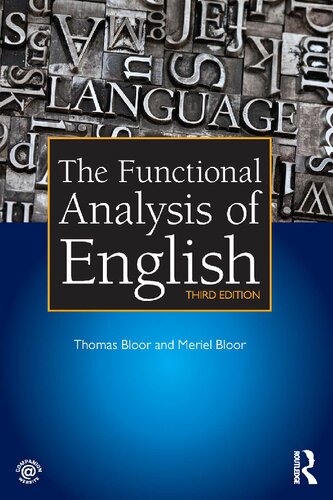
The Functional Analysis of English 3rd Edition by Thomas Bloor, Meriel Bloor 9781135971090 1135971099


Original price was: $50.00.$35.00Current price is: $35.00.
The Functional Analysis of English 3rd Edition by Thomas Bloor, Meriel Bloor – Ebook PDF Instant Download/Delivery:
9781135971090, 1135971099
Full download The Functional Analysis of English 3rd Edition after payment
Product details:
ISBN 10: 1135971099
ISBN 13: 9781135971090
Author: Thomas Bloor, Meriel Bloor
The Functional Analysis of English is an introduction to the analysis and description of English, based on the principles of systemic functional linguistics. It sets out the tools and analytic techniques of Hallidayan grammar with clear explanations of terminology and illustrates these with examples from a variety of texts, including science, travel, history and literary sources. This revised third edition incorporates references to recent research, better explanations of complex problems, and additional exercises. Key features: an updated overview of applications to real world issues revised sections on the current historical position of systemic functional grammar simple introductions to agnation, grammatical metaphor, and information structure chapter summaries, suggestions for further reading, exercises with answers and a glossary of terms a companion website with additional activities, exercises and supplementary readings for students and instructors This third edition is an indispensable introduction to systemic functional linguistics, which can be used independently or in preparation for M.A.K. Halliday and C.M.I.M. Matthiessen’s Introduction to Functional Grammar. The book is an ideal text for students of linguistics, applied linguistics and grammar- those new to the field, or who have a background in traditional grammar, as well as teachers of English language.
The Functional Analysis of English 3rd Table of contents:
1 A meaningful approach
1.1 How to use this book
1.2 Grammar and meaning
1.3 Meaning potential
1.4 System networks
1.5 Language in use
1.6 The study of texts
1.7 The notion of rank
1.8 Functions and metafunctions
Summary
Further study
Exercises
2 Labels
2.1 Music, mathematics, medicine and motor-vehicle maintenance
2.2 A political parable
2.3 Word classes
2.4 Subjects
2.5 Groups
2.6 Three ways of looking at a clause
Summary
Further study
Exercises
3 Clause structure
3.1 Subject revisited
3.2 Finites and Predicators
3.3 Complements
3.4 Adjuncts
3.5 Sample analysis
Summary
Further study
Exercises
4 Information structure and thematic structure
4.1 Organizing ideas
4.2 Information structure: Given and New information
4.3 Thematic structure: Theme and Rheme
4.4 The interaction of information structure and thematic structure
Summary
Further study
Exercises
5 Grammar and text
5.1 Text and texture
5.2 The textual component of the grammar
5.3 Thematic progression
5.4 Cohesive ties
Summary
Further Study
Exercises
6 Process and participant
6.1 Transitivity: the clause as representation
6.2 Processes
6.3 Material process
6.4 Mental process
6.5 Relational process
6.6 Verbal process
6.7 Other processes
6.8 Grammatical metaphor
6.9 Circumstance
Summary
Further study
Exercises
7 Group structure
7.1 Groups revisited
7.2 Nominal Groups
7.3 Verbal groups
7.4 Other group complexes and phrase complexes
Summary
Further study
Exercises
8 Embedded clauses
8.1 Embedded clause as Postmodifer/Qualifer
8.2 Multiple embedding of clauses
8.3 Embedded clause as Subject or Complement
8.4 Postposed clauses
8.5 Other embedded clauses
Summary
Further study
Exercises
9 Clause complexes: expansion
9.1 Ways of combining clauses
9.2 Paratactic clause relations
9.3 Hypotactic clause relations
9.4 More complicated complexes
Summary
Further study
Exercises
10 Clause complexes: projection
10.1 Projection
10.2 Paratactic projection
10.3 Hypotactic projection
10.4 Non-finite projection
10.5 Grammatical metaphor: embedding versus dependency
10.6 Even more complicated complexes
10.7 Ambiguous structures
Summary
Further study
Exercises
11 Applications of functional analysis
11.1 Explanations and theories
11.2 Writing in science and technology
11.3 Language development and language teaching
11.4 Language and literature: valued texts
11.5 Language and power
11.6 On applications and SFL theory
Summary
Further study
12 Historical perspectives
12.1 Origins
12.2 Before the twentieth century
12.3 De Saussure
12.4 Linguistics in America
12.5 Whorf
12.6 The Prague School
12.7 Malinowski and Firth
12.8 Corpus linguistics
12.9 Some functional alternatives
12.10 Systemic functional ‘grammars’
Summary
People also search for The Functional Analysis of English 3rd:
what is functional english with example
the functional analysis of english a hallidayan approach pdf
functional analysis english
a functional analysis
a functional analysis of language examines the following
Tags:
Functional Analysis,Thomas Bloor,Meriel Bloor