

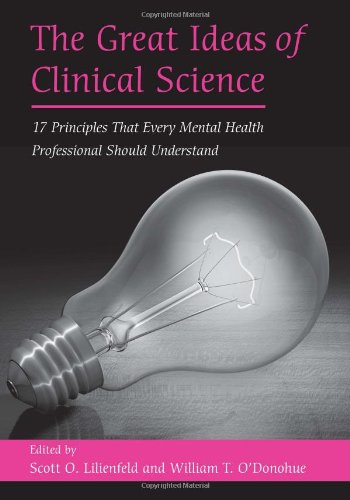
The Great Ideas of Clinical Science 17 Principles that Every Mental Health Professional Should Understand 1st Edition by Scott O Lilienfeld,William T O’Donohue ISBN 0415950384 978-0415950381


Original price was: $50.00.$35.00Current price is: $35.00.
The Great Ideas of Clinical Science 17 Principles that Every Mental Health Professional Should Understand 1st Edition by Scott O. Lilienfeld, William T. O’Donohue – Ebook PDF Instant Download/Delivery: 0415950384, 978-0415950381
Full download The Great Ideas of Clinical Science 17 Principles that Every Mental Health Professional Should Understand 1st Edition after payment
Product details:
ISBN 10: 0415950384
ISBN 13: 978-0415950381
Author: Scott O. Lilienfeld, William T. O’Donohue
The idea that there is a fundamental rift between researchers and practitioners should not come as a surprise to anyone familiar with the current literature, trends, and general feelings in the field of clinical psychology. Central to this scientist-practitioner gap is an underlying disagreement over the nature of knowledge – namely that while some individuals point to research studies as the foundation of truth, others argue that clinical experience offers a more adequate understanding of the causes, assessment, and treatment of mental illness.
The Great Ideas of Clinical Science is an ambitious attempt to dig beneath these fundamental differences, and reintroduce the reader to unifying principles often overlooked by students and professionals alike. The editors have identified 17 such universals, and have pulled together a group of the most prolific minds in the field to present the philosophical, methodological, and conceptual ideas that define the state of the field. Each chapter focuses on practical as well as conceptual points, offering valuable insight to practicing clinicians, researchers, and teachers of any level of experience. Written for student, practitioner, researcher, and educated layperson, this integrative volume aims to facilitate communication among all mental health professionals and to narrow the scientist-practitioner gap.
Table of contents:
PART I: How to Think Clearly About Clinical Science
Chapter 1: How to Think Clearly About Clinical Science
Chapter 2: Science is an Essential Safeguard Against Human Error
Chapter 3: The Clinician as Subject
Chapter 4: Decision Research Can Increase the Accuracy of Clinical Judgment and Thereby Improve Patient Care
Chapter 5: Psychometrics
Chapter 6: Classification Provides an Essential Basis for Organizing Mental Disorders
Chapter 7: Psychotherapy Outcome Can Be Studied Scientifically
Chapter 8: Clinical Case Studies are Important in the Science and Practice of Psychotherapy
Chapter 9: Treatment and Assessment Take Place in an Economic Context, Always
PART II: The Great Paradigms of Clinical Science
Chapter 10: Evolution-Based Learning Mechanisms Can Contribute to Adaptive and Problematic Behavior
Chapter 11: Behavior Genetic Approaches are Integral for Understanding the Etiology of Psychopathology
Chapter 12: Evolutionary Theory Provides a Framework for Understanding Abnormal Behavior
Chapter 13: Personality Traits are Essential for a Complete Clinical Science
Chapter 14: The Cognitive Neuroscience Perspective Allows Us to Understand Abnormal Behavior at Multiple Levels of Complexity
PART III: The Great Cross-cutting Perspective of Clinical Science
Chapter 15: Early Developmental Processes Inform the Study of Mental Disorders
Chapter 16: Mental and Physical Health Influence Each Other
Chapter 17: Some Forms of Psychopathology are Partly Socially Constructed
Chapter 18: Cultural Factors Influence the Expression of Psychopathology
Chapter 19: The Great Ideas of Clinical Science Redux: Revisiting Our Intellectual Roots
Index
People also search for:
the great ideas of clinical science
the fascinating history of clinical trials
what to do after msc clinical psychology
what can i do with a clinical science degree
what were some of the new ideas in the sciences
Tags: Scott O Lilienfeld, William T O’Donohue, The Great Ideas of Clinical Science, 17 Principles that Every Mental Health, Professional Should Understand